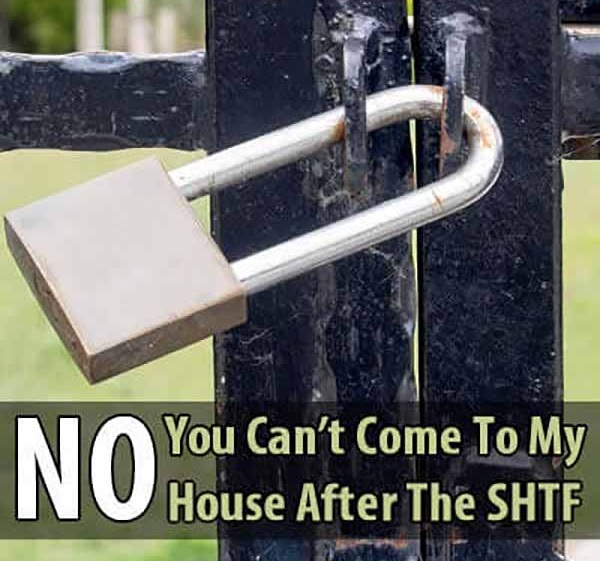
No, You Can’t Come To My House After The SHTF: Most preppers have thought about this topic and while some have an idea or plan of what they would do, it is hard to really say until you are in the thick of it

no-you-cant-come-to-my-house-after-the-shtf-pin-2

A disaster occurs. People have been without power or running water for a week and are now out of food, too. They show up at your house and ask you to share. What do you do?

I have had this article topic in my ‘drafts’ for about 6 months now. It is a touchy subject that I, quite frankly, did not want to touch on due to the controversy that it can cause. Ironically, that is the very reason that I decided to: it is a subject that is unpleasant therefore it needs to be discussed. Learning how to sail a boat during a storm is a surefire way to get yourself killed. Trying to decide what to do in this situation while it is happening can have some negative consequences.

I do not claim to be an expert on any of this stuff. I do, however, have some very strong feelings about it and tend to look at the situation in a black and white, logical manner. Of course, logic will have little to no bearing when you have 5 people at your door, begging for food they think you have to spare (whether you do or not does not matter). So, let’s dive in.

Most preppers or survivalists have thought about this topic and while some have an idea or plan of what they would do, it is hard to really say until you are in the thick of it. Part of preparing is having the skills and plan to deal with the ugly side of humanity who will be knocking on your door. Even if you have 100% solid OPSEC and there isn’t another soul who knows about your 6 month supply of necessities, they will come knocking. Even if you are like us and aren’t ‘preppers’ per se but lean more on the side of homesteading, they will come knocking. Or just break your door in. Are you ready for that?

For those who have tried to talk to people and wake them up to the need to have some food and whatnot set back just in case, only to hear them say, “If something bad happens, I’ll just come to your house.” you need to tell them loud and clear.

“NO, YOU CAN’T COME TO MY HOUSE.”

It doesn’t matter if they are saying it in a joking manner. It doesn’t matter if it will tick them off or offend them. They need to understand that you are serious and that you are not FEMA, the local government, or their parents. Here is a real conversation I had not too long ago about this very topic at my day job. It was with one of the paraprofessionals I know.

_________

THEM: “Well, if it all goes crazy, I will just come to your house since you have all I would need!”

ME: “Uh, no. I don’t think so. That would not be a good move on your part. I don’t have anything for you at my house or anywhere else.”

THEM: “But you just said you are building a 3 month food supply up. That is plenty extra to share.” (It was at this point my temper started to rise. I took a deep breath and kept my calm.)

ME: “You’re right. I am trying to build a 3 month supply of food for TWO people. How long do you think that will last if you and your 3 kids come? Not only that, even if I only had enough extra for two weeks, what makes you think it is acceptable to come to my place and expect me to take care of you and your children with my resources? Resources that I worked for, saved for, and put up.”

THEM: “But we’ve known each other forever. Would you really turn me and my hungry kids away?”

ME: “Yes, yes I would. You acknowledge that there is a need to prepare and yet don’t. You assume that it is OK for you to come to my house and eat up my food and resources without offering anything in return?” (Of course, the smile was gone from their face at this point and they did not look very happy.)

THEM: “Wow… I guess I never expected you to be so greedy.”

ME: “Greedy? How is it being greedy to work, save, and plan for my family to make it through some hard times and not want to just give it away to someone who didn’t take care of their own?”

THEM: “Well, not sharing when others are in need…”

ME: “OK, let me ask you something. I am out of ammo for my .22 rifle. You have some and I want you to share it. You know you can’t get anymore but since I am in need, I think you should give it to me.”

THEM: *Scoffing* “Well, you should have stocked some up like we did! We need it for ourselves.”

ME: *Looks at them…waiting*

THEM: “That is completely different than if my kids were starving.”

ME: “No, it isn’t. You stocked up when you could and now you have supplies. I am stocking food a little at a time so I will have it if needed. It is not my responsibility to prepare for my family and yours. I am not FEMA and I am certainly not the local charity. I worked, I planned, I have. A lack of planning and foresight on your part does not make a responsibility, emergency, or obligation on mine.”

THEM: *Looking at me, slightly aghast that I would be so inhumane and ‘greedy.’*

ME: “You are an able bodied person who can choose to do the same thing I am or you can expect that the government will swoop in and hand over whatever you need in the quantity you are used to. Because, we all saw how well thatworked during Katrina and Sandy. What world do you live in that makes you think that is acceptable? I am not the government, I am not FEMA and I don’t have the supplies you think I do. Why should I be expected to just freely give over what I have to you? How can you even expect that would be a given or normal thing? Do you just hand over what you have to people without expecting anything in return?”

THEM: “Well no but you are talking about the grid being down or some other disaster. People need to help each other get through it.”

ME: “Yes, people do have to help each other to make it. But first, they need to help themselves. I’m not saying that I would be ‘that guy’ who just turns people away on principle. If people are willing to work with me and the group for the betterment of all, then I am right there next to them but the people who just expect you should share without contributing anything or even trying to barter, will not be welcome.”

__________

Needless to say, that person is much less friendly toward me than they used to be. I consider it worth it if they started to think about what I said and began planning for their own family’s needs.

Now consider having this conversation with family members. Your lazy cousin who spends more time trying to get free entitlements from the government than they would if they just got a job. The aunt who lives high and mighty in her huge home worth half a million dollars but only shops for food once a week and never has anything extra. Your siblings who tease you constantly about being a ‘doomsday prepper’ while they go into debt just to get the latest iPhone. All of these people will come to your home when they run out of food (or even before, hoarding what they have but expecting you to share all you have) and other supplies. How will you handle it? There is no perfect answer here. The worst solution you can go with is to just freely let them in because it puts your immediate family in jeopardy of not surviving the disaster.

There are solutions that can be worked out beforehand though! Offering to store supplies for them (if able) is one. Giving them a shopping list of extra stuff to buy here and there and then storing it at your home is a great way to make sure that the people you know will come have been accounted and planned for. Even if it is a little, that is better than nothing! One of the things I have personally done is to buy preparedness items as Christmas and birthday gifts.

Of course, these are only to those I really care about and worry over (or just know in my heart that they will come running if the SHTF). I explain to them what it is and why I am giving it to them. I explain that since they will not listen, the items are their ‘key’ to being let in. They will not come empty handed and will contribute to the group overall. They were very grateful actually. More than one commented about how it was kind to think of their emergency needs and supplies. I would like to believe that people will band together and do whatever they can to help each other and there will certainly be that….at first. When your 3 year old is so hungry that they don’t even cry for food anymore and just stare with a dull, blank look – what would YOU do? That’s right, whatever it took.

There is a large risk with any of the above suggestions, of course. It is likely that these people will tell others “I have 20 pounds of rice and beans stored at my cousin’s house in case of a disaster.” That causes less security for not only them but you as well. The people they told will show up either with them or alone, and when you tell them you have nothing for them, will say, “But so and so told me you have all this food.” When you tell them no again, they will likely get ticked off and come back with more people to take what you may or may not have. You could be telling the truth when you say you have nothing left but hungry people aren’t thinking logically. They will not believe you (or care) and are bent on getting inside to take whatever they believe you have. It is really easy for people to be generous with supplies they took from someone else (or were given by the government).

I find myself getting hardened to the prevalent mindset of people today. Particularly those who only consume and do not create or contribute. They don’t try to learn how to preserve food or provide for themselves at all, only consume. What really gets me is the people on food stamps who spend a fortune on steak and lobster dinners but refuse to get a 20# bag of rice, beans, and oats to make sure they have enough food in a bad situation (like when there are no more food stamps accepted or the stores are wiped clean).  Now, before you get all twisted and think I am getting down on people who use food stamps, just stop right there. I use it to make a point of how people these days focus primarily on the now and never consider the later because there will be more on the card the next month.

The majority of the population never considers that during martial law, stores can and likely will be shut down completely. In a large disaster, there may be no 911 to call. No police will come to your rescue when hungry mobs are breaking into your house to take the last grains of rice. Law officials will be either dealing with something else or taking care of their own family. If the power goes out for a long time, say goodbye to having clean, running water.

When people get desperate enough, they will go out looking for whatever they can find. That sweet teenager who helps mow your lawn every summer could turn into a gun toting looter if hungry and desperate enough. We here in America are so used to seeing these things happen on TV and in ‘other places’ that they couldn’t possibly fathom it actually happening here and to them.

And that is their first mistake.

American Anomalophobia: Does the U.S. Have a Greater Bias Against the Unexplained?

“What has happened to that vaunted American pioneering spirit? We suppose that an American scientist cannot paddle too far out of the scientific mainstream without jeopardizing his or her funding.”

These were questions asked by the late William R. Corliss, a longtime champion of the scientific study of anomalies in nature, in the May-June 1996 edition of his Science Frontiersnewsletter. Corliss spent several decades of his life combing through scientific journals, periodicals, and a host of other publications in search of oddities that might be worthy of some degree of scientific scrutiny. On occasion, he might include slightly more “questionable” entries too, but generally only for their novelty, and often with additional commentary that he added to clarify it as being such.

In the aforementioned edition of Science Frontiers, the late physicist commented on a common theme that arose between the listing of publications in that particular edition, under the heading “American Anomalophobia.”

“Isn’t it interesting that of the 21 sources used above 14 are from British publications?” Corliss asked.

Even in 1996, this may not have been a new trend. A look back at some of the scientific luminaries over the years who have been advocates of science applied to the unexplained does seem to show a disproportionate number from European countries.

In 2012, John Horgan wrote in a blog at Scientific American about a number of innovative scientists who are “open-minded about paranormal stuff.” In Horgan’s list, he included computer scientist and all-around genius Alan Turing, who was interested in the psychic phenomena famously studied by J.B. Rhine. Others who made Horgan’s list included Swiss psychologist Carl Jung, as well as his former colleague Sigmund Freud. Wolfgang Pauli also made the list, and so as not to refer exclusively to past luminaries of the sciences, Freeman Dyson (an English-born American) and Brian Josephson (hailing from Wales) were also included on the list.

“My guess is that many more scientists believe, at least tentatively, in paranormal phenomena,” Horgan wrote, “but they are loath to disclose their views for fear of harming their reputations—and even science as a whole.”

I would say this is probably likely. While I realize this is supposition, rather than any kind of statistical certainty, in my own personal experience I have known many professionals in the sciences who would never discuss or publicly advocate any sort of “fringe” ideas, though in private they may indeed confess to having at least measured interest in such things.

The list goes on well beyond those mentioned on Horgan’s blog. Physicist Max Planck also dipped his toe into the unusual when he proposed the idea that, rather than the universe conforming strictly to a materialistic state of being, perhaps matter and physicality could have its root someplace else; perhaps even in a non-physical “realm” that is synonymous, essentially, with our idea of consciousness.

One final example that warrants mention here–though his inclusion is almost sure to be disputed–would be Carl Sagan. As one of the most prominent scientists and educators of the last century, he was unquestionably skeptical. However, Sagan also wrote famously in his book The Demon Haunted Worldabout the possibility, however remote it seemed, that certain phenomena deemed “paranormal” could have a basis in reality. Among these, he cited children who claim to possess memories of “past lives.”

Writing for The Atlantic in 2014, Jake Flanagin wrote about the Division of Perceptual Studies at the University of Virginia’s School of Medicine. Founded in 1967 by Dr. Ian Stephenson (best known for his pioneering research into chronicling such “past life” claims), the work has continued under Dr. Jim Tucker, who has spoken frequently over the years in various media appearances about the impressive number of cases the UVA’s studies have collected and studied.

However, perhaps one of the more salient quotes from Flanagin’s Atlantic piece actually came from Jesse Bering, a research psychologist and blogger for Scientific American on behavioral science. Bering, in response to the kinds of studies undertaken by Stevenson and Tucker over the years, said:

“I’m happy to say [Stevenson’s work is] all complete and utter nonsense. The trouble is, it’s not entirely apparent to me that it is. So why aren’t scientists taking Stevenson’s data more seriously?”

It’s a good question. Whether or not this has to do with the idea of there being a greater degree of bias against the unexplained in America in particular, it certainly shows that even when good science is being done in relation to more offbeat topics, that doesn’t necessarily mean it will be noticed, let alone well received.

Coming back to Corliss’s original observation about the prevalence of paranormal interest in British science publications, one might argue that the country’s history with paranormal research is part of the reason for its continued popularity there. Organizations like the Society for Psychical Research have helped maintain this presence (although that’s not to say there haven’t been American counterparts, such as the aptly-named American Society for Psychical Research).

However, if there’s truly one thing that the United States seems to have in greater amounts than most other countries, that might well be its paranormally-themed entertainment. The motion picture business only really began booming in the early 20th century thanks to a burgeoning American industry being built around it, and with the resulting prevalence of film and television entertainment produced in the U.S. over the last century, it is only natural that the amount of paranormal-themed programming would be higher here too.

Could it be that largely credulous paranormal television shows and “science made for TV” style programming has helped contribute to a more negative attitude toward the subject, which even carries over when actual science is being applied?

It’s just a thought… but it certainly puts a different spin on the old idea that, “there’s no such thing as bad press.”

China Looks at Ways to Root Out Corruption — Using Artificial Intelligence to Root out Corruption, Only to Find That Many of the Corrupt People it’s Finding are Employed by the Government!

chinasocialcredit.jpg

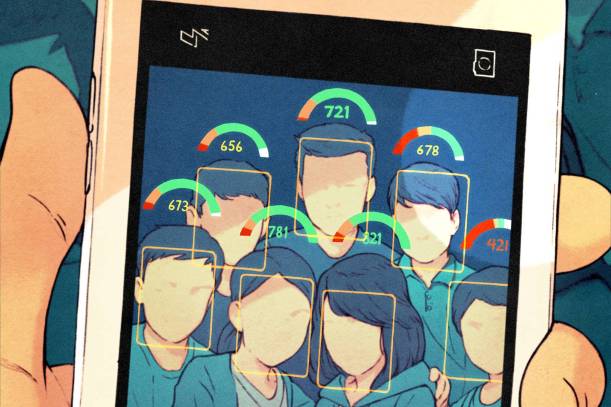
Good conspiracy theorists know that they’re getting close to the truth when the government tries to shut them down. However, what does it mean when the conspiracy theorist turns out to be part of the conspiracy itself? That seems to be the case in China where the government has been using artificial intelligence to root out corruption, only to find that many of the corrupt people it’s finding are employed by the government! Could this be why the program is being shut down before it can be rolled out nationwide?

Kudos to the whistleblowers at the South China Morning Post for exposing this Chinese Catch-22 by publishing both the results of the artificial-intelligence-driven investigation and the subsequent shutdown by heat-fearing government officials. China has an estimated 64 million people working in government jobs (2016 figure), which mean almost 5 percent of its population is part of the governing bureaucracy at some level. To manage this monster, parts of it are implementing technological tools. The foreign ministry is using machine learning to aid in risk assessment and decision-making major investment projects overseas. The province of Guizhou has a system that tracks the movement of its entire police force. And it’s well-known that China is the world leader in implementing ubiquitous surveillance cameras and a nationwide facial recognition system for a wide variety of both good and questionable purposes. However, some think it went too far when it pointed the cameras and the AI technology on itself in 2012 with the anti-corruption Zero Trust system.

A joint venture by the Chinese Academy of Sciences and the Communist Party, Zero Trust ’s internal control institutions to monitor and evaluate the personal lives of public servants using over 150 protected government databases and social relationship maps. Zero Trust looks for indicators such as unusual large bank account deposits or major purchases, government contracts being awarded to friends or relatives, and other behaviors it deems suspicious indicators of possible embezzlement, abuse of power, misuse of government funds and nepotism. How well is it working?

“Despite being restricted to just 30 counties and cities, artificial intelligence system has already helped snare 8,721 officials.”

That represents just one percent of the population. Some of the crimes were serious enough to warrant prison terms, but South China Morning Post found that most just received warnings and were allowed to keep their jobs under the assumption (provided by an unnamed computer scientist) that the exposure and further monitoring would keep them from “going down the road of no return with further, bigger mistakes.” With that kind of efficient AI machinery keeping workers on the straight and narrow path, management must be thrilled with Zero Trust, right?

“Still, some governments – including Mayang county, Huaihua city and Li county in Hunan – have decommissioned the machine, according to the researchers, one of whom said they “may not feel quite comfortable with the new technology.””

Is Zero Trust getting too close to the top? Some officials (all unnamed for obvious reasons) are hiding behind the claim that there are no laws governing AI access to sensitive databases. Computer scientists designing and implementing Zero Trust counter that the system has been proven right most of the time and claim that no accusations are made without a human reviewing them first. A human? We’re talking oversight of 64 million government employees by … other government employees! What could possibly go wrong … or right?

Another unnamed researcher exposed the Catch-22 by pointing out that the idea of Zero Trust was to “avoid triggering large-scale resistance among bureaucrats”, especially the most powerful ones, to the use of bots in governance. In other words, exactly what happened.

The deal between Big Brother and its new tool, Big AI, is turning into a battle instead, with China as the first battleground. Which one will win? Which one deserves to win? Should there even be a winner? What do you think YOUR government would do?

Zero trust … it goes both ways.

World War 2 Continued By Other Means – Nazi Roots Of The European Union

5C4CD3E8-90AB-46A9-BFA8-1569D83BEF8E

This is an intelligence briefing. Here I present the bare bones of what has been happening before our eyes…if we would see it.

Once upon a time, there was an industrial combine in Nazi Germany called IG Farben. It was the largest chemical/pharmaceutical octopus in the world. It owned companies, and it had favorable business agreements with companies from England to Central America to Japan.

The author of The Devil’s Chemists, Josiah DuBois, traveled to Guatemala, on a fact-finding mission, in the early days of World War 2, and returned with the comment that, as far as he could tell, Guatemala was “a wholly owned subsidiary of Farben.”

The pharmaceutical empire was and is one of the major forces behind the European Union (EU). It is no accident that these drug corporations wield such power. They aren’t only involved in controlling the medical cartel; they are political planners.

This is how and why Big Pharma fits so closely with what is loosely referred to as the New World Order. The aim of enrolling every human in a cradle-to-grave system of disease diagnosis and toxic drug treatment has a larger purpose: to debilitate, to weaken populations.

This is a political goal. It facilitates control.

IG Farben’s main component companies, at the outbreak of World War 2, were Bayer, BASF, and Hoechst. They were chemical and drug companies. Farben put Hitler over the top in Germany as head of State, and the war was designed to lead to a united Europe that would be dominated by the Farben nexus.

The loss of the war didn’t derail that plan. It was shifted into an economic blueprint, which became, eventually, the European Union.

The European Commission’s first president was Walter Hallstein, the Nazi lawyer who, during the war, had been in charge of post-war legal planning for the new Europe.

As the Rath Foundation reports: In 1939, on the brink of the war, Hallstein had stated, “The creation of the New Law [of the Nazis] is ONLY the task of the law-makers!”

In 1957, with his reputation sanitized, Hallstein spoke the words in this manner: “The European Commission has full and unlimited power for all decisions related to the architecture of this European community.”

Post-war, IG Farben was broken up into separate companies, but those companies (Bayer, Hoechst, and BASF) came roaring back, attaining new profit highs.

I refer you to the explosive book, The Nazi Roots of the Brussels EU, by Paul Anthony Taylor, Aleksandra Niedzwiecki, Dr. Matthias Rath, and August Kowalczyk. You can also read it at relay-of-life.org. It is a dagger in the heart of the EU.

At the Rath Foundation, you can also read Joseph Borkin’s classic, “The Crime and Punishment of IG Farben.”

In 1992, I was deeply engaged in researching the specific devastating effects of medical drugs. Eventually, I concluded that, at the highest levels of power, these drugs weren’t destructive by accident. They were intended to cause harm. This was covert chemical warfare against the population of the planet. The Rockefeller-Standard Oil-Farben connection was a primary piece of the puzzle.

It was, of course, Rockefeller (and Carnegie) power that had forced the birth of pharmaceutical medicine in America, with the publication of the 1910 Flexner Report. The Report was used to excoriate and marginalize Chiropractic, Homeopathy, Naturopathy, and other forms of traditional natural practice, in favor of what would become the modern juggernaut of drug-based treatment.

In an article about the FDA, “Medical Murder in the Matrix,”  show the fact that this federal agency has permitted at least 100,000 deaths of Americans, per year, from the direct effects of drugs it, the FDA, has certified as safe. (See, for example, JAMA, July 26, 2000, ‘Is US Health Really the Best in the World,’ Dr. Barbara Starfield.)

The FDA knows these death figures. “Unintended” and “accidental” can no longer be applied to this ongoing holocaust.

The pharmaceutical industry itself also knows those death figures.

To understand the dimensions and history of the ongoing chemical warfare against the population, in the form of medical drugs (and of course pesticides), one must factor in the original octopus, IG Farben.

World War 2 never ended. It simply shifted its strategies.

In any fascist system, the bulk of the people working inside the system, including scientists, refuse to believe the evidence of what is happening before their own eyes. They insist they are doing good. They believe they are on the right side. They see greater top-down control as necessary and correct. They adduce “reasonable” explanations for inflicted harm and death.

World War 2 is still underway. The battleground has been changed, and the means are far cleverer.

Sun Tzu wrote: “Hence to fight and conquer in all your battles is not supreme excellence; supreme excellence consists in breaking the enemy’s resistance without fighting… The best victory is when the opponent surrenders of its own accord before there are any actual hostilities…It is best to win without fighting.”

This is what has been happening: invisible warfare.

What To Do When a Pandemic Starts: This Infectious Disease Spreads Quickly To Other Continents, Basically Causing Disease Globally, Most Likely Resulting In High Fatality Rates

gh-inquiry-banner

The world is an open book in terms of transportation, economy and immigration. This also means its open to disease as well.

A highly communicable pandemic would have the potential to travel this world and back again in a matter of 48 hours. I make this bold prediction just based on international business travel. This does not take into account tourism. If it reared its head in a place like China or the US, it would be the worst-case scenario. The blessing with something like Ebola is that it is in Africa and the population as well as tourism and business travel pales in comparison to places like US and China

Viruses More Likely to Cause a Pandemic

Why are these viruses more likely to cause a pandemic?

All of these viruses are so-called RNA (not DNA) viruses. This means there are more mutations happening every time the virus replicates in a cell. More mutations lead to more changes in the viral genome, potentially making the virus more virulent– better at infecting humans, replicating more efficiently and therefore making people sicker. Another thing these viruses have in common is the fact that they are usually present in animals and might not necessarily cause disease in those carriers but adapt to humans at some point, causing severe disease. These viruses also tend to cause high mortality because they affect several organs causing them to shut down.

When a Pandemic Starts

When a pandemic starts, don’t panic right away. You might hear on the news about new cases of avian flu in China or other Asian countries. They will be the most likely source of a pandemic flu, due to the presence of unregulated live bird markets that can spread the disease quickly, and the close contact people have with these animals. The same is true for respiratory infections such as SARS or MERS, which usually have adapted to humans after going through several animal species, starting with bats but then transmitting to agricultural animals and finally to humans.

The adaptation phase can be slow, but when the time comes that a virus transmits between humans, these infections will be rapidly spreading. Human-to-human transmission is the most critical barrier. So far, avian flu has not caused a pandemic simply due to the fact that almost all infections happened through contact with the animals themselves. At the most, family members transmitted among themselves due to close and prolonged contact. However, when human transmission becomes easy, it will be bedlam.

Human Cases

Most likely you will hear something about some human cases first, followed by rapid growing numbers in the country of origin and around. From there it won’t be long to hear about the first cases in the U.S. or Europe, maybe just a few days. This part is difficult to predict, as some infections are contagious at very early to slightly later stages of infection, but typically when people start to sneeze they are contagious. So, if you are relatively sure that a pandemic is at hand, call in to work sick, take your kids out of school, ensure you got supplies to sit it out, and rather enjoy some vacation days.

(Disclaimer: I am a scientist working with viruses, and that is what I will do). Folllowing this procedure, the worst case scenario is that you get some vacation days and the kids do too. That is better than going to work because you think you are overreacting and catching something by a colleague who just returned from his vacation, sat in an airplane, and is starting to sneeze into your general direction when trying to show you some pictures of that great landmark he visited (with many other people) on his cell phone.

Virus Transmission

So how does a virus like the flu or SARS transmit?

Transmission of a respiratory virus happens by droplets, so this is sneezing and coughing but also when somebody sneezes into his/her hands and then touches the shopping cart, the door knob, the debit/credit card checkout, et cetera. In other words, transmission happens extremely easily. You got more germs on your cell phone than there are on a public toilet seat, true story. Ebola is harder to transmit, as it is through bodily fluids, so people most affected were in close contact with patients, such as medical personnel and relatives. But again, there is a potential for a critical mutation making transmission easier.

Do’s and Don’ts of Biosecurity Measures

So, you decided to stay home, and it turns out there really is an avian flu or other virus spreading rapidly. You realize that even though you planned ahead, there are a few items you still want to get in a last-ditch effort. If you really have to go to a public place, take Lysol wipes with you in the car. Put on that NIOSH 95 mask. Don some nitrile or latex gloves. If people look at you funny, cough a bit, so they think you are being very considerate trying not to spread something or alternatively tell them the end is near. You could also ignore them; do whatever works for you. Just don’t be too embarrassed and take it off.

It is supposed to keep 95% of infectious particles out, so if somebody coughs or sneezes directly at you, you got a fighting chance. If you want 100% protection, you need to be prepared to spend a lot of money on a biohazard suit, go through the pain of putting it on and walking into the store looking like an alien, and be prepared to possibly cause a panic and deal with a 911 call while there. When you grab what you need, be aware of your hands.

Touching Your Face

Most people don’t realize that they tend to touch their faces unconsciously many times during the day, and you do not want to touch a surface containing the virus and then get your hand in contact with eyes, nose, or mouth, which will give the virus access to your body. Put those Lysol wipes in your cart and use them throughout, particularly after checkout and again when you arrive at your car. Give the steering wheel and the gear shift a wipe down just to make sure. If you wore gloves, take them off before entering your car.

General Biosecurity Measures

General biosecurity measures include: stay home! If you have to leave your house, use personal protection equipment, including the following:

  • Gloves. Wear gloves if you go anywhere near potentially contaminated surfaces. Take them off when done! They might get contaminated and you will just distribute the virus evenly around. Gloves are able to protect you from virus touching your skin, but if that virus sits on the glove, you can still get sick if you are not careful. Picture that you are touching a surface with glowing green or red paint with those gloves and then continue to use them. Where is that paint going to end up? It will be on a lot of things that you touch afterwards.
  • Mask. Wear a NIOSH 95 mask if venturing among people. Surgical masks won’t do a lot really.
  • Hand Washing. Wash your hands frequently.
  • Wipes. Keep up with wiping down surfaces that you and others touch frequently, particularly doorknobs and appliances.
  • Keep Your Distance. Droplets can travel several feet, so try to stay a distance of six feet or more from somebody who is actively sneezing or coughing.

For respiratory viruses, these measures are the most effective ones.

Disinfectants

If you do not have a commercial disinfectant, a dilution of bleach does the trick. Generally, a 10% dilution is very effective, especially if it sits for 10 minutes, but on metal surfaces such as those on appliances that can be a bit problematic after a while. I use the metric measurements on my pitcher, 50 ml of bleach with 450 ml of tap water added for a total volume of 500 ml. It is just more precise, but if you are allergic to metric measurements, 0.2 cups (so a little less than 1/4 cup) in a bit over 2 quarts is approximately the same.

You want to use gloves, nitrile or latex is fine, and a 10% bleach solution won’t destroy your skin right away, but it will be irritating to some people, especially if you keep using it. Rubbing alcohol and hydrogen peroxide work too. Influenza and coronaviruses (the ones that cause SARS- or MERS-like infections) are not as stable in the environment due to their structure. On the outside these viruses have what is called an envelope, made out of components of the cell wall from the cell they were replicating in, in other words a human cell. This envelope makes the virus actually more susceptible to disinfectants, UV light, and other environmental factors.

Evading Your Immune System

However, it also makes it better at evading your pesky immune system. Although not extremely stable in the environment, enveloped viruses, like the flu or SARS, can survive on some surfaces for up to 24 hours. This is why wiping down frequently is important, but of course you don’t have to do that if nobody goes in and out. The virus does not appear out of nowhere; you have to pick it up from somebody.

In summary, if you can avoid going out after a pandemic hits, stay at home. Don’t let neighbors or family in (especially the in-laws), and you will be fine, assuming you are self-sufficient in regards to food and water.

The Venezuelan Coup & Gilets Jaunes: Great-Power Politics In a Multipolar World Order

MaduroMacron

The Venezuelan Coup and Gilets Jaunes: Great-Power Politics In a Multipolar World Order

The protests seen in France and the interference in the domestic politics of Venezuela highlight Western double standards, which stand in contrast to the respect for international law maintained by China, India and Russia.

FEDERICO PIERACCINI

In France on November 17, 2018, hundreds of thousands of citizens, angered by the diminishing quality of their lives, the social iniquity in the country, and the widening gap between rich and poor, took to the streets in protest. The protests can easily be encapsulated in the following slogan: “We the people against you the elite.”
.
This slogan has been a recurring theme throughout the West over the last three years, shaking up the British establishment with the pro-Brexit vote, discombobulating the United States with Trump’s victory, overturning Italy with the Lega/Five-Star government, and bringing Merkel’s star crashing down in Germany. Now it is the turn of Macron and France, one of the least popular leaders in the world, leading his country into chaos, with peaceful protests drawing a bloody response from the authorities following ten weeks of unceasing demonstrations.
.
In Venezuela, Western elites would like us to believe that the situation is worse than in France in terms of public order, but that is simply a lie. It is a media creation based on misinformation and censorship. In Europe, the mainstream media has stopped showing images of the protests in France, as if to smother information about it, preferring to portray an image of France that belies the chaos in which it has been immersed for every weekend over the last few months.
.
In Caracas, the right-wing, pro-American and anti-Communist opposition continues the same campaign based on lies and violence as it has customarily conducted following its electoral defeats at the hands of the Bolivarian revolution. The Western mainstream media beams images and videos of massive pro-government Bolivarian rallies and falsely portrays them as anti-Maduro protests. We are dealing here with acts of journalistic terrorism, and the journalists who push this narrative, instigating clashes, should be prosecuted by a criminal court of the Bolivarian people in Caracas. Instead, the West continues to tell us that Assange is a criminal for doing his job, that Wikileaks is a terrorist organization for publishing true information, and that Russia interfered in the US elections. All of these deceptions are carried out by the same Western journalists, media publications and US government that are currently plying their mendacious trade in Venezuela. What double standards!
.
In Venezuela, the people are with Maduro, and before him they were with Chavez. The reason is simple and easy to understand, having everything to do with the economic policies adopted by thegovernment of Caracas, which during just over a decade in power, reduced the level of poverty, illiteracy and corruption in the country, lengthening life expectancy and increasing access to education. The leftist model followed by dozens of South American countries during the 2000s favored the poorest layer of society by redistributing the wealth of the top 1%.
.
The contrast between events in France and Venezuela perfectly encapsulate the state of the world today. In France, the people are fighting against Macron, austerity policies and globalist superstructure. In Venezuela, the the opposition (synonymous with the rich population) is leveraging external interference from the governments of Colombia, Brazil and the United States to try and overthrow a government that enjoys the full support of the people thanks to its domestic policies. Even as many in France are not conscious of it, they are actually protesting against an unjust, ultra-capitalist system imposed by the globalist elite of which Macron is a major cheerleader. In Venezuela, the ultra-capitalist class, backed by the transnational globalists, seek to overthrow a socialist system that places the interests of the 99% before those of the 1%.
.
Maduro has an approval rating of around 65%, higher than any European or American leader. In France, Macron’s approval ratings hover around the single digits, with only Ukraine’s Poroshenko scoring lower. Poroshenko, quite naturally, dutifully joined the chorus of those egging on a coup against the Bolivarian government of Maduro, even as he leads a country besieged by out-of-control neo-Nazis.
.
The protests in France are driven by two decades of impoverishment as a result of European diktats that prescribe austerity and the need to strip the middle class of its wealth to favor the influx of cheap labor. This strategy of reducing labor costs has already been employed in other countries, the aim being to increase profits for multinational companies without the need to relocate production to low-wage countries. The large-scale importation of exploited people from Africa has continued unabated for years, and now the average French citizen not only finds himself in an increasingly multi-ethnic society (with the government giving little incentive for newcomers to integrate) but also sees his lifestyle suffering due to a combination of lower wages and increasing taxes, making it increasingly difficult for him to make ends meet every month.
.
In Venezuela, the crisis stems entirely from external interference coming from the United States, which has economically strangled Venezuela for over a decade. The methodology is that of sanctions and economic destabilization, the same as has been applied against Cuba over more than 50 years, albeit in that case unsuccessfully. Chavez and Maduro have drawn the ire of the global elites by blocking their international oil corporations from access to Venezuela’s oil reserves, the largest in the world. It must be noted that Venezuela is one of the most important members of OPEC, with Riyadh and Moscow advancing the creation of an oil conglomerate known as OPEC +, with Russia, Saudi Arabia and Venezuela as influential members. The West is of course deploying the “democracy promotion” canard to justify its shenanigans in Venezuela, one of its go-to tactics drawn from its well-used PSYOP toolkit.
.
The French and Venezuelan situations also serve as a barometer for the general state of international relations in a multipolar context. While the US has little trouble interfering in Venezuela’s internal affairs, Russia, China and India employ a completely different approach, maintaining a uniform foreign-policy line on Paris and Caracas. They express total support for their Bolivarian ally, which is an important source of trade for New Delhi, a strategic military-oil partner for Moscow, and a major seller of crude oil for Beijing. Each of the three Eurasian powers has every interest in actively opposing Washington’s attempts to subvert the Maduro government, given that Venezuela performs important regional-stability functions, as well as, above all, offering these Eurasian powers an opportunity to respond asymmetrically to Washington’s destabilization efforts in Asia, the Middle East and Eastern Europe. There has been talk of creating particular synergies between Venezuela and other countries similarly struggling to free themselves from under Washington’s boot. China and Russia’s sending of naval ships and military aircraft to the Americas, violating the Monroe doctrine, represents a riposte to the continued pressure placed on the borders of Russia and China by the US and NATO as part of their containment strategy.

The Next Crash Could Make The Last One Look Like A Tea Party – It Costs You No Money To Think Through Some Basic Questions And Come Up With Realistic Answers

Accessories

The global financial system is beginning to come apart like a cheap suit. When the normal life you rely on ceases to function properly, what are you going to do? If you do not have a plan you will be left helpless in a rapidly deteriorating situation that will put you and your family in danger. It costs you no money to think through some basic questions and come up with realistic answers. The sooner you address this, the more secure your future will be when things don’t go as planned.

Everyone expects the government to be there with a safety net when things go wrong, but the government may not be there in the future when you need them or they may require things of you that you are not willing to do or give up. When times are uncertain, it is your responsibility to care for your family and that is a responsibility you cannot pawn off on someone else. If you have no plan or don’t know where to start, you can begin with some basic questions.

How will I feed my family? – If your income is cut off or your food supplier is shut down, what is your backup plan to provide food for your family and how long will you be able to do so? The acquisition of potable water is also a concern you need to address.

How and where will I shelter my family? – If you lose your job and the ability to pay your bills, will you still be able to live in your current home? If your community becomes dangerous will you stay there and if not where will you go?

How will I provide security for my family? – When the financial system breaks down, many who depend on it will become desperate. They will do things they normally would not do in order to maintain their living standard. Many will become violent as their comfort zone is breached by many unknown variables they are not ready to confront.

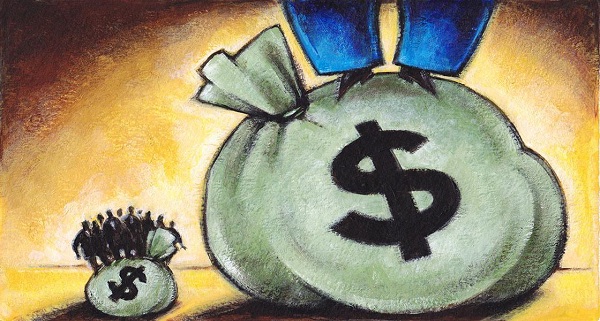
How will I preserve my wealth for future use? – If you have wealth in the form of paper assets and they are stored with institutions, you may lose access to them in an emergency. They may also become lost, stolen or greatly devalued depending on the circumstances. If the well being of your family depends on those assets, are you prepared to lose them? If not what are your contingency plans to protect those assets so you have buying power in the future no matter what happens to the system?

What will I use for transportation? – In a depression type of collapse it may be difficult to acquire fuel or get your vehicle repaired. What is your backup plan if you need to evacuate your family to another area? Do you have a storage of fuel supplies, an alternate fuel source or the ability to maintain your own vehicle? Do you have an alternate source of transportation you can use?

How will I provide clothing for my family? – If you have no income or savings, how will you provide clothing for your family? Can you make your own or do you have a plan to trade for what you need? Should you store extra clothing now for future use and how much should it be?

Do I have others I can depend on if I need help? – If the situation deteriorates, do you have others you can rely on? It may be a need for food, clothing, shelter or security but in a prolonged situation you will need help in some form at some point.

What will I do to earn a paycheck? – In a serious downturn that lasts many years, what will you do to earn a paycheck? What skills do you have that can be traded for the things you need? What equipment do you have that can be used to provide a product or service?

How will I provide medical services to my family? – If the situation is desperate and medical help is expensive or unavailable, how prepared are you to care for a sick or injured family member? While broken bones and internal injuries may require a professional, can you care for minor injuries and provide medicine for sick individuals?

Can I provide power and communications if the grid is disabled? – The financial collapse of nations can lead to the shutdown of major service providers or leave you unable to pay for those services. If you can provide your own power and communications during critical times, it can provide you with information and capabilities to keep your family safe. Even a solar panel, 12v battery and small power inverter can give you many capabilities.

Once you have answered these questions in as much detail as possible you will have the outline for a basic plan to follow. As you answer these questions, more questions will arise that will lead to more detailed planning. Planning is a continuous process that develops more capabilities as you progress. In the future, the more capabilities you have, the easier it will be to navigate the disruptions in society that you are likely to encounter.

Are You Ready For The Next Influenza Epidemic? How Will You Survive The Next Pandemic?

virus_outbreak_bw-apha-090907

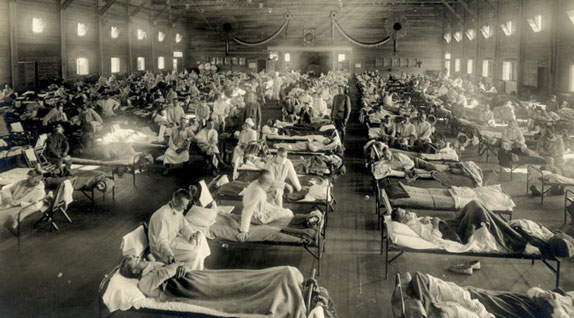
In doing some research about influenza, I came across the great Influenza Epidemic of 1918-1919. This happened during World War I and affected everyone on both sides of the ocean as well as across the world. It affected soldiers as well as citizens. It is estimated that 50 million people died during this epidemic. That is compared to the 16 million people who died during World War I.

One of the things that was missing from this epidemic was antibiotics. They simply did not exist as a medicine during this time. Antibiotics in an usable form was discovered in 1928 by Sir Alexander Fleming. However, antibiotics are rarely used for any influenza viruses. We do have some medications now that will treat influenza.

It is unlikely though that antibiotics would have been effective anyway during the epidemic of 1918. The influenza epidemic came in two phases. The first phase was less severe and most people recovered from it. It came in back a few months later and killed people within hours to a few days. Most people died from the fever and fluid filling their lungs which suffocated them. The disease affected people ages 20-40 the most.

Doctors and scientists were at a loss at how to treat this influenza. They could not control or stop the disease. Remember, there was no Center for Disease Control at the time. That was not established until 1946.

Don’t remember learning this in history class? I didn’t remember learning it either. However, what can we take away from this?

1. It was not treatable. They believe the strain during this epidemic was the H1N1. Influenza strains can be mild or develop a variant that can make them deadly. Since very little was known about influenza then, it was almost impossible to treat. Today’s influenza strains are proving harder to treat. Flu shots do not cover all strains of influenza. A strain or a variant in the strain of influenza could be strong enough to not be treatable or controllable.

2. It affected strong, healthy adults the most. The age group that was affected the most was 20-40 years old. This is a group of people who are at the peak of life in terms of health and vitality. The problem with that is this is also the group of people who would be the most social group especially in 1918. Even today, people in that age range rarely stay home. The disease would be able to spread very quickly because people are constantly going. They go to work, kids’ activities, social gatherings, and college.

3. It was not controllable. This influenza strain spread very, very quickly. People were given poor advice on how to not catch the disease and how to treat the disease. We now have the Center for Disease Control who would hopefully be on top of the disease. We also now know the best way to treat the symptoms of influenza. We also know that we need rest and to stay home to keep influenza from other people.

Do you think this could happen again? Many people do. Are you ready for the next influenza epidemic? An influenza epidemic of the proportions that occurred in 1918 would be considered a pandemic now.  We hear threats of pandemics now that could happen. How would you survive the next pandemic? What do you need to do to get ready?

1. Get a sick room ready. You should have a room, preferably a bedroom, ready to be a sick room. You should have some medical supplies ready in that room like a thermometer, ibuprofen, hot water bottle, instant cold packs, face tissues, disinfectant spray cleaner, trash bags, face masks, and disposable gloves. You may also want a pandemic flu kit in that room for the people treating the sick.

2. Have white towels, wash cloths, and white bedding ready to use. You want linens you can wash in very hot water or even put in boiling water to disinfect. You can also use bleach on white linens without issues. You want to have extra linens so you can change the sick beds quickly and wash the infected bodies without worry.

3. Have rolls of heavy plastic to cover surfaces like the bed, the floor, the windows,and the doorways. You have to think about disease control going in and out of the house. You are trying just as hard to keep the disease out as well as keeping it controlled in your home.

4. Keep some chem suits on hand. You may want to completely cover up to deal with a sick patient or having to go into infected areas. A chem suit with boots and gloves would be the ideal solution. You will also want a face mask and eye protection to keep safe.

5. Have one person who would be dedicated to taking care of the sick. The less people exposed to the sick person, the better the chances for everyone to stay healthy. Having one person designated to taking of the sick will keep everyone healthier. Having a designated respite person for the caretaker would be a good idea too.

6. Have a plan in place for death. In a pandemic, death is inevitable. What will you do if someone dies? As morbid as it seems, you may want to have a body bag on hand. You also want to have a plan for disposal of the body. Where will it be buried? Will you bury the body? Those are your decisions alone, but having a plan will make those decisions easier.

7. Do not go anywhere if you don’t have to. During a pandemic, being a homebody is your best bet for not catching the disease. Having a good food storage, water storage, and a disinfected home will be wise.

No one wants to think about getting sick much less think about a lot of people getting sick. We like to think with all the technological and medical advances we have now, another influenza pandemic will not happen again. However, new strains of diseases are being developed all the time in nature and in labs. We can not be sure this will not happen again. In fact, it is likely to happen again.

What will you do to protect yourself during a pandemic? Do you think we could have another influenza pandemic?

In A Long Term Grid Down Situation Where Society Breaks Down, Many People Would Die And Those That Hold The Keys To Our Technology Would Be Among Them

original

When technology fails society is suddenly limited to the resources it needs that are already produced and on hand for immediate use. If water suddenly stops being purified and pumped through the lines, you are limited to what you now have in the lines or storage tanks. Gas stations are limited to the fuel they have in storage tanks. Stores are limited to the food and clothing they have on hand. The failure of technology will stop water from being replaced, sewage from being removed, refrigeration from keeping foods edible, light from illuminating dark areas that must be traversed, elevators from getting people to upper floors, gas and electric for heating and cooking, water for fighting fires, communications for calling for help and medical devices to keep people alive.

The reason everything will stop is because of another word to remember, infrastructure. Without infrastructure nothing gets done, even on a simple basis. You cannot cook food without some type of infrastructure to produce heat, you cannot store food without some type of storage to keep it cold or some type of container to keep it protected from rodents and the environment. You cannot process or store food without equipment to cut, grind, dry, smoke, can or root cellar it. You cannot harvest, plant or grow food without some type of equipment to do those jobs.

The original definition of an acre was the amount of ground a farmer could plow in a full day. Farmers now plant hundreds of acres a day to keep Americans fed. With no modern equipment, how many acres can a farmer plant even if he had a trained team of horses and the equipment to pull behind them? Let us not forget that 2 percent of the population now grows the food for the whole country. How much would they now be able to produce even if they had the necessary equipment to do it manually? Let us also not forget that farmers need to buy their seed every year to plant. Very few individuals raise heritage seeds that they can plant every year from their own production. Where would these seeds now come from? Farmers also need lots of fertilizer to make these plants grow, where would that fertilizer come from? Many farms need irrigation to grow plants, so where would the power come from to pump that water? The age old practice of utilizing animal manure to fertilize fields only works if the farmer has livestock to produce that manure. Once harvested, how will that food now get transported to distant markets? How will farmers know where to send it without communications? A telegraph system is simple but must be built before it can be used.

Many people think that if technology fails we will simply live as past generations have but they conveniently neglect the fact that regardless of what systems you use you must have the infrastructure to provide for that system. If you go from mail to telegraphs or from analog to digital technology the problems are the same, you must have the infrastructure in place to switch to first. It is true we know how to build the older technology but where will the resources come from to actually build it? Remember, once technology fails you are somewhat limited to what you have on hand to work with.

If we had to return to 1880’s living, how many people have a team of horses, a wagon to hook them to, a butter churn, a grain mill, cheese making supplies, candles, oil lamps, matches, wood cook stoves, blacksmith supplies, hand pumps or dug wells? People were able to live back then because they had the infrastructure to do so. This is what many people do not understand. How hard would it be for us to go back to vacuum tube technology now without the infrastructure to support it, even if we do know how to build it?

In 1776 America, about 40% of men worked their own farm. Another 30% worked as laborers on farms. About 20% owned large commercial farms or plantations. The remaining 10% or so who were professional businessmen frequently owned modest farms where they might raise a cow, some chickens and have a garden to provide for the home table. Even those town people that had no farm usually had a cow, some chickens and a kitchen garden for home use. To go back to this model would be difficult if not impossible for many reasons only one of which is the fact that city dwellers have no room for gardens or the infrastructure to maintain cows and chickens on the large scale that would be needed.

The other thing that many people ignore are the skills required to live in a different system. Most people cannot simply plant seeds and suddenly become a great gardener. They do not know how to make cheese or how to improvise cheese making supplies from items now in the home. They do not know how to make soap or candles or something as simple as toilet paper. A roll of paper seems simple in design but how many know how to process wood pulp or other fibers to make paper? It does not matter if you are making ten thousand rolls in a factory or one roll at home, you need the skills and infrastructure to do it.

Skills come in many forms but the skills that society depends on the most are the craftsmen and engineers that design and build the technology we depend on. Without their knowledge, it would be difficult to replace the technology we now use. How many people know how to rebuild and maintain the phone system we now use? How many people know how to build and repair refrigeration units or make electric motors? How many people know how to refine oil into gasoline and diesel and make plastics and all the other things from petroleum?

In a long term grid down situation where society breaks down, many people would die and those that hold the keys to our technology would be among them. The longer the duration of disruption, the less likely it would be that those who could rebuild the systems would be able to do so. It is a situation where society’s capabilities decrease as time goes on.

Many people talk of hunting and fishing to fulfill their dietary needs but if even ten percent of the nation decides to do the same due to necessity, how long will the game and fish last before it is all gone? Even if you have some food and seeds to plant, it will take time to grow new supplies. In the days following an event, those that are not prepared will seek out supplies from those that have them, including those that have gardens. It is for this reason that it will be difficult to grow replacement supplies for the first one or two years following an event in most places. This would necessitate those that have supplies be able to support themselves and their families until new crops could be produced. The less prepared the population is the longer your initial supplies will need to last.

Once you take into account these things it becomes evident that it would not be easy to revert to an earlier type of system without major disruptions. It is for these reasons that it becomes necessary for the population in general to have the necessary resources to tide them over until infrastructure and skills can adjust to the new reality people find themselves in.

During the cold war the government maintained three years worth of grain in reserve to feed the population until agriculture could recover after a major attack. Today the government keeps little in the way of food for the entire nation. If something happens they depend on resources coming from unaffected areas of the country to help. In a nationwide disaster, there may not be any help to send. This is the reason individuals need to keep the necessary resources on hand to tide them over until the system can be stabilized in some way and some technology can come back on line.

Unfortunately in a worse case disaster, this would only buy some of the population a little time. If the technology we depend on is offline for longer than the resources that are available to the population last, then a mass die-off would ,occur. It is important to remember that only 2% of the nation farms today. Without the modern systems to farm large tracts of land, it would be impossible for any small percentage of the population to feed the whole nation utilizing older, manual techniques. The population would decrease until technology was sufficient to support the population. This would hold true for other parts of the system such as clothing production and healthcare as well.

Because of the high impact this scenario would have on the population, that is the reason people need to resolve to store supplies and resources to care for themselves in the unlikely event this happens. The possession of basic food supplies, medicines, toiletries, energy supplies and alternative transportation and communication systems can provide society the room it needs to extract itself from the worst of the situation. The lack of preparedness will only insure a higher casualty rate and more destruction of surviving infrastructure in the aftermath of an event. The lower the preparedness level of society, the less likely society will be able to survive and rebuild itself.

A Depression Era Economics Lesson – When this system fails it will cause much discomfort and even death for some that are not able to adapt to the changing times

economics-final11120x600

When the great depression hit in the 1930’s, many people had a difficult time surviving. When the system they depended on ceased to function properly, they no longer had the ability to earn a living wage and care for their families. Even at a time when you could get a meal for a nickel, many people struggled to feed themselves.

In many rural areas, farmers faced the difficulty of being able to even grow enough to feed themselves. The drought that accompanied the depression left many no choice but to move to more hospitable locations where jobs could be found.

Some people were in a much better position to weather the national problems than others. They were not rich in monetary terms but they had a stable living condition that enabled them to get by as always.

In the rural community that my family had called home for over 100 years, my family got by better than most. The fact that many of the people were watermen, that made their living on the Chesapeake Bay catching various types of seafood throughout the year, made the depression different for them. As my father related to me, they really didn’t know there was a depression going on most of the time.

The men went to work every morning catching what they could. Anything they couldn’t sell was taken home for dinner. Everyone had a garden and maybe some chickens and a hog out back providing meat for the winter. The area was also surrounded by many small farms producing many things they could trade for. Nobody had much money but the area teemed with the things that were needed to get by and barter was the norm.

Electricity was not seen in the community until the late 1940’s and few people had a car. These people really did live off the grid. That was the norm for them and they got by very well even with the national economy in a state of hard times. They could not buy many of the things they needed so those things had to be made out of whatever materials they had.

There are many stories like this that have been told and they are worth listening to once again. These stories provide the foundation people will need when the economy fails again in spectacular fashion leaving many in dire straits. When everything fails you have to go back to what works. That is a lesson that our ancestors have left for us to follow if we have the sense to learn from their hardships.

The current generation has known nothing but excess and prosperity. When the system turns down again they will be lost without all of the creature comforts and gadgets they are used to getting with great ease. They have been raised with the notion that everything is easy and when that paradigm fails they will not know how to cope with reality. This is the problem we face and must deal with in the months to come.

There are two lessons that can be taken from this story. When hard times come your location and creativity can make up for many shortfalls in life. Those things can make the difference between suffering and having a decent standard of living. Living in an area rich with resources allows you to produce many of the things you need locally with little money and can even provide you with a stream of income. The lack of resources in your area can make things very difficult over the long term.

The current generation has lost the ability to trouble shoot the problems they are faced with and come up with simple solutions. Creativity is something many people no longer possess and that is one of the things that will make life hard on them. The greatest generation knew how to devise creative solutions to their problems that allowed them to get by and even prosper. That is a lesson we need to take away from the last depression.

It is good for people to plan for hard times by stocking up, learning to produce food and storing real money for times of need but that will not be enough when the time comes. Your location and the ability to be creative and solve the many problems you will face will be necessary ingredients to surviving the coming hard times. Keeping your plans simple and learning the ways of our grandparents will help in ways we cannot even contemplate at this time but their wisdom will be as critical as your other supplies. One of the many slogans that came from that time is worth remembering.

When the economy as we know it fails, the only thing you can do is to return to an earlier point in time that depended on a simpler more functional system and utilize the available resources. When mechanized farming fails it may be necessary to return to less mechanized methods and cheaper alternatives to grow the food and fibers we need for survival. The thought of having to go backwards to get to the future is not pretty and will likely be difficult but sometimes that is the only way to move forward.

Surviving during a collapsing economy where systems we depend on cease to function requires individual actions to reduce the hardship that will ultimately overwhelm society and cause societal breakdown on most levels. Skills to lessen the hardships are critical to stabilization and recovery. These skills are the only way to utilize available resources to provide the necessities of society. The first things individuals strive to produce are food, shelter and clothing. These are the very basic things people need to survive over time. Later, other things such as security, medicine, communication and transportation become necessary to form a more cohesive community.

The skills to grow and store food, purify water, build shelter, make clothing, produce heat and light, produce energy to power machines, produce medicines and administer healthcare, harvest and move raw materials and communicate over long distances are skills necessary today and will continue to be vital in times of economic distress.

The skills and resources to provide these things are the foundation of a functional society. The lack of these things results in chaos and anarchy that prevents the construction of sustainable systems that a functional society needs to grow. The special skills needed to utilize available resources depends on the location of the person and the natural resources available for development. Because of this, different locations may develop along somewhat different lines but the destination is the same.

The need to know or learn these skills is necessary now while the social situation is stable enough to enable persons to plan and prepare for the hardships we will ultimately face as the economy fails due to fraud and mismanagement. Those with a lack of skills and resources will be a detracting factor on society as hardships increase and constitute an ever present danger for those with the resources to survive the times. These are the things that everyone must prepare for now while the system is still intact. There are no guarantees for tomorrow.