Coronavirus will accelerate and finalize America’s grim transformation into poverty, paralysis, and collapse — the lack of response to it will probably finish off what’s left of the American economy

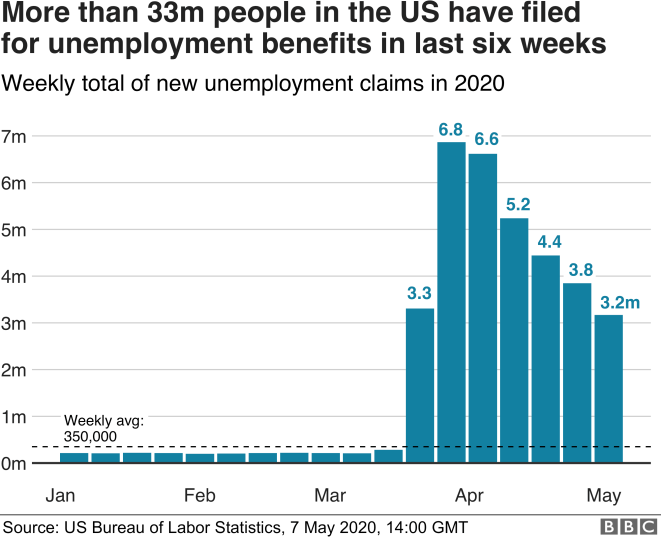
Another 3 million people filed unemployment claims last week, bringing the total since the beginning of the pandemic to a staggering 33 million. How much is that, in context? The US labour force is 165 million people. 33 million people means a full 20% of the labour force is now unemployed.

But even that’s an understatement. Here’s another, truer way to think about it. These numbers mean that, since the the employment to population ratio has crashed to just fifty percent. That means: just half of the American population is now employed.

These are numbers so catastrophic they make economists like me shudder. They have no modern parallel whatsoever. They point to an emerging depression — call it the Coronavirus Depression — that’s probably going to be greater and worse than the Great Depression. That’s because even the Great Depression had a New Deal. America, instead, has Donald Trump.

Coronavirus — or more accurately — the lack of response to it will probably finish off what’s left of the American economy. America will end up a country with permanently lower levels of all the following: employment, income, savings, trust, happiness, assets, and so forth. America was already in the process of becoming something very much like a poor country, with the failed politics of one, too — but Coronavirus will accelerate and finalize America’s grim transformation into poverty, paralysis, and collapse.

I know that sounds improbable, maybe even absurd, to some. I don’t much like writing in such terms myself. So let me spell out just how and why.

These shocking, unreal unemployment numbers are like the shockwave of a great tsunami, or the tremors that signal an earthquake spiking off the Richter scale. They’re a beginning, something like a plume of smoke to be followed by a deafening explosion.

This presentation PROOVES WITHOUT DOUBT that America is in for a major fight that will put you and your family in the firing line, literally… So make sure you watch this presentation while it’s still online…

Why? The logic of depression is simple — Keynes discovered it a century ago. It involves two things: money, and confidence. An economy undergoes a shock — a stock market crash, a natural calamity, or, in this case, a pandemic. I lose my job. I stop spending. So do my neighbours. Our local businesses — who usually exist on the margin, with little in reserve — begin to go shutter their doors, as a small but crucial number of customers stays away. That causes yet another wave of unemployment, which causes yet another wave of bankruptcy, and so on. Until, at last, the vicious spiral has engulfed the whole economy.

By that point, five transformations have happened — that usually spell ruin for a generation or more.

First, because waves of businesses have closed, the nature of unemployment changes: it goes from a short term challenge to find work, to a long term lack of jobs at all. You can already see that happening in America. Many of the jobs lost now aren’t coming back — ever. Those businesses, small and medium sized ones, are gone for good. Their owners will spend years in liquidation — if they’re lucky. How many will ever start businesses again?

Bang! The few jobs that are left are “low-income service jobs” offered by mega-monopolies, which means delivering groceries and driving cars and walking pets. But they don’t provide stable incomes, benefits, guarantees, much less raises, career paths, and so on But when economy’s labour force…goes nowhere…what future can it really have?

That brings me to the second transformation depressions wreak. Economies grow permanently poorer. Yes, as in “forever.” That’s already happening in America, too. yesterday’s if not great but somewhat decent jobs were already being substituted away by the new, gruesome “gigs” that modern-day American techno-capital offers — driving an Uber, delivering an Instacart, selling a pallet on Amazon — but Coronavirus has accelerated that transition, massively. Megacorporations aren’t going to magically hire huge numbers of people once they’ve found out they can make do with permanently lowers levels of hiring. But lower levels of hiring across the economy mean that workers have less bargaining power. Bang! Incomes fall — the share of the economy going to working people craters. What’s the net result? Society grows poorer.

What happens to poorer societies? They’re left in a kind of terrible paradox, which is my third transformation: they can’t afford the very things they need to survive most. Why is it that the average American is the only person in the rich world by now who votes against their own healthcare, retirement, education, childcare, and so on? Because they can’t afford it. 80% of Americans lived paycheck to paycheck before Coronavirus. Who can afford to pay an extra 5% or 10% in taxes for decent social systems? Nobody, really, except the already rich — who don’t need them. Hence, the famous paradox of the American Idiot: people who vote against their self-interest. It’s not their fault, really: they have no choice. They can’t afford to vote for things like public healthcare.

America was already becoming too poor a society to have functioning public goods, like healthcare or retirement for all. Coronavirus is going to seal that fate. America will be poor now — far too poor to ever really make the transition to having decent public goods. Think of that full half of the American population who’s now not employed. How exactly are they going to afford the higher taxes it takes to have a European or Canadian style social contract? They struggled to before — and after Coronavirus, it’s going to be flatly impossible.

That’s another of depression’s vicious cycles: it makes nations poor, and they end up being unable to afford decent being modern societies at all, places in which people support one another with expansive social contracts, in the end — because when people can barely even afford self-preservation, how can they support anyone else’s quest for a better life, too?

Even SWAT Teams are Helpless Against ThisWATCH THIS VIDEO and you will find many interesting things!

That brings me to my fourth transformation: as a result of depression, an economy’s whole structure tends to change. As groups, classes, segments. Think of America not so long ago. It’s structure resembled a bell curve. A broad middle class, a small number of rich, and a larger — but still small — number of poor. And then around 2010, for the first time, America’s middle class became a minority. The gentle bell curve was on its way to becoming something more like a U-shape: a caste society of very rich, and everyone else: the imploded middle and the old working class who became the left-behinds, all of whom became the new poor, that 80% living paycheck to paycheck.

Coronavirus will accelerate that change, too. America’s already dying middle and working class will finally crumble and coalesce into one vast permanent underclass. America will have effectively a massive pool of something very much like easily, algorithmically exploited technofeudal neoserfs — people who’ve reverted to servitude to make a living, only their overseer is an app. Those “low income service jobs” are economists’ jargon for “people becoming servants again.” To whom? To a kakistocracy, if you like — a class that’s the opposite of aristocrats, who were supposed, at least, to the best and brightest. America’s ruling class is now visibly made of predators, the kinds of men who put men in cages, or addict a whole society to painkillers, just to make more money they’ll never spend.

That brings me to my fifth and final transformation. What happens to societies with imploded structures? The gentle bell curve of a modern society — a broad middle — is so crucial because it underpins and anchors democracy. Democracy is a luxury. It takes time, money, effort. To be a democratic society. A society of servants is rarely a truly democratic one — think historically for a moment — for the simple reason that, well, servants are too busy being exploited around the clock to really engage with the res publica, the body politic. So when a society’s structure implodes from a gentle bell curve into a U-shape — it’s usually accompanied by political implosion, too. Into authoritarianism, theocracy, fascism, or any number of tyrannies.

Modern history’s full of examples. In the Arab world, in Latin America, or take the canonical example, Russia. As the Soviet Union failed, what emerged wasn’t a wise and gentle democracy — but Putin’s Neo-authoritarian dystopia. But that was inevitable — because Russia never really evolved much the past the U-shape of inequality, unable to develop the bell curve of moderation that democracy requires.

America’s social structure collapsing foretold the rise of Trumpism. If you understood what the implosion of the middle class meant in 2010, you could have predicted Trumpism a mile out — I did. And what I see today is…more, only worse. Societies growing poorer can’t just not afford functioning social systems — they can’t afford democracy, either. America was on that trajectory — but Coronavirus is like adding a rocket engine to it. How democratic a nation do you think America will be when a full half of its population is now not in employment? You can already see that Americans hover between despising each other, and being totally indifferent to each other. When self-preservation is an everyday struggle, that’s the result. But the struggle for American self-preservation is about to get a whole lot harder, more intense, more painful, more tragic. And that spells the end of America’s time as a democracy, too, most likely.

Furthermore, because in America, lockdown is being lifted prematurely — before the infection rate has even peaked — the emerging depression is going to linger. If the pandemic lasts another three months, six months, year — how long will the depression last? The answer is: every day of pandemic is going to add up to weeks, maybe months, of depression, as people lose confidence in visiting shops, spending money, or hiring anyone else. Just as in any relationship, once confidence is lost throughout an economy — it doesn’t magically spring back the next day: it takes far, far longer to regain confidence than it does to destroy it, and it’s much, much more expensive, too.

This is what a dying economy looks like. Yes, a dying economy is a nation plunging into poverty — like America. But what people often fail to understand is that it’s much more than that, too. A dying economy takes systems and institutions and public goods with it. A dying economy takes a functioning society with it — it’s gentle bell curve, it’s norms of trust and acceptance and coexistence and tolerance. And a dying economy, ultimately, takes a sane, decent, sensible politics with it — the basic elements of democracy — too.

When an economy dies, everything we cherish and treasure is dying. Jobs, yes — but so much more than that. What is really withering is human potential itself. What can a nation of people who’ve become servants, being exploited to the bone, accomplish, really? Discover, create, build, share, nurture? They will be too busy driving cars and cleaning homes and delivering gadgets — just to pay off that crushing mountain of unpayable debt — to create tomorrow’s great breakthroughs, whether books, films, vaccines, experiments. That’s the tragedy. See many breakthroughs happening in Russia these days? See much civilization, many great films or books or art or science? Even much democracy? Nope. That’s because it’s now a poor society, where the struggle for self-preservation has taken over — making anything nobler or greater or truer flatly impossible, an unaffordable luxury. That is where America is headed now as the Coronavirus Depression emerges as the first Greater Depression of the 21st century.

The economy may not be the roots of a society — call that something more like values, aspirations, ideals — but it is the trunk. And when the trunk is sundered or split by lightning — which is what this pandemic is — then no matter how strong the roots, often, the tree never grows full and strong again. That, my friends, is America’s probable future. Not “recovery.” But an accelerating descent into poverty, powerlessness, self-destruction, and chaos, by way of a depression, that will easily last a decade. It’s not pretty. And if you think all the above is what Americans so often call “negative”, then I invite you to consider this. Do you think that we can change the future without understanding the present?

The economy may not be the roots of a society — call that something more like values, aspirations, ideals — but it is the trunk. And when the trunk is sundered or split by lightning — which is what this pandemic is — then no matter how strong the roots, often, the tree never grows full and strong again. That, my friends, is America’s probable future. Not “recovery.” But an accelerating descent into poverty, powerlessness, self-destruction, and chaos, by way of a depression, that will easily last a decade. It’s not pretty. And if you think all the above is what Americans so often call “negative”, then I invite you to consider this. Do you think that we can change the future without understanding the present?

If you’re interested in learning more old remedies, you should read The Lost Book Of Remedies.

Lost Book of Remedies pages

The physical book has 300 pages, with 3 colored pictures for every plant and for every medicine.It was written by Claude Davis, whose grandfather was one of the greatest healers in America. Claude took his grandfather’s lifelong plant journal, which he used to treat thousands of people, and adapted it into this book.

Lost Book of Remedies cover

Learn More…

The hunger pandemic reminds of the movie the Hunger Games, as it is premised on similar circumstances of a dominant few commanding who can eat and who will die

By the end of 2020 more people will have died from hunger, despair and suicide than from the corona disease. We, the world, is facing a famine-pandemic of biblical proportions. This real pandemic will overtake the “COVID-19 pandemic” by a long shot. The hunger pandemic reminds of the movie the Hunger Games, as it is premised on similar circumstances of a dominant few commanding who can eat and who will die – by competition.

This hunger pandemic will be under-reported or not reported at all in the mainstream media. In fact, it has started already.

In the west the attention focuses on the chaos created by the privatized for-profit mismanagement of the health system. It slowly brings to light the gross manipulation in the US of COVID-19 infections and death rates – how allegedly hospitals are encouraged to “admit”  COVID19 patients – for every COVID19 patient the hospital receives a US$13,000 “subsidy” (under Medicare), and if the patient is put on a ventilator (average death rate 40% to 60%), the “bonus” amounts to US$ 39,000. According to Dr. Senator Scott Jensen, Minnesota in a Fox News interview with Laura Ingraham:

“Right now Medicare is determining that if you have a COVID-19 admission to the hospital you get $13,000. If that COVID-19 patient goes on a ventilator you get $39,000, three times as much. Nobody can tell me after 35 years in the world of medicine that sometimes those kinds of things impact on what we do.”

(Dr. Sen. Scott Jensen, from Fox Interview)

In real life, poor people cannot live under confinement, under lockdown. Not only have many or most already lost their meager living quarters because they can no longer pay the rent – but they need to scrape together in the outside world whatever they can find to feed their families and themselves. They have to go out and work for food and if there is no work, no income – they may resort to ransacking supermarkets in the city or farms in the country side. Food to sustain life is essential. Taking the opportunity to buy food away from people is sheer and outright murder.

“Every child who dies from famine in the world – is a murder” – Jean Ziegler, former UN-Rapporteur on Food in Africa.

Whoever the architects behind this COVID-19  pandemic –who have the universal order to instruct national governments to follow strict total lockdown– are wittingly or unwittingly responsible for “crimes against humanity”.

This presentation PROOVES WITHOUT DOUBT that America is in for a major fight that will put you and your family in the firing line, literally… So make sure you watch this presentation while it’s still online…

This process is committed on a worldwide scale.  It is unprecedented in the history of humanity. Only few countries have not or only partially following the total lockdown tyranny, and thereby saving a considerable segment of their social wellbeing and economy.  Is the objective to dominate the world under a New World Order, aiming at a totally controlled and massively reduced world population?

Who will live and who will die? The stated objective of the depopulation agenda is to reduce world poverty. How? through tainted toxic vaccinations, rendering African women infertile. (The Gates Foundation with support of WHO and UNICEF have a track record of doing so in Kenya and elsewhere, see here  Kenya carried out a massive tetanus vaccination program, sponsored by WHO and UNICEF); or letting the “under-developed”, the already destitute, die by famine – preventing them from access to sufficient food and drinking water. Privatizing water, privatizing even emergency food supplies – is a crime that leads exactly to this: lack of access due to unaffordable pricing.

Should this not be enough, “Lock Step” has other solutions to trigger food shortages. HAARP can help. HAARP has been perfected and weaponized. According to US Air Force document AF 2025 Final Report, weather modification can be used defensively and offensively, i.e. to create droughts or floods, both of which have the potential of destroying crops – destroying the livelihood of the poor.

And if that is not enough, the 2010 Rockefeller Report also foresees food rationing, selectively, of course, as we are talking about eugenics. Let’s not forget Henry Kissinger’s infamous words he uttered in 1970: “Who controls the food supply controls the people – the quote goes on saying,

“Who controls the energy can control whole continents;    

who controls the money can control the world.” .

A recent Facebook entry (name and location not revealed for personal protection) reads as follows:

“….. In the poorer country, where I live, the entire village is on lockdown since March 16. Here the people have nothing to eat … The wife of my main worker was raped and beaten to death. She was of Chinese descent. In spite of not being allowed to go outside, the people were starving and rampaged walking miles from farm to farm destroying everything. I have lost my entire livestock, fruits, vegetables. The houses were burned and the vehicles, tools etc. stolen. I am bankrupt with nobody around who can give money to rebuild. My workers cannot be paid. Their families are also starving. More malnutrition and undernourishment which will lead to a higher starvation rate or death from other diseases. How many will commit suicide through landing on the streets completely impoverished? – How many died in India trying to walk literally up to thousands of miles to get back home in the hope of finding refuge, after all public transportation was shut down and all had to go into lockdown. I am sure that these numbers will be a lot higher than the number who have died from the virus as well as will increase the numbers for those dying of next year’s flue due to a weakened immune system.”

And as an afterthought …. “Maybe the elites are planning depopulation. It sure looks like it.”

This happened somewhere in the Global South. But the example is representative for much of the Global South, and developing countries in general. And probably much worse is to come, as we are seeing so far only a tiny tip of the iceberg.

The International Labor Organization (ILO) reports that worldwide unemployment is reaching never-seen mammoth proportions, that nearly half of the world’s workforce – 1.6 billion people -may be out of work. That means no income to pay for shelter, food, medication – it means starvation and death. For millions. Especially in the Global South which has basically no social safety nets. People are left to themselves.

The New York Times (NYT) reports (1 May 2020) that in the US millions of unemployed go uncounted, as the system cannot cope with the influx of claims. Add these millions to the already reported more than 27 million unemployed, the tally becomes astronomical. The same NYT concludes that the millions who have risen out of poverty since the turn of the century, are likely to fall back into destitution along with millions more.  Latest FED forecasts predict unemployment could reach up to 50% by the end of 2020.

Dying of famine – mostly in the Global South, but not exclusively – is an atrocious death for millions, maybe hundreds of millions. Dying in the gutters of mega-cities, forgotten by society, by the authorities, too weak to even beg, infested with parasites due to lack of hygiene – rotting away alive. This is already happening today in many metropolitan areas, even without the corona disaster. These people are not picked up by any statistics. They are non-people. Period.

Imagine – such situations in large cities as well as in rural areas, under the Rockefeller “Lock Step”, the death toll could be even higher.

The current lockdown – brings everything to halt. Practically worldwide. The longer it lasts the more devastating the social and economic impact will be. Irretrievable.

How much is it worth to you to literally have an unlimited water supply for your family? The Water Freedom System Will Completely Change Our World

Not only production of goods, services and food – comes to a halt, but vital supply chains to bring products from  A to B, are interrupted. Workers are not allowed to work. Security. For your own protection. The virus, the invisible enemy could hit you. It could kill you – and your loved-ones too. Fear-Fear-Fear – that’s the motto that works best – it works so well that people start screaming – gimmi, gimmi, gimmi- gimmia vaccine! – which brings a happy grin on Bill Gates’ face. As he sees the billions rolling and his power rising.

Bill Gates along with WHO “he bought” will become famous. They will save the world from new pandemics – never mind, their side effects – 7 billion people vaccinated (Bill Gates’ dream
)  and nobody has time to care or report about the side effects, no matter how deadly they may be. The Bill and Melinda Gates Foundation (BMGF) may be slated for the Peace Nobel Prize – and, who knows, Bill Gates may become one of the next Presidents of the dying empire. Wouldn’t that be an appropriate reward for the world?

Meanwhile the rather cold-blooded IMF maintains its awfully unrealistic prediction of a slight “economic contraction” of the world economy of a mere 3% in 2020, and a slight growth in the second half of 2021. The IMF’s approach to world economics and human development – to social crisis, is  fully monetized and lacks any compassion – and thus, becomes utterly irrelevant in the age of corona.  Institutions like the IMF and the World Bank, mere extension of the US treasury, they are passé in the face of an economic collapse, for which they are also in part responsible.

“Debt Jubilee”

What they should do – perhaps IMF and WB combined – is call for a capital increase of up to 4 trillion SDRs (as was suggested by some of the IMF Board Members) and use the funds as a special debt relieve fund, a “Debt Jubilee Fund” for Global South Nations. Handed out as grants. This would allow these nations to get back on their feet, back to their sovereign national monetary and economic policies, recovering their internal economy, with a national currency, public banking and a government-owned central bank, creating jobs and internal autonomy in food, health and education.

Why is this not happening? – It would require a change in their constitution and a redistribution of voting rights according to new economic strength of nations. China would become a much more important player – with a more important share and decision-making role. Of course, that’s what the US does not want to happen. But the unwillingness to adapt to new realities, makes these institutions irrelevant to the point that they should and might fade away.

Interestingly, though, two of the three economic projection scenarios of the IMF, foresee another pandemic, or a new wave of the old pandemic in 2021. What does the IMF know that we don’t?

Juxtaposed to the insensitive approach of the global financial institutions and the globalized private banking system, the World Food Program warns (25 April 2020) that the COVID19 pandemic will cause “famines of biblical proportions”; that without urgent action and funding, hundreds of millions of people will face starvation and millions could die as a result of the COVID-19 pandemic.

As it is, every year about 9 million people die from famine in the world.

The WFP Executive Director, David Beasley, told the UN Security Council that in addition to the threat to health posed by the virus, the world faces “multiple famines within a few short months,” which could result in 300,000 deaths per day—a “hunger pandemic.”

Beasley added that even before the outbreak, the world was “facing the worst humanitarian crisis since World War II” this year due to many factors. He cited the wars in Syria and Yemen, the crisis in South Sudan and locust swarms across East Africa. He said that coupled with the coronavirus outbreak, famine threatened about three dozen nations.

According to the WFP’s “2020 Global Report on Food Crises” released Monday (20 April ), 135 million people around the world were already threatened with starvation. Beasley said that as the virus spreads, “an additional 130 million people could be pushed to the brink of starvation by the end of 2020. That’s a total of 265 million people.”

The famine pandemic is further exacerbated by the ongoing refugee crisis – which is also a catastrophe of misery – hunger, disease, lack of shelter – total lack of hygiene in most of the refugee camps.

Professor Jean Ziegler, Sociologist (University of Geneva and Sorbonne, Paris), Vice-President of the UN Human Rights Committee, recently visited the refugee camp of Moria on the Greek island of Lesbos. He described a situation where 24,000 refugees are cramped into military barracks that were built for 2,800 soldiers, live under calamitous circumstances – lack of potable water, insufficient and often inedible food, clogged and much too few stinking toilets…. diseases no end. COVID19 would just be a sideline.

These people who fled Europe-and-western-caused warzones, destroyed livelihoods – are being pushed back by the very European Union, as most countries do not want to host them and give them a chance for a new life. This atrocious xenophobic behavior of Europe is against the Human Rights that all EU countries signed and against internal EU rules. They are a sad reminder of what Europe really is – a conglomerate of countries with a history of hundreds of years of colonization, of merciless exploitation, plundering and raping of the Global South.

This abjectly atrocious characteristic – shamelessly continuing to this day – seems to have become an integral part of the European DNA. These wars and conflicts are willfully US-NATO made, for power, greed – to maintain the US military industrial complex alive and profitable – and as a stepping stone towards total world hegemony.

The refugees emanating from these conflict zones, their fate and famine will be added to those starving from the also man-imposed corona crisis. The death toll from sheer hunger and famine-related causes, may become astronomical by the end of 2020, way-way outweighing and dwarfing the doctored and manipulated COVID-19 figures.

Is there hope? Yes, there is hope, as long as we live.

The world has to wake up.

Seven billion people under lockdown- wake up! Realize, what is happening to you, all under false pretenses to control humanity, to digitize and robotize your very lives.

What better way to do this than under the pretext of locking you away “for your own safety”? – Defy these rules, stand up against these invisible omni-powerful self-appointed rulers, who only have the power, we, the People, give them, or allow them to take from us. Because all they have is money, and corrupted media that spread fear and more fear to keep locking you down.

My final words: follow you heart. Open your heart to love and beyond your five given and media-manipulated senses and enter a higher consciousness.

Get out of FEAR, get out of the lockdown, stand up for your rights, for your freedom. Because freedom and liberty cannot be bought with money, nor trampled by the media. They are inherently within us all. If enough of us open our hearts to LOVE, to an all-englobing love, we will overcome this small psychopathic elite.

If you’re interested in learning more old remedies, you should read The Lost Book Of Remedies.

Lost Book of Remedies pages

The physical book has 300 pages, with 3 colored pictures for every plant and for every medicine.It was written by Claude Davis, whose grandfather was one of the greatest healers in America. Claude took his grandfather’s lifelong plant journal, which he used to treat thousands of people, and adapted it into this book.
Lost Book of Remedies cover

Learn More…

AS IF YOU DID NOT KNOW NO ONE WANTS TO UTTER THE POSSIBLE TRUTH WHEN IT COMES TO THE COVID-19 VIRUS.

The outbreak of Covid-19 has the potential to cause not just millions of deaths but a global depression that will resemble a global war.

Ultimately both will be determined not by the spread of the virus in wealthy countries but how it evolves (which is almost impossible to predict ) in what is called third world countries.

Dare I say it if no vaccine is found with such a contagious virus unimaginable devastation is becoming a very real possibility.

Sure, if the current level of disruption is manageable our way of life will return drip by drip until the virus hits ill-equipped countries when it will return with a vengeance.

Then we won’t be worried then about the potential cascading economic effects.

It could end up for lack of better terminological words like Donal Dump’s might voice it, ” It’s going to be great. Really big and really really serious.”

What can be done?

The UN is too cumbersome.

The big powers of the financial world are exhausted from a decade of fighting anemic growth.

With global debt three times, the size of the global economy coordination of any global response is unlikely in an increasingly fractured world.

Multinational institutions have little or no teeth when it comes to day to day issues.

So we the people of the world (While vaccines are in development and initial treatments are showing some signs of success, the potential human impact of the disease is immense and a cause for global concern.) need to start thinking about it now and not just muddle through, hoping to put it all back together with sticking plaster over the next few years.

Broadly speaking, the economy will cease to function. Capitalism will be suspended.

At the outset, politicians will tend to prefer maintaining the current system – even though it will have been completely broken by Covid-19.

Globalization will go into reverse.

The speed of any reversal will depend on the type of government that emerges from the crisis. There is a higher likelihood of more nationalist, protectionist, and less cosmopolitan politicians emerging in countries traumatized by the virus.

The world is mired in the worst disaster of our times.

Unpalatable as it may sound, we must anticipate the even bigger problems of climate danger.

I fear they will be unimaginably catastrophic in countries with fragile infrastructures, economies, and medical services.

Of the 195 countries in the world, the World Health Organization (WHO) reports that virtually all have confirmed cases.

Despite compelling evidence of this danger, the climate crisis, too many, still feels futuristic.

The much-needed stimulus packages that governments are readying to revive their economies and lessen the suffering must ameliorate rather than aggravate the even more deadly climate crisis.

Should COVID-19 cases skyrocket in regions of extreme poverty, conflict zones and refugee camps the effects will be deadly and will jeopardize decades of global health progress and efforts to eradicate poverty for generations to come.

It is in these very places that the coronavirus can infect not thousands, but millions of people.

According to the World Bank, 10% of the world’s population lives on less than $1.90 a day. That’s 700 million or 7 billion fingers that can buy a bar of soap.

How we respond to this pandemic will reshape humankind.

No one is safe until we’re all safe

There are few times in collective memory that call us to a united human

community as now.

Our duty calls us to stop the third wave.

Politics and Corruption at the World Health Organization (WHO)

Would the world be getting along any better without this outfit, which is in theory such a good idea? Would we be in better health?

The question is as serious as it is relevant.

Though even one death is one too many, compared with the alarmist forecasts from this professional organisation that were foisted on all the ministries of health the world over, one could say that the H1N1 viral pandemic, version 2009, has so far produced not much more than a mouse.

But what a fabulous show for the media!

What a brilliantly organized panic!

How many millions of euros spent, and best of all, what worrying rumours, about the health risks linked this time to the vaccination, which might not even work!

Thus arose a psychosis that might have stolen the headlines even from a much more palpable threat, much more deadly and with effects that have already been felt to the bone by a large part of the world’s population: the climatic effects of pollution and of the way of life engendered by the currently prevailing ideology, that of extreme and unfair capitalism, “deregulated” as it is called in the sober phraseology of its well-heeled master thieves.

Meanwhile the media, ignoring for a moment its celebrities and football matches, chose to focus the limelight – and thus the gaze of the spectator sheep – on the representatives, experts and spokespersons of this organization, the WHO. Until this year its existence may have been news to some people, but now its importance is plain to see.

We have been shown people with serious faces and a professional air, the sort to whom ordinary mortals tend to ascribe genuine competence and evident integrity.

Their herald, elevated by some to hero, is called Margaret Chan. If her manner does not excite much sympathy, her curriculum vitae speaks for itself.

WHO: the Facts

Like other world organisations born from the ashes of the war of 1940-45 (the WTO, successor to GATT, the IMF, the UN, successor to the League of Nations), the WHO is a sort of transnational superministry, in this case for health.

Its power overrides that of its national equivalents. It is not subjected to genuinely democratic electoral procedures, in the sense of representing the choice expressed by the populations of its member countries. This is true of all these organisations that in fact control our daily lives in their respective fields. Its constitution came into force on 7 April 1948.

All these organisations are in a way like the arms, the tentacles of an enormous octopus whose purpose is to coordinate, improve and reinforce significant action on a planetary scale.

To clarify a crucial point: it would be misleading to think that these organisations undertake anything at all independently of each other. One could as well imagine that the liver can go on doing its own thing without being at all involved with the heart or the kidneys.

All of them work towards the same goals, each in their own specialist sphere, and all of them answer to the UN and to those who provide their funding.

The WHO has nothing to blame itself for

If you go to the official WHO site, you will of course get the impression that this organisation has a spotless record, and deserves to be praised for its humanitarian deeds.

It’s a bit like Monsanto, this multinational that dominates the market in agribusiness and wants to impose on the whole world its GM seeds complete with the Terminator gene (1), yet which tries to make you believe that the well-being and development of poor countries is its main concern.

Anyway, as in any court of law, it’s democratic, enlightened, modern, to give the “accused” party the chance to put its case.

As for the accusations of corruption and collusion with the pharmaceutical companies in the context of the worldwide vaccination campaign of 2009, it is Margaret Chan in person who has stepped up to the plate to defend the reputation of the WHO.

It’s important to realise that the accusations are weighty, well argued, and made by institutions that are well established, and pronounced by scientists and investigative journalists who are credible and trustworthy. It is difficult to dismiss all of them as a handful of conspiracy theorists, as regularly happens nowadays as soon as an interesting and well-argued debate is launched on a sensitive issue (the official version of the 9/11 attacks, the GIEC’s theory of global warming, Iran’s nuclear intentions, and so on).

It’s true that there is a certain logic in having a measure of collaboration between the WHO and the pharmaceutical companies that produce the medications.

However it is legitimate to ask questions about the exact part played by these firms in the decisions finally taken by the WHO, and on their real influence.

According to the WHO, there are many guarantees in place for managing potential conflicts of interest, as well as how they are perceived by public opinion.

The external experts who advise the WHO are […] obliged to provide a declaration of absence of conflict of interest as well as full professional and financial details that might compromise the impartiality of their opinions. Procedures are in place to identify, research and evaluate any potential conflicts of interest, to divulge them and take appropriate measures, such as excluding an expert from a consultative body, an expert study group or a meeting.

Still according to the WHO, the members of the Emergency Committee have to swear to the absence of any conflict of interest. The members of the Committee are chosen from a list of about 160 experts covering a range of areas of public health. The international health regulations (IHR) that came into force in 2007 envisage also a ruling that aims to coordinate the response to public health emergencies on an international scale, such as the H1N1virus pandemic. But the IHR also includes provisions for setting up, if a pandemic arises, an Emergency Committee that advises the Director General on such questions as the need to raise the level of alert, to recommend temporary measures, and so on. All the members of the Emergency Committee will have signed a confidentiality agreement, provided a declaration of no conflict of interest, and agreed to devote time as a consultant to fulfil their duty, without compensation.

Admirable principles, but without any basis in fact!

More details regarding France:

Who are the French experts? On behalf of France, we find among the consultants for the WHO and the Group SAGE, several members of the Agence de Médecine Préventive (AMP), an agency that lists its industrial partner as Sanofi Pasteur, Sanofi Aventis. We also find Prof. Daniel Floret, President of the Comité Technique de Vaccination, who lists numerous collaborations with the pharmaceutical industry; several members of the Sanofi Pasteurlaboratory, declared as such; a member of the Sanofi Pasteur MSD laboratory; and some other members from the pharmaceutical industry who are based in France.

Thanks to the site Santé log for providing the extracts (in italic, above) of a document from the WHO.

The WHO must give an account of itself

If, unlike most people who only stop to admire the window display, we actually go into the shop, we’ll discover two things:

While the fine words are there to soothe our feelings of distrust, it is still true that the close ties between the WHO experts and the pharmaceutical industry are very dangerous, very obscure and difficult to unravel.

Without being a conspiracy theorist for the fun of it, as if it was a sport or a pastime – as the crusaders backing the official versions and the window-dressing of the official sites seem to think – one thing is clear to my mind, that being obscure does not sit well with being truthful.

If the complexity that characterizes all modern institutions bewilders the outsider and puts major hurdles in the way of ordinary people like me pursuing their interests, it is an unintended consequence of modernity and of the ever-multiplying range of tasks and objectives.

Being deliberately obscure is something else. It is intended to hide something, to conceal intentionally.

The financing of the WHO

Have you ever heard anything about public-private partnerships?

In the beginning, the WHO was supposed to receive funds only from the governments of United Nations members, but a few years ago, in order to swell its coffers WHO set up what it calls a “private partnership” that allows it to receive financial support from private industries. But which industries?

Since that time its credibility, seriously tarnished, has not improved very much, and its independence is seriously questioned because of its total lack of transparency with regard to the scientific proof that supports its recommendations, and its collusion with the multinationals. It is obvious that on the world stage, business and politics have a powerful influence on health. (2)

The spotless reputation of the WHO was already besmirched by a book that came out in 1997, Le OMS : Bateau ivre de la santé publique [The WHO, the drunken sailor of public health], ed. L’Harmattan, by Bertrand Deveaud, a journalist, and Bertrand Lemennicier, professor of economics, who had spent two years making enquiries throughout the world and consulting numerous official and confidential reports. Two medical journals well-respected by the profession had already sown doubts as to the integrity and the infallibility of the WHO, The British Medical Journal (BMJ) in regard to the management of the bird flu in 2005, and The Lancet (3), which described the WHO as an institution that was corrupt and on its last legs.

I leave you to ponder awhile these phrases, reported by the journalist Sylvie Simon in one of her articles (4), particularly the passages in bold (my emphasis):

Doctors Andrew Oxman and Atle Fretheim, from the Norwegian Knowledge Centre for the Health Services and Dr John Lavis, from McMaster University in Canada, interviewed the management of the WHO and analysed its various recommendations. Andrew Oxman concluded that “it is difficult to evaluate the confidence thatone can have in the recommendations of the WHO without knowing how they were prepared.”* (*Obscurity).

“We know that our credibility is at stake,” admitted Dr Tikki Pang, director of research for the WHO. “The lack of time and the shortage of information and of money can sometimes compromise the work of the WHO.” Some senior officials of the organisation have also admitted that in many cases the proof that was supposed to be the basis of a recommendation did not exist.

Many testimonies have revealed that when the results don’t match those that the industries and companies are hoping for in order to validate their products, standards are altered and the results manipulated.

Contrary to any procedure that is genuinely scientific and independent, which should base its conclusions on the verified results of its experiments, it seems that the tendency is to do just the opposite, and that results are adapted to produce the desired conclusions; desired that is by the firms producing the medicines, vaccines, and other products concerned.

To cite one example:

Dr Oxman criticized the WHO for having its own quality control methods. In 1999 when its views on the treatment of hypertension were criticised, mainly because of the high price of the medicines recommended without any proof that they were more effective than cheaper ones, the Organisation published some “recommendations for preparing recommendations” which led to a revision of the advice on treating hypertension. (5)

Other murky issues have been brought to the surface by courageous researchers: cholesterol and statins (6), mobile telephony, with manipulation of the data on the harmfulness of electromagnetic radiation (7)…and of course, serious doubts are being expressed on the real danger of the 2009 viral H1N1 pandemic, which has enabled the pharmaceutical companies to rake in millions of dollars of profit.

The bank JP Morgan on Wall Street estimated that, thanks mainly to the pandemic alert issued by the WHO, the pharmaceutical giants, who also finance the work of the ESWI run by Albert Osterhaus, were set to make $7.5-$10 billion profit. (8)

The ESWI, European Scientific Working group on Influenza, describes itself as “a multidisciplinary group of leaders of opinion on the flu, whose purpose is to fight against the repercussions of a flu epidemic or pandemic”. As its members themselves explain, the ESWI, directed by Osterhaus, is the central pivot “between the WHO in Geneva, the Institut Robert Koch in Berlin and the University of Connecticut in the United States”.

The most significant thing about the ESWI is that its work is entirely financed by the same pharmaceutical laboratories that are making millions thanks to the pandemic emergency, while it is the pronouncements made by the WHO that compel the governments of the whole world to buy and to stock the vaccines. The ESWI receives funding from the manufacturers and distributors of the H1N1 vaccines, such as Baxter Vaccines, MedImmune, GlaxoSmithKline, Sanofi Pasteur and others, including

Novartis, who produces the vaccine, and the distributor of Tamiflu, Hofmann-La Roche.(9)

Who is Albert Osterhaus?

Nicknamed “Dr Flu”, Albert Osterhaus, the best known virologist in the world, official consultant on the H1N1 virus to the British and Dutch governments and head of the Department of Virology in the Medical Centre of Erasmus University, has a seat among the élite of the WHO gathered together in the SAGE Group, and is president of the ESWI, which is supported by the pharmaceutical industry.

In its turn the ESWI recommended extraordinary measures to vaccinate the whole world, considering that there was a high risk of a new pandemic which, they insisted, could be comparable to the terrifying pandemic of “Spanish” flu in 1918. (10)

Albert Osterhaus is not the only senior consultant to the WHO whose name is implicated in the dossiers on corruption and possible collusion between the WHO and the pharmaceutical firms, and an industry that wants to sell its products whatever it costs: others are David Salisbury (3)(9), Frederick Hayden (9), Arnold Monto (9), Henry L. Niman, Klaus Stöhr (11).

Professor David Salisbury, who is attached to the British Ministry of Health, is the head of SAGE at the WHO. At the same time he directs the Consultative Group on H1N1 at the WHO. Salisbury is a fervent defender of the pharmaceutical industry. In Britain the health action group One Click (10) accused him of concealing the proven correlation between vaccine use and the steep increase in autism in children, as well as the correlation between the vaccine Gardasil and cases of paralysis and even death.

Dr Frederick Hayden is at the same time member of SAGE at the WHO and of the Wellcome Trust in London; in fact he is one of the close friends of Osterhaus. In exchange for “consultative” services, Hayden receives money from Roche and from GlaxoSmithKline as well as from other pharmaceutical giants engaged in producing goods connected with the H1N1 crisis. (12)

There is yet another member of the WHO enjoying close relations with the vaccine manufacturers who profit from SAGE’s recommendations, in the person of Dr Arnold Monto, a consultant paid by the vaccine manufacturers MedImmune, Glaxo and ViroPharma. (13)

[interview with Wolfgang Wodarg]…Without going so far as outright corruption, which I’m sure exists, there are a hundred and one ways in which the labs can bring their influence to bear on decisions. I noticed specifically, for example, how Klaus Stöhr, who was the head of the epidemiology department at the WHO during the time of the bird flu, and who had therefore prepared the plans for dealing with a pandemic that I referred to earlier, had meanwhile become part of the senior management at Novartis. And similar links exist between Glaxo, Baxter, etc. and influential WHO members. These big firms have “their people” in the system and somehow manage things so that good political decisions are taken – that’s to say, decisions that enable them to pump the maximum amount of money out of the taxpayers. (14)

As for “Dr Flu” Osterhaus, it’s so bad that the Dutch Parliament (15) has serious doubts about him and has opened an enquiry into conflict of interest and bribery.

Outside the Netherlands and the Dutch media, only a few lines in the well-respected British journal Science(16) have made mention of the sensational investigation into the affairs of Osterhaus, who still has the confidence of his Minister of Health.

What all these experts have in common is the concealment of their connections with the pharmaceutical companies while they hold a senior and influential position in the decision-making hierarchy at the WHO, and the fact that they are never challenged. The conflict of interest is obvious, yet systematically minimized.

It is not their expertise or their intrinsic competence that is being questioned, but their independence and their integrity.

The whole matter is sufficiently serious, given the topic in question – our health, to sow doubt and to justify pursuing every investigation, every question, with means that match the urgency of the issue, and by organizations of irreproachable reputation that are truly independent.

It is not the WHO that should investigate the WHO

It’s as if the accused was allowed to lead the enquiry into the crimes imputed to them. If I were an impartial prosecutor, not aiming for scandal or publicity but only for the truth, whatever it may be, even if it is worse than the worst of the lies, I would call to the bar:

Dr Wolfgang Wodarg, president of the Health Commission of the Council of Europe. This member of the German parliament, an epidemiologist, has just requested the Council for a commission of enquiry. In his interview with the paper Der Spiegel, Dr. Wodarg did not hesitate to talk about “one of the greatest medical scandals of the century”. (17)

Next, Alison Katz,

A researcher who spent 17 years at the WHO, and who on 22 January 2007 sent an open letter to the new director of the agency, the Chinese Margaret Chan, accusing the organisation of “corruption, nepotism, violation of its statutes and ineffectiveness in its internal control system”, and concluding that “the WHO has become a victim of neo-liberal globalisation”. She denounced “the commercialisation of science and the close ties between the industry and academic institutions” and “corporatist” private science, and considered that “the WHO ought to be the leader of a movement to transform the way in which scientific research is done, including its sources of funding, as well as the acquisition and use of knowledge” and that the officials of an international organization do not have the right “not to know”. (18)

Lastly, Tom Jefferson, a renowned epidemiologist, member of the Cochrane Collaboration, an organisation of independent scientists including a commission that evaluates all the studies carried out on influenza. In an interview given to the German magazine Der Spiegel, he revealed the consequences of the privatisation of the WHO and the way in which health has been turned into a money-making machine. (19)

Tom Jefferson: “[…] one of the most bizarre characteristics of this flu, and of all the saga that has played out, is that year after year people make more and more pessimistic forecasts. So far none of them has come true, but these people are still there repeating their predictions. For instance, what happened to the bird flu that was supposed to kill us all off? Nothing. But that doesn’t stop these people from making their predictions. Sometimes you get the feeling that the whole industry is starting to hope for a pandemic.”

Der Spiegel: “Who are you referring to? The WHO?”

  1. J: “The WHO and those in charge of public health, the virologists and the pharmaceutical laboratories. They’ve created a whole system around the imminence of a pandemic. There is a lot of money at stake, as well as networks of influence, careers and whole institutions! And the minute one of the flu viruses mutates we’d see the whole machine roll into action.” (20)

When he was asked if the WHO had deliberately declared a pandemic emergency in order to create a huge market for the H1N1 vaccines and medications, Jefferson replied:

“Don’t you find it remarkable that the WHO had changed its definition of a pandemic? The old one specified a new virus, one that spread rapidly, for which there was no immunity and that caused a high rate of illness and of death. Now these last two points on the levels of infection have been deleted, and that’s how the A flu became classed in the pandemic category.” (21)

Very conveniently, the WHO published the new definition of a pandemic in April 2009, just in time to enable them, on the advice coming from, among others, SAGE, “Dr Flu” (alias Albert Osterhaus), and David Salisbury, to declare that mild cases of the flu, renamed A H1N1, signalled a pandemic emergency. (22)

Yes, Tom Jefferson, Alison Katz, Wolfgang Wodarg, among others, and investigative journalists who are neither conspiracy fanatics nor yes-men, would be on my list of witnesses to call.

Conclusions

Strangely enough, while the media were so agitated at the peak of the virus panic during 2009, as soon as a few rumours started spreading about strange goings-on at the WHO involving some scarcely known names, they switched off the spotlights, preferring to redirect the docile spectators to more amusing topics such as the antics of Johnny Hallyday, the comeback in Belgian women’s tennis, the escapades of Michel Daerden or of Nicolas Sarkozy (politicians Belgian and French respectively), and the hopeful proclamations of Barack PeaceObama – at the same time hinting that, while that was all well and good, we should still, as our obedient ministers were saying, be sure to go and get vaccinated while the wicked flu was offering a brief respite.

The dirty conspiracy rumours of corruption, the names so well-known in the business but so unknown to the general public – let’s forget them! Above all, let’s not rock the boat!

The vaccines have been bought, the recommendations given and millions of doses of poison already injected.

Does the truth frighten us so much that we prefer lies, and more and more of them, in our controlled lives, even when it is our health that is at stake?

It may all look very complicated but actually it is very easy.

For each new item of information, a “lite” sweetened version is made up, relayed by the bought-and-paid-for media and sold to us, the viewers, who swallow it without question.

The main drivers of this globalisation are fear and ignorance, the result of this insipid simplification of everything, which takes away any depth, any questioning that is necessary, in fact indispensable, if one wants to understand what is really happening.

It’s the same again with terrorism, where any unexplained event is always blamed on the same scary monster: Al Qaeda – without raising the slightest query about this attribution.(23) An explosion? Al Qaeda. A hijacking? Al Qaeda. An attack on civilians? Al Qaeda. An earthquake? Al Qaeda.

It’s the same again with the dogmatic statements about manmade global warming. This no longer brooks any discussion, any further research, any questioning: it’s a heresy to even think of it. Human CO2 is the Al Qaeda equivalent of the uncertainty factor in global warming.

It’s the same again with pandemics and other health cataclysms of the future. As the GIEC tells us about CO2, the WHO simplifies the problem for us and we thank them: “Get vaccinated. Don’t ask any questions. We have the most trustworthy and competent experts. The pharmaceutical firms, overflowing with philanthropy, are working day and night to save us.” And we believe it.

Humanity of the 21st century is in grave danger, a deadly danger that lurks within each of us.

It’s not Umar Farouk Abdulmutallab (24), this Nigerian student of 23, the Christmas present from Al Qaeda to the war strategy of Peace Obama.

It’s not a virus, the St Valentine’s present to Baxter, GSK, Novartis and the rest.

It’s not our CO2, Nature’s present to our bankrupt politicians. It’s not even Al Gore, that serial sweet talker, condemned by the courts in Great Britain for no less than 11 flagrant lies and misrepresentations noted in his film, which inconveniences only the truth. (25) It’s not Al Qaeda, or any other extremist Islamic organisation.

All those are nothing but scary monsters that press the fear button, that’s to say, they are enemies but relatively minor ones.

It’s our abdication. That’s our enemy number one.

We are living in a time when globalisation has not, as it was expected to in the beginning, brought about a world that is better governed, more just, more transparent, but on the contrary, has created a system that is harder to decipher and understand, and is all-powerful.

This brew of omnipotence and dense secrecy, of being all-powerful and totally resistant to democratic investigation, is deadly. That’s the greatest threat to mankind today.

We have surrendered, preferring to go on deluding ourselves, when so many signs that something is going wrong should have impelled us to regain control.

Instead of which we put ourselves in the hands of these great authorities who are suspected of bribery and corruption, endowed with bad faith and a cynicism that balks at nothing.

Guided by the media and looking only at the things they turn their spotlight on, held by the hand, we choose to believe them instead of asking questions.

Given the present situation, I’ll answer my own question without hesitating:

The world would be getting along much better without these international organisations whose original mission has been hijacked for the sake of financial profits for the few.

As far as the WHO is concerned, we would be in much better health.

The Science Behind Coronavirus Testing, and Where the U.S. Went Wrong

To detect a virus, we just have to look for its instruction manual.

How does the coronavirus test work?

To answer these questions, let’s first consider the culprit the test aims to detect: the virus itself. Viruses, at their core, are surprisingly simple entities: capsules with machinery to penetrate a cell, containing genetic information with instructions to make more viruses. Once a virus enters a cell, the instructions are read and more viral parts are made and assembled. Newly made viruses have mechanisms to escape their host cells and, in the case of coronavirus, travel further down the respiratory tract, eventually reaching the lung cells. When infected, lung cells can no longer perform their normal jobs, leading to the respiratory symptoms of Covid-19 (the disease caused by the novel coronavirus).

The novel coronavirus enters and multiplies inside our cells

The coronavirus test is relatively simple, and operationally the same in every country.

(To be totally accurate, coronavirus is actually an RNA virus. RNA is similar to DNA, but this method looks a little different in practice and is referred to as RT-PCR. The outcome is the same: Many, many copies of the DNA are made from the viral RNA instructions.)

If the test is so simple, why is the U.S. having trouble getting it to work?

The U.S. initially mandated the use of CDC-developed test kits for all coronavirus testing, but labs reportedly had trouble getting them to work. The CDC was criticized for not using test kits developed in Germany, which were successfully detecting coronavirus around the world and were backed by WHO. U.S. labs responded by developing their own tests, and in some cases reporting quicker turnaround of results. This prompts the question: What are the differences between these tests and why do some work better than others?

Most molecular biology labs can develop such a test in a week or two, but those who have done so have come against another major hurdle: FDA regulations.

Choosing primers for any PCR experiment turns out to be tricky and sometimes unpredictable. Primers are just short pieces of DNA themselves, and some DNA has a tendency to fold in on itself, creating a “hairpin” structure which inhibits PCR. (This is a bit like the matching letters in a palindrome finding one another). These “palindrome” primers can produce a false negative — an infected patient whose sample appears to lack the virus. Alternatively, the primers can work just fine to make copies of coronavirus RNA, but might also be capable of copying some part of human DNA. Because patient samples (most often nasal swabs) contain both viral particles and human cells, these primers can produce a false positive — an uninfected individual testing positive for the virus. Other potential sources of RT-PCR failure are temperature issues, low primer or sample concentration, and contamination, among others.

How a coronavirus test can fail. A “palindrome” primer can cause a false negative. Primers which can recognize human DNA can lead to a false positive.

Federal regulations complicate in-house testing

Before we get into the weeds here, it is important to remind ourselves why FDA regulations exist: to protect the consumer — us — from being given incorrect medical information. Typically, there is regulatory oversight both of the laboratories where clinical tests are performed and of the tests themselves (though as this article points out, prior to this outbreak, FDA oversight of clinical tests under the current administration has been alarmingly slim).

Massive supply shortages require creative solutions

Labs that manage to get proper certification to run clinical testing face another hurdle: a massive shortage of supplies. Patient samples are most commonly collected as nasal swabs, and before RT-PCR, viral RNA must be separated from mucous, human cells, and other debris. Commercially available RNA extraction kits are by far the quickest and safest way to process many samples at once, but unsurprisingly, demand has quickly outpaced supply, forcing testing labs to seek donations locally via social media.

Will drive-thru & at-home testing help?

First, let’s clear up some confusion here. When it comes to coronavirus testing, “drive-thru” and “at-home” do not describe the test itself, which requires training and specialized equipment. These terms refer instead to how and where nasal swabs are collected. Though these strategies may not substantially increase the speed of testing, there may be immense public health benefits to performing sample collection via mail or a drive-thru point. Why? Because those who fear they are ill need not travel to a clinic, risking infecting others while there or in transit. Plans to implement at-home sample collection are already in progress, and drive-thru testing is already available for UW Medicine patients and staff. But regulatory hurdles exist in this domain as well. To process at-home tests, labs must provide substantial evidence that these samples are reliable relative to those collected by trained individuals, further hampering labs’ ability to quickly roll out these operations.

Where do we go from here?

The challenges outlined here all converge around one conclusion: The U.S. was completely unprepared for a public health emergency of this scale. South Korea revamped its emergency preparedness plans after the MERS outbreak of 2015, recognizing that early detection and isolation were effective to mitigate an outbreak, and putting resources and procedures into place which could be mobilized quickly.

The United States would be in the deathgrip of a pandemic and on the brink of a prolonged economic recession

Last New Year’s Day—a mere three months ago—few could have imagined that by this date the United States would be in the deathgrip of a pandemic and on the brink of a prolonged economic recession. The nation’s sudden envelopment into this two-fold crisis has left politicians and policy-makers scrambling just to make sense of events, let alone to make the life-and-death decisions that fall to them. Given the sheer scale and complexity of the crisis, it is not surprising that public officials should struggle to find answers. At a minimum, however, they need to ask the right questions, especially about what they do not know, which is a great deal more than most would care to admit.

In recent days, a few public officials, including President Trump, have suggested that the current efforts to mitigate the impact of the coronavirus outbreak—social distancing and public closures—should be curtailed earlier than public health experts, including the president’s own advisors, think is prudent. It is clear that the virtual lockdown of the country is causing vast economic damage. It is also true that recessions and economic hardship have life-and-death consequences, often resulting in higher rates of suicide, domestic violence and substance abuse.

We do not know, for example, whether the official number of deaths in the United States will be 10,000, 80,000 or more.

It is understandable, then, that people are asking whether the coronavirus mitigation measures are doing more harm than good. These discussions usually take the form of comparing an unknown data point (i.e., the number of avoidable deaths Covid-19 will cause) against another unknown data point, which is assumed to be worse (i.e., a second Great Depression), or against a known, unarguable good (i.e., economic growth).

As for the first unknown, the number of avoidable deaths, we do know something—namely, that there will be many such deaths and each involves a profound human tragedy. We also know that the epidemiological models have large confidence intervals, meaning that the actual number of avoidable deaths is projected to fall within a very large range. We do not know, for example, whether the official number of deaths in the United States will be 10,000, 80,000 or more.

The reason the confidence intervals are so large is because we have terribly insufficient data, due in large part to the inadequate availability of testing. The federal government has badly bungled its response. The effects of ongoing, systematic underinvestment in the nation’s public health infrastructure were made worse by a president who spent the first weeks of this impending crisis behaving as though the number of cases would remain low. Mr. Trump downplayed the threat, and a federal bureaucracy unaccustomed to using its own power (including marshaling and coordinating private-sector forces) failed to efficiently address problems that affect the common good.

It is impossible to make good prudential decisions about completely unknown risks.

If U.S. officials had prepared for the coronavirus landfall by building up effective testing capacity, the nation would have been better able to enter into the required calculus. Perhaps the United States would have been able to mount a response similar to that of South Korea—isolating and contact-tracing known infected individuals instead of quarantining the whole population. This would permit public officials to accurately compare a more narrowly modeled epidemiological risk against the economic risk. As of now, we do not know enough to make that comparison.

These process failures have left Americans to debate ethical tradeoffs for which we lack the information to make good prudential decisions. It is impossible to make good prudential decisions about completely unknown risks, and it is a catastrophic failure of imagination and moral responsibility to act as if we are unable to learn what we need to know to make a better decision.

Making decisions such as these necessarily involves risk assessments and weighing different possible outcomes. But such decision-making must not descend into a strict arithmetical calculation that values human life as merely one material good among many. The inherent worth and dignity of human life are immeasurable.

We know there are many people who know more than the rest of us. We should listen to them. Experts can be overrated and can surely make mistakes, but in a public health emergency, prudence dictates both following their advice and doing what is possible to improve the data they are using to provide it.

And their nearly unanimous advice is clear: As Dr. Anthony Fauci told CNN on March 26: “When the numbers are going up, that’s no time to pull back. That’s when you have to hunker down and mitigate, mitigate, mitigate—get the people taken care of, that’s what you have to concentrate on.”

A crisis is not coming. It is already here, and it will be as defining a moment in the history of the United States as the Great Depression and Civil War

The Factors that Led to the Great Depression of the 1930s Had a Lot in Common with Today’s Economy, but That Depression Was Very Different.

The coronavirus or COVID19 has affected all aspects of our lives and most notably has affected the stock market. While the stock market is not always an indicator of overall economic health for an one way or the other, it’s the canary in the coal mine that reflects important economic factors.

What is worth watching is the effect COVID19 has on all factors affecting the economy, not only in the U.S. but globally. Certain impacts lead to a recession, and if those impacts are long-term, economies fall into what is described as a depression.

What is a Depression?

The term “economic depression” does not have a formal definition. Traditionally, it has been described as an extended and severe recession. Not surprisingly, recessions and depressions are never announced immediately.

It’s not until some key factors continue in a certain way over a period of time that economists reluctantly declare that a recession is occurring, and much later surrender to the realities of a depression.

What is a Recession?

Unlike a depression, a recession has a formal definition: “Two consecutive quarters of shrinking GDP.”

GDP stands for gross domestic product. It represents everything we produce over a specific period. Coming out of 2019, U.S. GDP growth stood at 2.3% in the last quarter. In the first quarter of 2020, it’s currently running at 1.6%. If the second quarter of 2020 sees a reduction from 1.6% by the end of the quarter, it will fit the formal definition of a recession.

However, most economists will wait until the end of the third quarter of 2020 before they even think to declare a recession, while ignoring that a third quarter of falling GDP is the sign of a depression.

The Unemployment Factor

In addition to a consistent decline in GDP is a rise in unemployment. While job numbers have been rising as of late, the effect of COVID19 on numerous industries has already become apparent.

  • Professional sports venues across all sports have shut down their seasons and the jobs that accompany them in both stadiums and other peripheral suppliers.
  • Retailers are either closing or reducing their hours, particularly in clothing and general merchandise.
  • Restaurants and bars are closed in many parts of the U.S. for an unknown period of time.
  • Theaters, gyms, and other spaces and places where large groups of people gather in close contact are closing.
  • Cruise ship companies and many vacation resorts have shut down or closed for an unknown period of time.
  • Airlines have seen a dramatic falloff of up to 50% and will all be bankrupt by the end of May if nothing changes.
  • Tourist destinations in the U.S. are either closing or seeing a rapid decline.

As a result, 18% of U.S. workers have already lost jobs or hours since the impact of coronavirus hit about a week ago. 

As businesses and locations that combine large numbers of people for any length of time continue to close or reduce hours, the impact on employees for all of those businesses will grow. Some stopgap measures have been implemented by the federal government to cover loss of employment but for now that only averages two weeks.

What happens if the closures continue? The obvious answer is growing unemployment which was one of the primary causes of the Great Depression of the 1930s.

In a press conference on March 16th, President Trump stated that social distancing and the effects of COVID19 could extend well into the summer. He also stated that there is a possibility of a recession. That’s longer than two weeks for anyone receiving brief unemployment benefits.

What Happened in the 1930s?

Most people are unaware that the Great Depression actually consisted of two severe recessions. One lasted from 1929 to 1934 and the second lasted from 1937 to 1939. A variety of factors caused the recessions of the 1930s including poor government policies related to management of the money supply, banking, interest rates, and taxes.

Another factor was poor land management that led to the dust bowl and rampant unemployment across the farm states and foreclosures on homes and farms. To give you a point of reference, from 1929 to 1932, global GDP fell by about 15%. This was much more than the 1% decline during the Great Recession, which started in 2008.

Many policies and laws have been put into place to forestall some of the mistakes of the 1930s including better management of interest rates and the money supply by the Federal Reserve Banks, the creation of the FDIC to insure cash deposits in banks up to $250,000, lower taxes relative to the 1930s, and better land management practices.

All of these changes should forestall a depression, but the depression we may be facing will be more similar to what happened in Japan in the 1980s. It was driven by real estate and credit speculation and the deflation and falling wages that ensued have continued to this day.

The point is that there is no set formula for a recession and the driving factors can come from anywhere, including a pandemic.

A New Definition of Economic Depression

Based on the past patterns leading to recessions and eventual depressions worldwide, two factors have now been identified as indicators of a depression.

  1. GDP must shrink by at least 10% (total GDP contraction).
  2. The economic downturn must last longer than three years.

Other signals of a recessionary cycle leading to a depression include growing unemployment, foreclosures, falling wages, credit defaults, deflation, and reduced economic activity. And that last point brings us back around to COVID19.

Reduced Economic Activity

COVID19 is causing an abrupt economic shock that some economists think is more unnerving than the 2008 financial crash, which caused the worst downturn since the Great Depression.

Widespread closures and cancelations seem certain to lead to more losses and layoffs, already reflected in a stock market down 28% in less than a month. A manufacturing survey hit its lowest level since 2009 on March 16, a sign of things to come. “This feels much worse than 2008,” according to Harvard economist Jason Furman.

This all gets back to the fundamental feature of a depression: duration of the recession. If the necessary response to COVID19 continues to have the severe impacts currently indicated… a depression is inevitable.

10 Ways to Prepare for this Depression

You can, in fact, take control of the situation at least to some degree. Here are 10 things to do to prepare for an economic depression:

1. Pay off debt starting with credit cards. 

Eventually, you can move on to other debts. There’s no need to pay off your mortgage, but if you have paid all of your debts and want to make some principal payments, you can consider it, but only after you’ve taken the next step.

2. Shore up your emergency fund for at least 6 months of expenses.

In the event you are laid off, this fund can get you through. However, the standard recommendation is for a 6-month emergency fund even in the best of times. If you’re concerned, you can extend that to the time frame you’re most comfortable with.

3. Build your network, both professional and personal.

If you lose your job, your professional network can be the fastest path to new employment. Also, people need to help and support each other in desperate times, so a strong social network is a smart idea.

4. Learn to prepare food at home and how to can and store food. 

If restaurants continue to be closed for any length of time and you don’t know how to cook, now’s the time to learn. It also saves money and keeps you out of public restaurants. The ability to can and preserve foods is also a good skill and a cost saver.

5. Learn to shop wisely. Shop for sales and only buy what you need.

With many retailers closed or closing, shopping may not be the issue it once was but even then, shop wisely. If you need it, buy it. But ask yourself if you really need it.

6. Plant some food. Start a vegetable . Plant vegetables instead of flowers. 

To a large degree, we depend on imports of produce. If for any reason those imports are affected, the cost and availability of produce could increase significantly. Plant a garden and take a second look at those flower beds. You may be better off planting strawberry plants or vegetables rather than zinnias.

7. Learn to live below your means.

Again, only buy it if you need it. Here are five frugal tips that will save you some money.

8. Keep your car in good condition. Especially if it’s paid off.

A new car payment adds to the debt.

9. Buy classic style clothes, not the latest trend.

Now is the time to think functionally not fashionably.

10. Avoid aggressive investments.

The stock market is deceptive and unless you have a strong grasp of investment fundamentals, stay with the safe investments.

Monitor What’s Happening

What has been true about all past recessions and depressions is that economists and governments don’t announce them until they have become woefully obvious. At some point, they are likely to point back to March 2020 as the beginning of the depression.

Don’t allow yourself to be surprised. Consider the 10 steps listed above and keep a close eye on reports related to GDP and unemployment.

The stock market can be a fool’s game and a fool’s indicator of the underlying strengths or weaknesses in an economy. Statistics related to GDP and unemployment paint a more accurate picture. With any luck, the steps being taken worldwide will curb the pandemic.

Recent reports from Hong Kong indicate life is getting back to normal. How their economy or any other economy in the world recovers has yet to be seen.

A Pandemic That Scares The General Population Into Submission Can Act As Cover For Many Different Events. This may be the future of gun control in America and total government control?

If a pandemic were to get lose in the nation most people would look to government for answers and help but there are those that would stay as far away from the government as possible. These are the self sufficient people that government fears the most. They have the supplies and knowledge to stay alive when most others won’t and that is reason enough for the government to get them out of the way. They are potential impediments to total government control. So what might the feds do to eliminate this potential threat to their power?

The first thing needed is to identify these people and assess their potential threat to the government. That has been ongoing for several years now with doctors asking about firearms ownership and new regulations to get child protective services into homes to insure the safety of the children.

The second thing is to verify the location of the individuals home. After all, you cannot do anything to someone unless you can find them. This was done in part during the last census when workers recorded the GPS coordinates to individuals homes and it is said that the postal service now scans the front and back of letters to capture the addresses on them not only to tag your address but to see the location and identity of those you are in communication with.

Once you have the enemy identified you want to destroy, neutralize or suppress their abilities to work against you. This can be done in many ways. The ostracizing of the prepper community and the listing of preppers, veterans and Christians as domestic threats by fusion centers has forced these people to try to keep a low profile while they prepare for future events.

The final phase is to remove these people from society completely. That is where we are now. There must be some coordinated way to separate these people from their supplies and their support networks.

With a pandemic the government has the excuse to conduct wellness checks on individuals to assess their condition. This will be done under the cover of containing the virus. The reality is that once it goes nationwide, the virus cannot be contained and these wellness checks can be used to remove those that the government wants out of the way. After all, what citizen would complain about the government removing someone that can infect the community. If the government has to get violent, no one will say anything so it is a good time to remove people for other reasons as well.

The health officials will force entry into homes to check individuals and when someone with firearms and ample supplies is found they can be labeled as infected and removed to camps with the sick. In the beginning those that know what is going on will resist and probably shoot at government workers that try to break through self imposed quarantine zones around their homes. This will lead to workers being escorted by armed security that will be able to assault homes and force entry. This is the future of gun control in America. It is the only way they could hope to accomplish it.

After these well individuals are placed in sick camps they will suffer one of three fates. They will either contract the disease and die, contract the disease and survive or not get sick at all. Those that survive will likely be kept at the camp to care for the sick that continue to come in. A pandemic would require tens of thousands of workers to tend to the sick and there are not enough to do that at this time so this is a likely answer. These healthy people would become forced labor for the government. If you do not think this is a possibility you need to read some of the executive orders now in effect. The government can conscript anyone during an emergency and use them as forced labor for free. These free laborers are expendable while trained medical personnel are not.

If the government wishes to maintain some type of healthcare system in the nation they will likely divert infected persons away from hospitals so that those locations can maintain operations. It would be necessary to maintain operational hospitals for the government workers and those that serve them. If hospitals were overrun with plague victims it would decimate the medical staff and completely collapse the medical system. The medical workers that did not die would stop showing up to work in many cases as an act of self preservation. Doctors and nurses are highly trained people and you cannot replace them easily.

Those forced laborers that are left after the pandemic is over can be utilized or eliminated as the government wants and is a good way to get trouble makers out of the way. This may not be the plan but it makes some sense. Its what I might do if I were in charge and had a certain agenda in mind.

A pandemic that scares the general population into submission can act as cover for many different events. It can be cover for the economic collapse that will surely arrive one day, it can be used as a money maker for pharmaceutical companies, it can be used to consolidate power by the government or it could be used to reduce the population which is the stated goal of some in society.

This article is meant to make you ask questions, not to frighten you so here are some things to think about in the days to come. Why did Crucell develop an Ebola vaccine in 2006 and now hides the fact? Why is GSK rushing another potential vaccine into production that will likely be mandatory for the general population? Why does FEMA have contracts with foreign governments like Russia to provide manpower in the event of a disaster in America? Why do we have executive orders that can turn the population into virtual slave labor even in times of peace? Why does the CDC have thousands of coffins on hand? Why do we have UN vehicles being prepositioned around the country? Why have local police been militarized? Why are preppers, veterans and Christians being demonized by the government? Why does the FED continue to destroy the dollar knowing what it will do to the country? Why is our southern border left open? Why is the government reluctant to stop people from infected areas from coming into the U.S.?

This outbreak may fizzle out and become nothing but if this black swan lands, it could be a world changing event. If the government does come for you one day, the only thing you can do is not be there when they arrive. At this time there are more questions than answers and some of the answers are not very comforting. One thing that is certain is that we are living in interesting times. Only time will tell how this will end.


All Computer Models Show Pandemics & BioWarfare Will Produce More Deaths Than Nuclear Warheads

In doing some research about influenza, I came across the great Influenza Epidemic of 1918-1919. This happened during World War I and affected everyone on both sides of the ocean as well as across the world. It affected soldiers as well as citizens. It is estimated that 50 million people died during this epidemic. That is compared to the 16 million people who died during World War I.

One of the things that was missing from this epidemic was antibiotics. They simply did not exist as a medicine during this time. Antibiotics in an usable form was discovered in 1928 by Sir Alexander Fleming. However, antibiotics are rarely used for any influenza viruses. We do have some medications now that will treat influenza.

It is unlikely though that antibiotics would have been effective anyway during the epidemic of 1918. The influenza epidemic came in two phases. The first phase was less severe and most people recovered from it. It came in back a few months later and killed people within hours to a few days. Most people died from the fever and fluid filling their lungs which suffocated them. The disease affected people ages 20-40 the most.

Doctors and scientists were at a loss at how to treat this influenza. They could not control or stop the disease. Remember, there was no Center for Disease Control at the time. That was not established until 1946.

Don’t remember learning this in history class? I didn’t remember learning it either. However, what can we take away from this?

Is starting to feel like it’s every man for himself, Is possible that right now, a global crisis is upon us, Without even knowing… And the virus may not be the biggest threat, but the crisis that follows, Everyday goods that keep us alive will be gone, I’m talking, food, fresh water, medicine, clothes, fuel…

bnr

1. It was not treatable. They believe the strain during this epidemic was the H1N1. Influenza strains can be mild or develop a variant that can make them deadly. Since very little was known about influenza then, it was almost impossible to treat. Today’s influenza strains are proving harder to treat. Flu shots do not cover all strains of influenza. A strain or a variant in the strain of influenza could be strong enough to not be treatable or controllable.

2. It affected strong, healthy adults the most. The age group that was affected the most was 20-40 years old. This is a group of people who are at the peak of life in terms of health and vitality. The problem with that is this is also the group of people who would be the most social group especially in 1918. Even today, people in that age range rarely stay home. The disease would be able to spread very quickly because people are constantly going. They go to work, kids’ activities, social gatherings, and college.

3. It was not controllable. This influenza strain spread very, very quickly. People were given poor advice on how to not catch the disease and how to treat the disease. We now have the Center for Disease Control who would hopefully be on top of the disease. We also now know the best way to treat the symptoms of influenza. We also know that we need rest and to stay home to keep influenza from other people.

Do you think this could happen again? Many people do. Are you ready for the next influenza epidemic? An influenza epidemic of the proportions that occurred in 1918 would be considered a pandemic now.  We hear threats of pandemics now that could happen. How would you survive the next pandemic? What do you need to do to get ready?

1. Get a sick room ready. You should have a room, preferably a bedroom, ready to be a sick room. You should have some medical supplies ready in that room like a thermometer, ibuprofen, hot water bottle, instant cold packs, face tissues, disinfectant spray cleaner, trash bags, face masks, and disposable gloves. You may also want a pandemic flu kit in that room for the people treating the sick.

2. Have white towels, wash cloths, and white bedding ready to use. You want linens you can wash in very hot water or even put in boiling water to disinfect. You can also use bleach on white linens without issues. You want to have extra linens so you can change the sick beds quickly and wash the infected bodies without worry.

3. Have rolls of heavy plastic to cover surfaces like the bed, the floor, the windows,and the doorways. You have to think about disease control going in and out of the house. You are trying just as hard to keep the disease out as well as keeping it controlled in your home.

4. Keep some chem suits on hand. You may want to completely cover up to deal with a sick patient or having to go into infected areas. A chem suit with boots and gloves would be the ideal solution. You will also want a face mask and eye protection to keep safe.

5. Have one person who would be dedicated to taking care of the sick. The less people exposed to the sick person, the better the chances for everyone to stay healthy. Having one person designated to taking of the sick will keep everyone healthier. Having a designated respite person for the caretaker would be a good idea too.

6. Have a plan in place for death. In a pandemic, death is inevitable. What will you do if someone dies? As morbid as it seems, you may want to have a body bag on hand. You also want to have a plan for disposal of the body. Where will it be buried? Will you bury the body? Those are your decisions alone, but having a plan will make those decisions easier.

7. Do not go anywhere if you don’t have to. During a pandemic, being a homebody is your best bet for not catching the disease. Having a good food storage, water storage, and a disinfected home will be wise.

No one wants to think about getting sick much less think about a lot of people getting sick. We like to think with all the technological and medical advances we have now, another influenza pandemic will not happen again. However, new strains of diseases are being developed all the time in nature and in labs. We can not be sure this will not happen again. In fact, it is likely to happen again.

What will you do to protect yourself during a pandemic? Do you think we could have another influenza pandemic?

If you’re interested in learning more old remedies, you should read The Lost Book Of Remedies.

Lost Book of Remedies pages

The physical book has 300 pages, with 3 colored pictures for every plant and for every medicine.It was written by Claude Davis, whose grandfather was one of the greatest healers in America. Claude took his grandfather’s lifelong plant journal, which he used to treat thousands of people, and adapted it into this book.
Lost Book of Remedies cover

Learn More…

Discover The Forgotten Power of Plants: The Lost Book Of Remedies.


What Happens When the Government Becomes Your Worst Enemy: You Can Almost Guarantee That It Will Be Accompanied By Widespread Gun Confiscation

Chile has struggled to become a thriving democracy. Once a dictatorship under Augusto Pinochet, the country has gone through considerable turmoil since his death. Capitalism has not treated everyone fairly in this country, even though Pinochet was once lauded for the dynamic free-market economy he created, once cited as the “model for the developing world.”

By no means has Chile been the only country which has struggled to become a free-market democracy. Russia is still struggling, decades after the collapse of the Soviet Union. Iraq really hasn’t accepted democracy as a political model, even after enormous amounts of investment by the US government. Other countries have struggled as well, but not with the same results.

Much of the problem that Chile has been experiencing has been due to the vast income inequality that exists in that country. While there are portions of the population which are thriving, many others are still suffering, especially those who are dependent on retirements that were established under the Pinochet regime. Many schoolteachers are still working into their 80’s, because they can’t survive on their $300 a month pension.

For those working in non-skilled jobs, public transit to take them to and from their work costs as much as 21% of their weekly wages. Thus, when the government announced a 30 peso rise in the cost of the metro, it was met with anger. A student-led protest, called evasión swarmed the metro, jumping the turnstiles to avoid paying the increased fare. Workers took advantage of the opportunity to save a little money and joined the protest.

While protests are nothing new in Chile, these seem to have gained traction. A demonstration which started in the capital has now spread to many of the major cities, with continued evasión of fares and widespread protests in the streets.

It appears that socialist organizers and anarchists have joined in the protests, working to turn it to their political ends. As in many such cases, word coming out of Chile is a bit confused, with each side accusing the other of what they themselves are doing. Much of the reporting is tainted by the political leanings of the reporters who are on the scene. But one thing is certain, the government’s response doesn’t stand up under scrutiny.

The Government’s Response

President Sebastián Piñera has declared that his country is “at war.” But if it is, it’s a war between the government and the citizens. While some government response is required to the violent acts of the protesters, that should be a police response, arresting the worst of the offenders and those who are inciting others to commit illegal acts. Protests, as our own government has learned, are not the reason to call out military forces armed and equipped to use deadly force.

What Happens When the Government Becomes Your Worst Enemy

We’ve seen that before in this country; at Kent State University in 1970. National Guard troops were called out in response to a protest. Although the National Guard does receive some training in how to respond to a riot, they are first and foremost soldiers, equipped and trained to kill, not to arrest people. In this case, the results were four dead college students and another nine who were injured.

The soldiers on the streets of Chile reminded many of the older citizens of the years of Chilean dictatorship, when such sights were common; a parallel that was lost on the students who started the protest. For the older citizens, that sight struck fear in their hearts.

The government has admitted to eight people being killed in the protests, but information leaking out of the country claims over 20 killed. There are also widespread reports of police and military brutality against the population, including against people who were not protesting, but merely in the wrong place at the wrong time.

Martial law was declared by the President, early on in the protests, allowing for the use of military forces and imposing ever more restrictive curfews on the people. Interestingly enough, whenever the protesters have gotten the upper hand, troops have retreated to wealthy areas of the cities, focusing on protecting the wealth centers. It seems clear from that action alone, that the leadership of the country is only interested in protecting their financial standing, not protecting the people.

Under martial law, police and military forces have beaten hundreds or perhaps even thousands of innocent people, often plucking them off the streets in civilian clothes, in an attempt to hide their identity. Civil rights are being trampled daily, as the government attempts to regain control.

Could that Happen Here?

Regardless of where you stand politically, Americans have grown afraid of politicians on the other side, especially as the political divide has grown. Each side assumes that the other is likely to declare martial law, on the thinnest of pretexts, imprisoning those who have declared themselves aligned with the other side. Yet that sort of thing has never happened in this country. For that matter, we haven’t seen people rounded up and put in any sort of detention camps since World War II.

Those on the left decry the “oligarchy” regularly, declaring that this country is actually run by them. But I’d like to propose a different viewpoint on that. That is, every government that has ever existed has been an oligarchy of one sort or another. Even monarchies are oligarchies, as the wealth is concentrated in the hands of the royalty.

Successful merchants could buy themselves titles under such a regime, gaining political respectability. But that’s not all they bought; they bought access to the throne, the seat of power. That’s what their titles and their money did for them, just like the oligarchy we have today.

Why is this important? Because in reality it has always been the oligarchy, the elite, who have been in control. I don’t care if you’re talking about the Rothchilds, the Bilderberg group, George Soros or our own political parties, they have kept the power to themselves. Much of the reason why they hate President Trump, is that he has defied their rule and has been working to do whatever he can to overthrow it.

What Happens When the Government Becomes Your Worst Enemy

As we’ve seen in the last few years, these power-brokers will do whatever they have to, in order to keep their power. Rumors have existed for years about how the Clintons have done away with anyone who could be a whistleblower on their nefarious actions. The same sort of rumors existed about Obama when he was in office. I’m sure if we searched around the world, we would find many more examples.

The accumulation of power and money is the central focus of these people’s lives. As such, they will do whatever it takes to retain that money and power. They don’t mind if we “little people” accumulate wealth or even some local power; but they aren’t sharing theirs with us. They will use whatever they have to, in order to keep control. Whatever they have to includes military forces.

These power brokers have control of large portions of our government, just like they do in other countries. As long as things go their way, they will allow us the illusion of our freedom. But if things don’t go their way, you can be sure they will take the necessary action to retain power.

What that Means for Us

One big difference between the United States and Chile is the Second Amendment. Even though there are those who are constantly chipping away, trying to take that right, the Second Amendment guarantees our right to keep and bear arms. There is no such equivalent in Chile.

That’s not to say that the Chilean people can’t own firearms. They can; but there are huge hurdles to overcome in order to get a permit to own one. Even bigger hurdles exist to having a permit to carry that gun outside your home. On top of that, private ownership of semi-automatic arms is prohibited.

Should martial law ever be declared in the United States, you can almost guarantee that it will be accompanied by widespread gun confiscation. This happened in New Orleans, in the wake of Hurricane Katrina. Probably the only thing that kept that from turning ugly and kept armed citizens from defending their right to keep and bear arms, was that there were so few of them still in the city; government forces had them outnumbered.

Many have declared that widespread gun confiscations would result in civil war. I tend to agree with that. While there are many gun owners who would give up their guns, albeit reluctantly, rather than fight government troops, there are enough of us who would stand up for our rights. How that war would end is anyone’s guess.

Recently, the new Democrat majority in Virginia’s state legislature passed a number of very restrictive gun control laws, without taking into account public opinion. They ended up being forced to retract those laws, when citizens got up in arms about it and law enforcement officers declared that they would not enforce those laws.

The same thing has happened in other parts of the country, as Democrat controlled state legislatures have tried over and over again to tamper with our Second Amendment rights. But in each and every case, while there have been some who have complied like good little sheeple, the majority refused.

This means that any protests against government overreach here in the United States have the potential of becoming much more violent than they do in other countries. While those of us on the right, who own most of the guns, are not the kind to take violent action, there are always a few who don’t see it that way. All it takes is one or two of them to start the ball rolling, and things could turn ugly, real quickly.

A second American Civil War would be even bloodier than the first. Not only are there more privately owned guns in the hands of citizens, than there are citizens, but the level of military technology has increased by several orders of magnitude. Hunters alone have our military grossly outnumbered. On the other side, the military has all the tanks, planes and artillery. As I said, it would be bloody.

This is probably why there are those in government service who are so bent on disarming the population. It also explains why the AR-15 is the main target of these people. You can’t win a war with pistols and even trying to win it without semi-automatic rifles would be difficult. Those who want to control us don’t want us to be able to fight back.

Throughout the last century, there have been numerous examples of what happens when the government disarms the civilian population. What we’re seeing in Chile today is nothing new; it has been done time and time again. Those who want to be despotic dictators (regardless of what political name they hide behind) know they must disarm the people first. It’s much easier to get sheep to submit, than it is to get sheep dogs too. The sheep dogs have teeth.

If anything, Chile serves as one more reminder as to why we need to defend our Second Amendment rights. Otherwise, it’s much too easy for those who would take away what remains of our liberty, the freedom to do so.