Gates, Kissinger and Our Dystopian Future. Everywhere in the western world, freedom is collapsing faster than a corrugated lean-to in a Kansas tornado

“The further a society drifts from the truth, the more it will hate those who speak it.” George Orwell

Can we agree that there are two types of Covid-19?

The first type, is Covid-19 ,”The Virus”, which is a fairly mild infection that most people don’t even realize they’ve contracted. They remain either asymptomatic or have slight flu-like symptoms that go away after a week or so. A tiny sliver of the population– that are mainly-older, vulnerable people with underlying health conditions– can develop complications, become seriously ill and die. But, according to most analysis, the chances of dying from Covid are roughly between 1 in every 200 to 1 in every 1,000 people. (CDC-IFR- 0.26%) In other words, Covid is not the Spanish Flu, not the Black Plague and the Genocidal Planetary Killer Virus it was cracked up to be. It kills more people than the annual influenza, but not significantly more.

The second type of Covid-19, is Covid “The Political Contrivance” or, rather,CODENAME: Operation Virus Identification 20 19. This iteration of the Covid phenom relates to the manner in which a modestly-lethal respiratory pathogen has been inflated into a perennial public health crisis in order to implement economic and societal changes that would otherwise be impossible. This is the political side of Covid, which is much more difficult to define since it relates to the ambiguous agenda of powerful elites who are using the infection to conceal their real intentions. Many critics believe that Covid is a vehicle the Davos Crowd is using to launch their authoritarian New World Order. Others think it has more to do with Climate Change, that is, rather than build consensus among the world leaders for mandatory carbon reductions, global mandarins have simply imposed lockdowns that sharply reduce economic activity across-the-board. This, in fact, has lowered emissions significantly, but at great cost to most of humanity. Covid restrictions have triggered a sharp uptick in suicides, clinical depression, child abuse, domestic violence, alcoholism and drug abuse. The list goes on and on. Also, it has left economies everywhere in a shambles, increasing unemployment and homelessness exponentially, while setting the stage for massive famines in undeveloped countries around the world. Even so, key players in the Covid crisis– like mastermind Bill Gates– continue to marvel at impact these onerous restrictions have had on emissions. Take a look at this excerpt from a recent post at the Microsoft founder’s blog:

“You may have seen projections that, because economic activity has slowed down so much, the world will emit fewer greenhouse gases this year than last year. Although these projections are certainly true, their importance for the fight against climate change has been overstated.

Analysts disagree about how much emissions will go down this year, but the International Energy Agency puts the reduction around 8 percent. In real terms, that means we will release the equivalent of around 47 billion tons of carbon, instead of 51 billion.

That’s a meaningful reduction, and we would be in great shape if we could continue that rate of decrease every year. Unfortunately, we can’t.

Consider what it’s taking to achieve this 8 percent reduction. More than 600,000 people have died, and tens of millions are out of work. This April, car traffic was half what it was in April 2019. For months, air traffic virtually came to a halt.

To put it mildly, this is not a situation that anyone would want to continue. And yet we are still on track to emit 92 percent as much carbon as we did last year. What’s remarkable is not how much emissions will go down because of the pandemic, but how little.

In addition, these reductions are being achieved at, literally, the greatest possible cost.

To see why, let’s look at what it costs to avert a single ton of greenhouse gases. This figure—the cost per ton of carbon averted—is a tool that economists use to compare the expense of different carbon-reduction strategies. For example, if you have a technology that costs $1 million, and using it lets you avert the release of 10,000 tons of gas, you’re paying $100 per ton of carbon averted. In reality, $100 per ton would still be pretty expensive. But many economists think this price reflects the true cost of greenhouse gases to society, and it also happens to be a memorable round number that makes a good benchmark for discussions.

Now let’s treat the shutdown caused by COVID-19 as if it were a carbon-reduction strategy. Has closing off major parts of the economy avoided emissions at anything close to $100 per ton?

No. In the United States, according to data from the Rhodium Group, it comes to between $3,200 and $5,400 per ton. In the European Union, it’s roughly the same amount. In other words, the shutdown is reducing emissions at a cost between 32 and 54 times the $100 per ton that economists consider a reasonable price.

If you want to understand the kind of damage that climate change will inflict, look at COVID-19 and spread the pain out over a much longer period of time. The loss of life and economic misery caused by this pandemic are on par with what will happen regularly if we do not eliminate the world’s carbon emissions.” (“COVID-19 is awful. Climate change could be worse“, Gates Notes)

Isn’t it curious that Gates has spent so much time calculating the impact lockdowns have had on carbon emissions? And look at how precise his calculations are. These are not “back of the envelop” type computations, but a serious bit of number-crunching. He even takes the number of people who have died of Covid worldwide (600,000) and painstakingly compares it to the projected “global mortality rates” (“on an annualized basis”) of people who will die from “increases in global temperatures”.

Does it seem to you that Gates might have more than a passing interest in these estimations?? Does it look like he might be more than just a neutral observer impartially perusing the data?

Let me pose a theory here: In my opinion, Gates’ interest in these matters is not merely speculative curiosity. He and his fellow elites are conducting an elaborate science experiment in which we– mere mortals– are the lab rats. They are deliberately using the Covid-scare to conceal their real objective which is to prove beyond a doubt that curtailing emissions by shutting down vast swathes of the global economy will NOT stave off catastrophic climate change.

So, let’s just assume for the sake of argument that I’m right. Let’s assume that other elites read Gates report and agree with its conclusions. Then what?

This is where it gets interesting, because Gates doesn’t really answer that question, but his silence gives him away.

Let me explain: Gates says, “The relatively small decline in emissions this year makes one thing clear: We cannot get to zero emissions simply—or even mostly—by flying and driving less.”

Okay, so we cannot stop climate change by doing what we are doing now.

Then Gates says: “Let science and innovation lead the way….Any comprehensive response to climate change will have to tap into many different disciplines…. we’ll need biology, chemistry, physics, political science, economics, engineering, and other sciences.”

Right again, we’ll follow the science.

Gates then says: “It will take decades to develop and deploy all the clean-energy inventions we need.”

Okay, so we have to move fast to avoid tragedy.

Finally, Gates says: “Health advocates said for years that a pandemic was virtually inevitable. The world did not do enough to prepare, and now we are trying to make up for lost time. This is a cautionary tale for climate change, and it points us toward a better approach.”

Got that? So, on the one hand, Gates is saying ‘We must act fast and follow the science’, and on the other he is saying, ‘Shutting down the economy alone isn’t going to work.’

WTF? If it’s not going to work, then why bother? Why is Gates sending a mixed message?

Ahh, but there’s the rub. It’s not a mixed message and it is not a contradiction. What Gates is doing is leading the reader to draw the same conclusion that he has, (wink, wink) that is, if reducing economic activity isn’t going to work, then we have to find an entirely different solution, like reducing the size of the population. Isn’t that the only logical conclusion?

Yes, it is. So, the Great Lab Experiment of 2020 (Covid) has alot to do with population control; thinning the herd so our exalted Davos Overlords can ensure their blue-blooded offspring will have mild temps when they winter-over on their private islands in the Caribbean. But population control is just a small part of a much more ambitious plan to restructure the global economy, vaccinate everyone on the planet and dispose of those niggling civil liberties to which Americans have become so attached.

The elitist strategy has been dubbed the “Great Reset” which refers to the World Economic Forum’s Covid Action Platform, a program that aims at restructuring “economic and social foundations” in a way that best suits the interests of “stakeholder” capitalists. Here’s a clip from their press release:

“COVID-19 lockdowns may be gradually easing, but anxiety about the world’s social and economic prospects is only intensifying. There is good reason to worry: a sharp economic downturn has already begun, and we could be facing the worst depression since the 1930s. But, while this outcome is likely, it is not unavoidable.

To achieve a better outcome, the world must act jointly and swiftly to revamp all aspects of our societies and economies, from education to social contracts and working conditions. Every country, from the United States to China, must participate, and every industry, from oil and gas to tech, must be transformed. In short, we need a “Great Reset” of capitalism…

The level of cooperation and ambition this implies is unprecedented. But it is not some impossible dream. In fact, one silver lining of the pandemic is that it has shown how quickly we can make radical changes to our lifestyles. Almost instantly, the crisis forced businesses and individuals to abandon practices long claimed to be essential, from frequent air travel to working in an office….

Clearly, the will to build a better society does exist. We must use it to secure the Great Reset that we so badly need. That will require stronger and more effective governments, though this does not imply an ideological push for bigger ones. And it will demand private-sector engagement every step of the way.” (“The World Economic Forum’s Covid Action Platform“, WEF)

If it sounds like our illustrious leaders want to remake society from the ground-up, it’s because that’s exactly what they have in mind. And they’re not even trying to hide their real intentions. They say quite bluntly: “the world must act jointly and swiftly to revamp all aspects of our societies and economies, from education to social contracts and working conditions.”

That sounds alot like marching orders to me and, indeed, that’s exactly what they are; orders.

But how do they intend to affect these dramatic and revolutionary changes?

Why Covid, of course. They’re going to use Covid to make fundamental changes to the existing system, including accelerating privatization (“stakeholder capitalism”), merging governments into a unified global regime, intensifying the elements of social control (via mass electronic surveillance, intrusive contact tracing, security checkpoints, lockdowns, internal passports, biometric IDs etc) and taking whatever steps are required to introduce a tyrannical Brave New World.

It’s all there in black and white, they’re not even trying to hide it. In their own words, the “Great Reset” depends on the Covid Action Platform, right? In order to “build a better society” we need to “make radical changes to our lifestyles” including reductions in “frequent air travel to working in an office”. So just forget that trip to Italy next year Mr. and Mrs. WorkerBee. Ain’t gonna happen. Bill Gates says, “No.” And get used to working from home, too, because we don’t want your dog-eared Capri spewing carbon into our pristine-blue skies.

The statement also makes clear that the obliteration of millions of jobs and small businesses was not an accidental casualty of the Covid lockdowns, but the planned demolition of business and workers these Mucky-mucks consider ‘non-essential’.

And as far as who will participate in this new blueprint for Capitalist Valhalla? Well, everyone of course. According to the authors: “Every country, from the United States to China, must participate, and every industry, from oil and gas to tech, must be transformed.”

There it is from the horse’s mouth: The glorious Biosecurity Slave State is emerging right before our very eyes and we just thought we were in another Great Depression rounded off with a pandemic.

So, when we talk about Covid the “Political Contrivance”, we’re actually referring to the vehicle that elites have settled on to transition the country from its present condition to a full-blown “lock-down” police state. Covid is the smokescreen that’s being used to conceal the maneuverings of filthy-rich powerbrokers who want to implement their Grand Plan for humanity. So, if everything feels chaotic and upside-down at the present time, don’t be alarmed; it’s all by design. The more muddled and turbulent the world becomes, the easier it is to get people to submit to moronic activities like wearing a diaper on your mouth every time you leave the house or standing 6 feet apart at the grocery store so invisible pathogens don’t climb up your pant-leg and bite you. Psychologists know that –in a topsy-turvy world where uncertainty prevails — people are more apt to follow the directives of affable blockheads, like Tony Fauci, even though they may be abandoning their last-claim to personal freedom in the process.

Looking back to April of 2020, we probably should have anticipated where all this was headed, after all, Mr. NWO himself, Henry Kissinger, announced what to expect in an op-ed he posted in the Wall Street Journal. Here’s what he said:

The reality is the world will never be the same after the coronavirus. To argue now about the past only makes it harder to do what has to be done…”(NOTE– Is Kissinger clairvoyant? How did he know the “world would never be the same again”?)

“Enlightenment thinkers (argued) that the purpose of the legitimate state is to provide for the fundamental needs of the people… Individuals cannot secure these things on their own. The pandemic has prompted an anachronism, a revival of the walled city in an age when prosperity depends on global trade and movement of people.” (NOTE– In other words: Globalism is good, Nationalism is bad. The same refrain we’ve heard for the last 30 years.)

While the assault on human health (from Covid) will—hopefully—be temporary, the political and economic upheaval it has unleashed could last for generations. (NOTE–Another peek into Henry’s crystal ball, eh?) No country, not even the U.S., can in a purely national effort overcome the virus. Addressing the necessities of the moment must ultimately be coupled with a global collaborative vision and program.” (“The Coronavirus Pandemic Will Forever Alter the World Order”Wall Street Journal)

As Kissinger clearly states, globalization is still alive and well among the Davos heavyweights who now see a once-in-a-lifetime opportunity to put their plan into action. Parts of Australia and New Zealand are already under de-facto martial law while PM Boris Johnson is adding another 2,000 cops in London to enforce his goofy Covid mandates. Everywhere in the western world, freedom is collapsing faster than a corrugated lean-to in a Kansas tornado. Meanwhile in panic-stricken America, fainthearted proles continue to hide behind their sofas waiting for the faux-plague to pass. Do they even see the train-wreck just ahead? Author Gary D. Barnett summed it up like this:

“At this moment in time we are standing on a precipice with the state attempting to push us over the edge. Once over that edge, there will be no coming back. This is why if the people fight back in mass, and withhold all support from the governing demons, we can awaken from this nightmare, and regain normalcy.” (“The State’s Covid Response Is a Cancer for the Freedom of Humanity”, Gary D. Barnett, Lew Rockwell)

Bravo, Mr. Barnett. That says it all.
The battle for the soul of America: Too many in the US are losing touch with the idealism, and the spirit of freedom and democracy, that inspired the founding of a new world

Historically, US presidential elections were dominated by competing views on economic and social issues. No longer. This approaching election has increasingly been consumed by a cultural conflict, at the heart of which is a war over American history. But this is no mere disagreement over the precise details of what happened three or four centuries ago. It is a battle for the very soul of the United States.

The principal battle is being fought over the founding of the US. As we will see, this is best captured, by, on one side, the New York Times’ 1619 Project, which contends America was founded when African slaves first arrived in Jamestown; and, on the other, President Donald Trump’s mooted 1776 Commission, which reasserts the traditional, would-be inspiring narrative of revolution and independence as America’s founding moment.

All of this raises questions of the utmost importance. Why has America’s founding become such a vital issue in the 21st century? And, more broadly, how should humanity engage with the legacy of its past achievements?

The erosion of the boundary between the present and the past

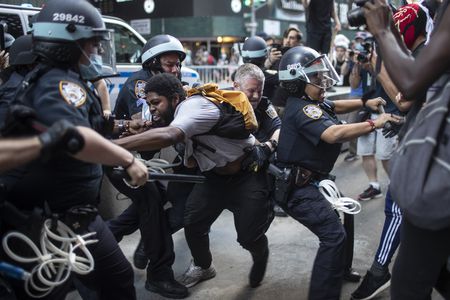
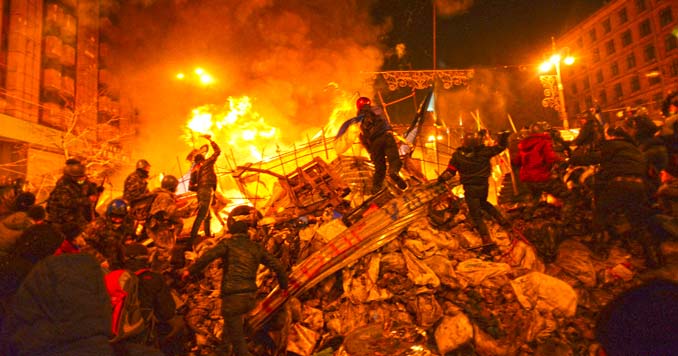
History has rarely appeared more alive than it does in the West today. Even before the Black Lives Matters protests this summer, protesters had been treating symbols of the past, be they building names or statues, as if they were living things. Some protesters even claim that these inanimate objects pose a threat to their wellbeing, with some Rhodes Must Fall campaigners at the University of Oxford claiming that merely walking past Cecil Rhodes’ statue is traumatic. Many more treat these symbols of the past as if they are living adversaries, against whom every act of vandalism or toppling is a vital act.

This presentation PROOVES WITHOUT DOUBT that America is in for a major fight that will put you and your family in the firing line, literally… So make sure you watch this presentation while it’s still online…

You could see something of this when activists pulled down the statue of Edward Colston in Bristol earlier this year. They did not simply want to topple it. They wanted to defile it, humiliate it, debase it. And so they pulled it down, and then dragged it along the street before throwing it into the river. It was almost as if they were parading the corpse of a hated tyrant before his liberated people, rather than a statue of a long-forgotten slave-trading merchant who died 300 years ago.

This captures something about the nature of these protests against historical symbols. Those involved – so emotional, angry and overwrought – appear to have lost sight of any distinction between the present and the past. And they are not alone. Indeed, the erasure of the boundary that separates the present from the past is one of the most important, if rarely acknowledged, cultural phenomena of the 21st century.

This can be seen in the way our present moment, marked by Brexit and Trump, is all too frequently seen by its critics in terms of the 1930s – as if there is little-to-no difference between then and now. It is difficult to pick up a newspaper today without encountering references to the Second World War, the fall of the Weimar Republic, or the rise of fascism. The reason for this form of historical revivalism is simple enough. Opponents of Trump, Brexit and so on are using symbols of past evil to discredit their present-day opponents.

This has led to a form of fantasy-driven radicalism, whereby leftist Don Quixotes tilt endlessly at Nazi windmills. But at least Don Quixote only harmed himself by fighting imaginary enemies. Today’s delusional crusaders, with Antifa to the fore, are far more insidious and dangerous. In their eyes, every white person enjoying a meal in a restaurant is a potential fascist, and therefore a legitimate target for violent anti-fascist action.

This attempt to demonise contemporary opponents through historical association should be understood in relation to the attempt to demonise history itself. That’s why those trying to topple statues, for instance, are not merely trying to rid the world of certain physical objects. They also want to purge it of what they see as the past evil with which those objects are associated. It does not matter whether the object in question is a flag, a statue, or even a song. If it connects the present to the now demonised past, it becomes an object of vilification.

Banishing the ‘bad old days’

Debates about history are usually confined to academic and cultural circles. But not at the moment. History has rarely been more politicised, or more politically significant, than it is right now. The reason for this is that the Western cultural and political establishment has become estranged from its past. So much so, in fact, that it perceives many present-day problems as the product of a past or history that it would like to jettison. Think, for example, of Brexit, and the swiftness with which numerous establishment commentators and politicians blamed it on the electorate’s nostalgia for the British Empire. This does not just speak to the anti-Brexit crowd’s political illiteracy. It also shows how even those in positions of cultural and political power are willing to confuse the present with the past.

This estrangement from society’s historical legacy transcends conventional political divides. Even mainstream conservative thought in the West has become emotionally disconnected from the past. Thus, in response to several racist incidents at football matches back in 2012, the then Conservative prime minister, David Cameron, could declare that ‘we will not let recent events drag us back to the bad old days of the past’. His use of the phrase ‘bad old days of the past’ was telling. Rather than just reference historical football hooliganism specifically, he talked of the past in general as a problem. It suggested that as far as he was concerned there was little worthwhile to ‘conserve’ from Britain’s past. And Cameron is far from the only conservative political leader in Europe who imagines the past as ‘the bad old days’ (1). Which raises a troubling question: if even conservative politicians adopt a dim view of their nation’s history, is it any surprise that others will seize the past and use it as a weapon against the present?

It is worth noting that the metaphor of the ‘bad old days’ is often deployed as a corrective to the supposed nostalgia of, say, Brexit or Trump voters. It is a way of ridiculing them as simple and gullible people, who, unlike their arch critics, still believe the past has some value. Take Cas Mudde, an academic critical of Brexit, Trump and so on. ‘Populists will pine for an imaginary, whitewashed past’, Mudde writes, ‘until politicians offer a credible future’. This critique of nostalgia does not merely warn people of the problem of living in the past; it also seeks to delegitimate the values and customs that the past might still generate. The irony of Mudde’s position sticks in the craw. He accuses populists of whitewashing the past, yet he is all too happy to indulge in a bit of inverted white-washing himself, painting the past as little more than an unending story of oppression and hypocrisy.

The narrative of the bad old days is dominant now. Warnings accompany reruns of TV shows, even those made as recently as the 1990s or 2000s. Museums present their exhibits as sources of colonial shame. Everywhere one looks, history appears as little more than a toxic tale of racism, misogyny, abuse and degradation.

There has been very little opposition to the narrative of the bad old days. Schools encourage young people to be ashamed of their ancestors. Universities conjure up the past for students as an amoral story of power and domination. And they do so without being challenged. Having won this very one-sided battle over the past, the different wings of the identitarian movement are now using this war against the past to discredit their present-day opponents. And none are doing so with more sophistication than the New York Times is with its 1619 Project. This project doesn’t only politicise history; it also attempts to stain the moral status of the institutions of America.

The war for the soul of America

In the mainstream media, Trump is often accused of starting a culture war, or of using history to portray himself as a ‘defender of American heritage’. So, earlier this month, when Trump declared, at a White House Conference on American History, that ‘our mission is to defend the legacy of America’s founding’, he was again denounced for trying to stir up a culture war.

What Trump’s detractors overlook is that it was not him who started this current phase of the culture wars. That honour falls to the 1619 Project, which was launched by the New York Times on 14 August 2019. By the time Trump delivered his speech, more than a year later, the 1619 Project had won the support of most of Hollywood, and Nikole Hannah-Jones, its lead author, had been awarded the prestigious Pulitzer Prize.

Trump was not starting anything. He was responding, in this case to the head of cultural steam built up by the 1619 Project. No doubt he sensed that what had begun as a demonisation of America’s past had mutated into a political ideology, one that was now mobilising unrest and protest throughout the US. It was no longer just history at stake. It was the soul of the nation.

Is starting to feel like it’s every man for himself, Is possible that right now, a global crisis is upon us, Without even knowing… And the virus may not be the biggest threat, but the crisis that follows, Everyday goods that keep us alive will be gone, I’m talking, food, fresh water, medicine, clothes, fuel…

bnr

Because make no mistake – the New York Times’ 1619 Project has played a vital political role in today’s political unrest. It has done nothing less than devalue and criminalise the founding of the United States.

As the 1619 Project’s title suggests, it claims that the year 1619, and not 1776, is the true founding year of the US. This, the project argues, is because the US was founded for the purpose of entrenching slavery, and 1619 was the year African slaves first arrived in Jamestown. According to this inaccurate version of the past, the actual founding of the US in the American Revolution was a selfish attempt to preserve the exploitative and oppressive legacy of 1619. In this way, the contribution of the American Revolution to the development of the ideal of freedom is erased from history. The Declaration of Independence and the US’s then remarkably advanced liberal and democratic constitution are implicitly renounced as slave-owners’ charters.

Most significantly, the 1619 Project is a self-conscious attempt to contaminate the traditions and undermine the foundation underpinning the American way of life. It is therefore a profound political attack on the present. Indeed, Hannah-Jones herself admits that its principal objective is not to shed new light on the past, but to undermine the moral authority of the present. ‘I’ve always said that the 1619 Project is not history’, she writes. ‘It is a work of journalism that explicitly seeks to challenge the national narrative and therefore national memory. The project has always been as much about the present as it is about the past.’

Indeed. This is a project devoted to the toxification of the past in order to delegitimise the present-day institutions of the US.

The 1619 Project erases the boundary not just between the present and the past, but between truth and fiction, too. In 1619, the African slaves, like many white people sent to Virginia, in fact became indentured labourers, not slaves. This is not a nitpicking distinction. It shows that it is wholly inaccurate to claim that the US was founded to entrench slavery. Other eminent historians have also drawn attention to the numerous liberties the 1619 Project has taken with the facts. Such has been the level of historical criticism levelled at the project that the Times edited out its claim that 1619 was the ‘true founding’ of America. Hannah-Jones went so far as to deny, on CNN, that she had ever intended to replace 1776 with the new founding date of 1619. The project’s casual approach to historical fact shows just how politicised and cynical the whole thing is.

Trump himself took issue with the project’s attempt to portray America’s foundation as being based on ‘oppression and not freedom’. He countered, saying that the Declaration of Independence ‘set in motion the unstoppable chain of events that abolished slavery, secured civil rights, defeated Communism and fascism, and built the most fair, equal and prosperous nation in human history’.

The aim of Trump’s 1776 Commission is clear. It aims to counterbalance the gloomy take on America’s past now taught in American schools. ‘We must clear away the twisted web of lies in our schools and classrooms’, he said, ‘and teach our children the magnificent truth about our country’.

But it is unlikely that, by itself, the 1776 Commission can match the cultural power of its opponents. After all, the educational establishment is extremely hostile to the teaching of what sounds like patriotic history. ‘It’s disgusting’, was the predictable reaction of Randi Weingarten, the president of the American Federation of Teachers, to Trump’s speech. Others said Trump’s version of the founding ‘revolv[ed] around white males’. For educators brought up on a diet of identity politics, denouncing dead white males is something of a quasi-religious duty.

Still, although it was only one speech promising a single commission, Trump’s comments do represent an overdue attempt to join the battle for America’s soul.

The problem of foundation

In a sense, the attention the 1619 Project has drawn to the question of America’s foundation is to be welcomed. Why? Because virtually every issue raised in the course of the current phase of the culture wars is ultimately linked to the view that one takes towards the authority of foundation.

The Latin term auctoritas refers to what can best be characterised as foundational authority. Authority that is foundational is that to which a decision or opinion can be referred back as a source of legitimacy. Throughout much of modern history it is the absence of precisely this foundational authority that has haunted public life. Political instability and institutional fragility are symptoms of societies that lack an authoritative foundation on which to draw.

The founding of the US and its articulation in the Declaration of Independence and Constitution is arguably the most successful example of the act of foundation in the modern era. The political philosopher Hannah Arendt regarded the founding of America as a unique event, not just for Americans, but for humanity as a whole. In her essay ‘Founding Fathers’, she wrote that the challenge of realising freedom demanded a ‘new foundation’, a demonstration that humanity ‘can begin something altogether new’. Arendt observed that:

‘the question of the foundation of a republic was how to preserve this spirit, the revolutionary spirit, how to find lasting institutions which could prevent this experience from being the experience of only one generation’

The preservation of the spirit of foundation was successfully realised in the Constitution of the United States.

As Arendt explained, the difference between the American constitution and those of postwar Europe, ‘which were given from above, usually by experts’, is that ‘the foundation’ was ‘an event’ that was ‘absent everywhere except in America’.

What makes the US Constitution so unique is that it has been revered almost ever since it was enacted. Arendt remarked that:

‘One is tempted to conclude that the remembrance of the event itself – a people deliberately founding a new body politic dedicated to freedom – has shrouded the document in an atmosphere of reverent awe and shielded it against the onslaught of time and circumstances’

She concluded on an optimistic note:

‘One also is tempted to predict that the authority of the republic will be safe as long as the act itself, the beginning as such, is remembered as the promise it holds out, and was meant to hold out, for all those who, by virtue of birth, enter earthly life as beginners.’

Arendt wrote ‘Founding Fathers’ in 1963. At that point in time, her optimism about the future of the republic was justified, because the normative underpinning of the US’s foundation was rarely questioned. Those who questioned the dark moments of American history – such as the practice of slavery, or certain racist policies – did so on the grounds that they violated the norms of freedom and equality enshrined in the Constitution itself. The Constitution was therefore seen as a corrective to, say, racial oppression, not as its embodiment.

Today, however, the promise of America’s foundation is under constant attack. Too many in the US are losing touch with the idealism, and the spirit of freedom and democracy, that inspired the founding of a new world. That is why, contrary to Arendt, the republic is no longer safe. The toxification of the act of America’s foundation, by cultural and educational elites and self-styled radicals, is corroding the legitimacy of its constitution and institutions. The decay of the republic, the detachment of its present from its often inspiring past, will not only affect the people of America. For America’s founding is a central part of the intellectual and moral legacy of all of humanity. That is why those of us watching events in America from afar have every reason to join the battle for the soul of America.

If you’re interested in learning more old remedies, you should read The Lost Book Of Remedies.

Lost Book of Remedies pages

The physical book has 300 pages, with 3 colored pictures for every plant and for every medicine.It was written by Claude Davis, whose grandfather was one of the greatest healers in America. Claude took his grandfather’s lifelong plant journal, which he used to treat thousands of people, and adapted it into this book.

Lost Book of Remedies cover

Learn More…

The United States Is In A Time Of Great Danger-Do Nothing And You Will Make Sure Your Wife And Mother And Children Will Be Raped And Potentially Murdered

As COVID-19 continues to ravage our nation, the economic toll is racing to outstrip the toll in lives taken. While there is clearly no way of comparing the two, the millions of people who have lost their jobs due to the pandemic are the ones who are suffering the brunt of shutting down our country. Many of those people will never get those jobs back, because the companies who laid them off have gone bankrupt.

We have yet to see the full impact that COVID-19 will have on our country and the world.  Even so, it’s surprising that we haven’t yet entered into a time of economic depression. Many financial gurus are predicting that it’s just around the corner, so we’re clearly not out of danger yet. Probably the only way we’re going to see the end of that risk, is by going through the depression and coming out the other side.

Some people have been a bit too quick to dismiss the effects of the pandemic, forgetting that it has been worldwide, not just here in the United States. While there are those who may be trying to use it for political gain, they can’t be making up the disease or its effects; doing that would require creating the conspiracy of all time.

Most Americans who have been around for a while know life is nothing like it used to be. When someone wanted a job one was found with a little bit of searching. Today jobs are difficult to find, especially in small communities.

This presentation PROOVES WITHOUT DOUBT that America is in for a major fight that will put you and your family in the firing line, literally… So make sure you watch this presentation while it’s still online…

When I was growing up in the 70’s, there were several car dealers in my community. There were three tractor dealers and too many mom and pop stores to count. Today there are two used car dealers and the nearest tractor dealer is twenty miles away. So how is it that we now have more people, but fewer businesses to employ them?

A nations wealth is derived from having a product to sell. That wealth needs to circulate in towns and cities to compound the wealth effect and create jobs and businesses. When wealth is not created or it is siphoned off to other places, the wealth effect can not happen, and in many cases goes into reverse. A community needs a certain amount of service related jobs to function but it also needs some type of production jobs to bring in money from the outside. This can be mining , agriculture or manufacturing type jobs, but they must exist to insure a healthy economy.

America has two major problems today. A large amount of our production is done outside the country eliminating production jobs in local communities and many of the small local businesses that kept wealth within communities have been supplanted by large corporations that siphon wealth out of communities and send it to wall street.

In the past when a small business made profit, that profit was kept in the local community because that is where the owner lived. Now, that profit leaves the community never to be seen again. With less money to circulate within the community the businesses that depend on people spending their extra dollars, have fewer customers and eventually go out of business. With fewer jobs there is that much less money circulating and the economic situation spirals down until nothing is left.

These days corporate businesses and government jobs make up the major part of many local communities. In many cases if it were not for the government jobs, many communities would no longer exist. So what do you think would happen if the government suddenly no longer had money to pay those workers? What would happen if corporate profits dropped to the point where corporate stores decided to close and cut their losses?

To some extent we are seeing this happen now in many places. Corporate stores moved in and drove small local businesses out. Then when the profits dried up the corporate stores closed leaving the community with no jobs or products to buy. With no capital in the local communities to rebuild small businesses, the people simply drive to other areas to do their shopping.

The corporate cronies and government laggards control most of the money flowing through communities now and they want to keep it that way. Any attempt to rebuild local businesses is met with luke warm results. Any business that might make a difference is either killed outright or regulated into oblivion before it can get off the ground. The county where I live has all but abandoned local businesses. The bulk of their income comes from property taxes generated by vacation homes and retirement homes of retired government employees. As long as the government pensions and paychecks continue, they see no reason to change the status quo. The result is that the younger people leave as soon as they can and the average age of the population continues to get older. As with many places today, this area has no future.

Where I live is a microcosm of the nation. Corporate and government entities continue to siphon what little money there is out of communities and just as small communities are dying, the nation will soon follow if current trends do not change. A return to small local economics is the only way to reverse some of the damage and keep our communities livable. But, do not be deceived. There is no way to undo all of the damage that has been done and even if we survive, we will only be a shadow of what we once were as a nation

Will Americans just let this happen? Will lazy Patriots just give a minimal effort?
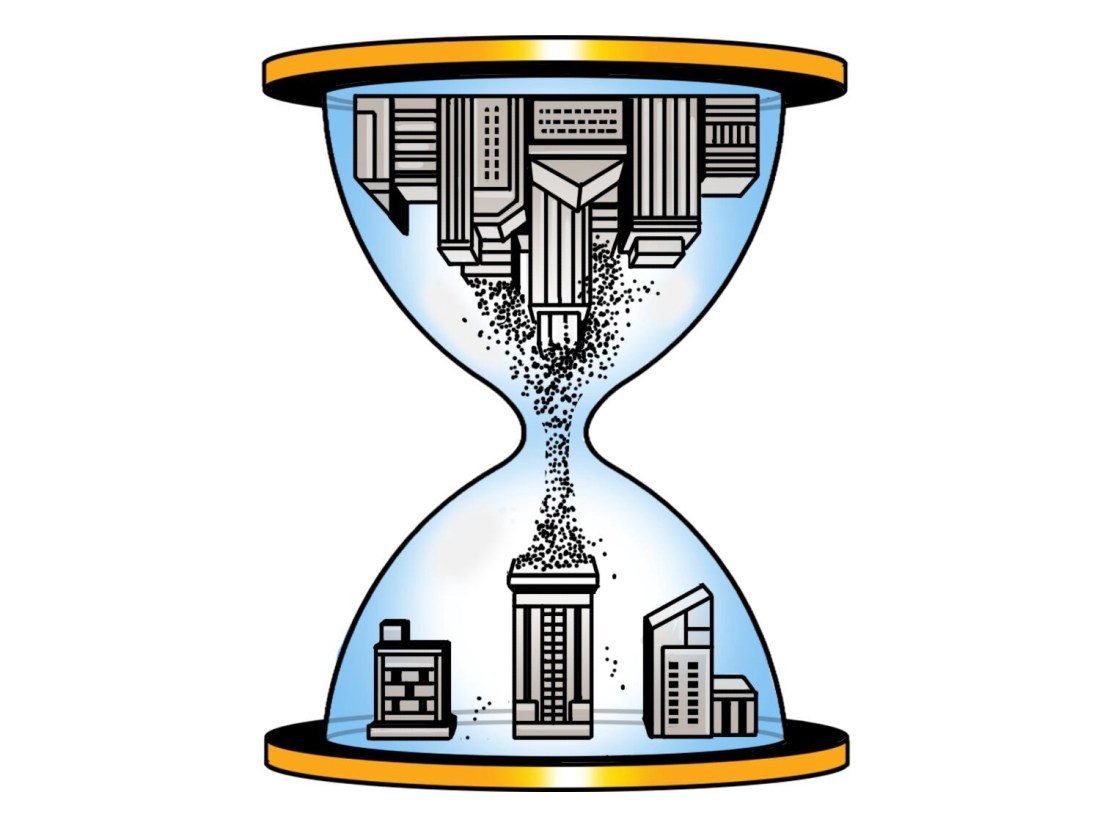
For readiness, the hour glass has almost run out! In the absence of your local FEMA rep (that is, local spy) organize your neighbors into groups of three and four (so they can’t be infiltrated) and get ready! There is a Wild Ride just ahead! Let’s make a swift effort of taking the Red door, now opening, and painting it black!  Death to all destroyers of America!

Our forefathers lost knowledge must be kept alive by all means. So before you go please take a second and think how you can benefit from their wisdom.

In the next crisis these lost skills will be more valuable than gold, food supplies and survival equipment combined. These skills have been tested and proven to work for centuries.

This is wild lettuce also known as opium lettuce… for a good reason. It has side effects similar to Morphine but milder, being by far the strongest natural painkiller that grows in your backyard.

CODENAME: Operation Virus Identification 2019; the Elitist Plan to Remake Society

Everything we were originally told about the Coronavirus has turned out to be wrong. In fact, it’s not a “novel” one-of-a-kind infection at all, but a member of a larger family of which there have been many iterations in the recent past. It’s also not the most contagious or most lethal virus we’ve ever seen, but a fairly-mild infection that has no impact on the majority of people and that only kills somewhere between 1 in every 200 to 1 in every 1,000 people. (CDC-IFR- 0.26%) Also, there was no real danger that our public health system was going to collapse, because the projected number of potential deaths (1 to 2 million in the US) never approached the estimates of the flawed computer models that were used to decide the policy. In short, just about everything we were told from the very beginning turned out to be demonstrably wrong. Why is that? Why do you think that the people who provided us with the information –many of them supposedly “experts” in their field– were so wrong about everything? And why haven’t they made any effort to publicly correct their mistakes when they realize how much confusion they’ve caused?

It’s politics, right? What other explanation could there be? Our leaders and their behind-the-scenes puppet-masters are using science as a vehicle for achieving their own narrow political objectives. In broader terms, COVID–19 or, should we say, CODENAME: Operation Virus Identification 2019, is the plan to manipulate virus-hysteria “to drastically and irrevocably” change the “fundamental structure of society” to establish a totalitarian world order. (Quote: from CJ Hopkins) That’s what’s happening, and the Democrats, the media and the many infectious disease experts are playing key roles in this operation that’s bound to continue until its objectives are achieved.

But let’s forgo the political analysis for now and review what we actually know about the virus itself. This, of course, would not be necessary if the media had been doing its job by providing accurate information rather than fueling public hysteria. Sadly, the majority of people are just as misinformed now as they were 6 months ago when the outbreak began. How could that be if the media was actually doing its job? It couldn’t.

What we know for certain is that the doomsday scenarios never materialized. 2 million Americans did not die and the world did not come to an abrupt end. We also know that the computer model predictions from the Imperial College were bogus just as we know that the countries that ignored those absurd models did better than the others. As Nobel prize winner Michael Levitt points out in an article at Haaretz:

The same type of models predicted that in Sweden, the number of deaths from COVID-19 would reach about 100,000 by June, if the Swedish government continues to refuse to impose lockdown measures. Sweden rejected these models and bravely adopted… a democratic policy that broadly enabled normal life to continue. Despite the large nursing homes in Sweden...the number of deaths turned out to be 6% of the one predicted, about 6,000 people, at an average age of 81. Half of the victims were nursing home residents who, in Sweden, have a median life expectancy of 9 months after admission.” (“Countering the Second Wave with Facts, not Misconceptions” Haaretz)

Repeat: Sweden’s death toll turned out to be just 6% of the original estimate. By comparison, the US death toll (167,000) is not quite 10% of the original (Imperial College) estimate. Both estimates were catastrophically wrong, and yet, we shut down the economy, drove unemployment up to levels not seen since the Great Depression, and condemned the country to years of agonizing restructuring. And for what??

Well, to promote a ghastly, authoritarian political agenda, that’s why. And this just helps to underscore what Covid-19 is really all about. It’s politics masquerading as science.

The Haaretz article also sheds light on the issue of “herd immunity” which is routinely mischaracterized in the media as the point at which 60% (or more) of the population have been infected and therefore have developed antibodies to the virus. This is wrong, in fact, the threshold for herd immunity is much lower than that, perhaps 5 to 15% of the population.

But, how can that be, after all, we were told that this was an entirely new “novel” virus that our species had never before experienced and for which we had no built-up immunity?

That was another lie. Here’s Michael Levitt again:

“Widespread infection is not required for stopping the epidemic. The argument that 60% of the population must be infected and becomes immune before the infection spread is halted is based on an incorrect mathematical calculation….The most significant evidence – decidedly refuting the need for 60% infection rate – is pre-immunity. For example, COVID-19 has several relatives (other coronaviruses) to which the population had been exposed, and such prior exposure can provide immunity to a significant segment of the population. Back in April, two of us wrote an article about the postulated nature of this immunity and the statistical evidence that pointed to its existence. We noted that in several closed communities that underwent testing, the infection rate was always capped at 20%, which statistically aligns with maximal infection rate in these communities rather than recurring coincidences. About a month later, a group of researchers published corroborating evidence in Cell, one of the most prestigious journals in the life sciences. About 60% of people in California who had never been exposed to COVID-19, had immune memory cells that recognized the virus and are therefore likely to provide immunity.

Moreover, a study in Germany showed that such immunity could reach a level as high as 81% of the population. …This rate of pre-immunity to COVID-19 is also evident in the global rates of infection. The virus began infecting humans more than eight months ago, and the epidemic has already spread to most of the world. Yet in all countries, the infection rate remains below 20 percent of the general population. This limited rate of infection has remained unchanged regardless of social distancing measures (if any),such as quarantines, local or country-wide lockdown, mask-wearing, and so on. In Sweden, for example, the infection rate did not exceed 20% and the percentage of people who survived the epidemic exceeds 99.9% (!) of the population. Such is the case in Belgium as well, the country with the highest population mortality rate, where less than 20% were infected, and more than 99.9% of the population has survived the epidemic…The implications of these findings are of utmost importance. They call for immediate removal of most restrictions on the economy, immediate return to normal life of low-risk population while helping high-risk groups reduce the rate of social contacts.” (“Countering the Second Wave with Facts, not Misconceptions” Haaretz)

This is not some minor point. Our policy and the policies adopted by countries around the world are based on assumptions that are both unscientific and false. Do you really think the people responsible for implementing these policies don’t know the science or don’t know about “pre-immunity” or that that “prior exposure can provide immunity” or that ” the infection rate was always capped at 20% in all countries” (which means that only 1 in every 5 people will contract the infection regardless of their exposure.) or that in all cases and all countries “more than 99.9% of the population has survived the epidemic”?

Admit it, most readers don’t know anything about any of this because none of it has appeared in the MSM. Why is that? What malicious, evil forces are at work here? Why do our leaders and our media want to keep us in the dark about issues that are critical to our decision-making, critical to our livelihoods, and critical to our very survival? Why?

Again, do you really think our leaders and infectious disease experts– like the affable Anthony Fauci– are unaware of these facts? Do you think they have dismissed them as too trivial or too superficial to tell the public or do you think they are deliberately withholding any information that might mitigate the prevailing atmosphere of hysteria that is keeping the American people afraid, isolated and abjectly submissive to the manipulations of their paymasters?

That’s what you call a “no-brainer”. We have entered a period in which wealthy, globalist oligarchs are using fake science, amplified through their assets in the media and Democrat party, to fundamentally restructure society in a way that enhances their material interests while strengthening their grip on power. It’s as plain as the nose on your face.

And there’s more too, because censorship, manipulation and politics have real costs, and the costs can be calculated in terms of the lives that are lost due to the imposition of a ruthless and thoroughly-counterproductive policy: Lockdown. Here’s Levitt again:

“The third argument – removing restrictions will result in a higher mortality than a policy of lockdowns and restrictions – is also incorrect. A virus spreads in the population until enough people become infected and immune, or until a vaccine is foundLockdowns and restrictions may only slow down its spread (“flatten the curve”) but they do not lower the total number of infections or overall mortality. If there is a risk of overwhelming hospitals, there might be a need to slow the spread of the infection. Otherwise, flattening the curve can only be harmful since the infection returns once the restrictions are removed. Moreover, efficient protection of high-risk groups is possible only for a limited period of time: The longer the time, the harder it is to prevent their exposure to the virus. Therefore, paradoxically, it is precisely lockdowns and restrictions that slow the building of herd immunity, which in turn is needed to stop the epidemic and protect high-risk groups. In the long run, such policy can lead to excessive mortality.” (“Countering the Second Wave with Facts, not Misconceptions” Haaretz)

In other words, lockdowns can postpone infections but cannot prevent them. A virus is going to do what a virus does. Period. Imposing lockdowns is as bound to fail as standing at the water’s edge and ordering the tide to stop coming in. It’s empty posturing that achieves nothing. As Levitt says, lockdowns are, in fact, a threat to older and vulnerable people because the longer they are in place, “the harder it is to prevent their exposure to the virus.” In short, the lockdowns actually kill the people they are supposed to save.

Do you think our leaders know this? Of course, they know it. Levitt is not the only scientist who’s able to think clearly and rationally. The others have merely shaped thier approach to the demands of their employers. Does the name “Bill Gates” ring a bell?

Here’s Levitt again:

“In Sweden…there is no “second wave” because there was no lockdown. Thus, the policy of imposing and easing restrictions only prolongs the crisis, destroys the economy, and eventually leads to a larger number of victims. It may even continue for years as long as a vaccine is not available. The alternative to lockdowns and restrictions must be seriously considered.” (“Countering the Second Wave with Facts, not Misconceptions” Haaretz)

Indeed, lockdowns cost lives, lockdowns cost money, and lockdowns are the wrong policy. Here’s Levitt one last time:

“It can be assumed that the handling of the COVID-19 crisis will be scrutinized – both in terms of health aspects, but also in light of public outrage over the state of the economy. So many people all over the world have lost their sources of income, livelihood, dignity and future. Poverty is a much more severe mortality risk factor than COVID-19, and it affects children as much as adults. One of the key questions that will surely be asked is whether the leadership in each country has ever seriously considered a worthy alternative to resolving the crisis, which will not cost so many human lives or destroy the economy. Countries such as Norway, Ireland, and Belgium have already declared that they will not impose further lockdowns as the obvious damage outweighs the doubtful benefit by a wide margin.” (“Countering the Second Wave with Facts, not Misconceptions” Haaretz)

By any measure, the United States is in worse condition than ever before. We have destroyed our economy, closed our schools, obliterated our small and medium-sized businesses, increased suicides, depression, domestic abuse, poverty, homelessness, alienation and destitution. The American people have been plunged into a strange world of persistent fear and relentless manipulation by scheming elites who are resolutely committed to remaking society from the ground-up. COVID-19 is merely the vehicle they have chosen to achieve their nefarious objectives.

Does Hydroxychloroquine work? You decide?

Does Hydroxychloroquine work? You decide?

Note–All excerpts taken from (“Countering the Second Wave with Facts, not Misconceptions” Haaretz) Udi Qimron, Uri Gavish, Eyal Shahar, Michael Levitt”
https://www.dropbox.com/s/72hi9jfcqfct1n9/Haaretz-20Jul20_ENGLISH%2012082020%20v3.pdf

1– Prof. Udi Qimron is the (elected) Head of Department of Clinical Microbiology and Immunology, Faculty of Medicine, Tel-Aviv University
2– Dr. Uri Gavish is a Physicist, an expert in Algorithm Analysis and a Bio-medical consultant
3– Prof. (Emeritus) Eyal Shahar is an Epidemiologist, University of Arizona
4– Prof. Michael Levitt is a Nobel Prize-winning (Chemistry, 2013) Structural Biology professor, Stanford UniversityThe original article was published in Ha’aretz in Hebrew on July 20, 2020. The English text contains minor revisions.

Covid-19 Has Accelerated U.S.-China Feud And The beginning of a new “Cold War”

The implications of the pandemic for US-China relations are relevant for global peace and prosperity, well beyond the Asia-Pacific. Rather than joining forces against the pandemic, COVID-19 is among the factors that have widened the rift between the United States and China, bringing bilateral relations to their lowest level since Nixon and Kissinger’s overtures in 1971. In fact, US-China zero-sum interactions across the geopolitical, economic, technological and political domains have spiralled towards a dangerous race to the bottom. While it is too early to declare a US-China “Cold War”, China’s assertiveness and the US maximalist pushback are working in lockstep to reify the Cold War trope past the 2020 US presidential elections. 

***

The fight against COVID-19 and its aftermath poses one of the most pressing challenges confronting the international community since the end of the Cold War. At the same time, the coronavirus crisis coincides with momentous changes in world politics and seems to accelerate the decline of the so-called liberal international order, a misnomer for an era loosely defined by multilateral diplomacy, an open world economy and a degree of international stability buttressed by US military preponderance and a US-China entente that extended from geopolitics to economics, trade, technology and finance. Yet, China’s new-found assertiveness, global political involution, the fecklessness of international organizations, the growing allure of dirigisme, and the advent of a more isolationist, if not outright disruptive and protectionist United States posture, have dealt repeated blows − both exogenous and endogenous – to international stability.

The pandemic has accelerated these political and economic trends. For instance, international organizations, such as the World Health Organization (WHO) and the United Nations, have been powerless in the face of COVID-19 because they’ve been playing second-fiddle to great power politics. China’s misreporting to and influence over the WHO contributed to an initial underestimation of the health risks and infectiousness associated with the novel coronavirus. Still, Washington’s populist decision to withdraw its funding and membership from the WHO – adding to growing frustrations of its European and Pacific allies – only exacerbated the problem of multilateral coordination during a pandemic. The emergency has allowed states to further centralize control over economic and social affairs – arguably also for good reasons – and has lent legitimacy to a recrudescence of nationalist and protectionist instincts, effectively empowering many of the world’s strongmen. Still, the ripple effects of a potential post-pandemic depression are hard to discern. As popular discontent mounts, populist strongmen and democratic leaders alike may exhaust the charisma acquired through COVID-19 crisis-responses, ushering the way to two broad scenarios. A pessimistic outlook suggests further political decay and deepening geopolitical tensions as national interests more easily clash, and leadership seeks to divert attention from socio-economic grievances. Alternatively, contemporary history has demonstrated that genuine political evolution, new social compacts, redistributive political economies and multilateral systems of governance may acquire a new shine following a major crisis (Both scenarios assessed by Fukuyama 2020).

The SHTF we all prep for is what folks 150 years ago called daily life: …no electrical power, no refrigerators, no Internet, no computers, no TV, no hyperactive law enforcement, and no Safeway or Walmart

This essay focuses on the geopolitical impact of the pandemic in the Asia-Pacific with an accent on US-China dynamics. I argue in favour of the first, pessimistic scenario because COVID-19 is cementing Sino-American strategic rivalry and crystallizing Washington’s maximalist pushback against Beijing, with implications that go well beyond the region. High-stake geopolitical manoeuvrings between the US and China are impacting economic, political and security dynamics globally. More importantly, the ongoing political warfare between the two – one that has been exacerbated by the pandemic – is cementing US-China enmity and reifying the new “Cold War”. Understanding the drivers of US-China strategic competition will help third parties better navigate the stormier geopolitical seas ahead. As the discussion below will demonstrate, US allies are well-advised to prepare for the challenges posed by a rising and aggressive China, but there is a concomitant need to manage and ameliorate the risks associated with a disruptive, and declining, hegemonic power – the United States of America. Given space limitations, this essay places special emphasis on the US pushback; the author recognizes China’s composite assertiveness, if not aggressiveness, that has fed into US behaviour (Small et alia 2020), but the radical pushback is arguably feeding the monster it has tried to tame.

US-China Power Politics During the Pandemic: Minds, Money and Might

Ever since the unveiling of the December 2017 National Security Strategy (NSS) and 2018 National Defense Strategy, the Trump administration has embarked on a steady crescendo of initiatives, both domestic and international in scope, aimed at curbing China’s influence. Following the demise of voices of moderation, such as former director of the National Economic Council Gary Cohn, security and economic hawks within the Trump administration have steered the American ship of state towards a maximalist pushback against Chinese assertiveness. For instance, the National Security Council has worked in tandem with Mike Pompeo’s State Department, the Department of Justice (DOJ) and other relevant government agencies to craft a “whole-of-government” response that mobilized US leverage – from trade embargoes and military power to strategic communications and counterintelligence (Sutter 2019) – to contain China’s rise. The foreign policy pendulum had shifted substantially from the Obama presidency – an administration that was keener on transnational threats and diplomatic inducements over big-stick diplomacy – to usher in Trump’s highly transactional diplomacy, and contempt for global challenges – such as climate change –, multilateral cooperation, and international organizations. Thus, the US muscled up for an age of “great power competition” to pursue peace through strength and aimed at rectifying supposed security and economic imbalances with friends and foes alike, through an “America First” agenda.

Specific to the China challenge, the recent overhaul of the United States’ foreign and security policy is premised on a Manichean diagnosis of the nature of its main strategic competitor. Fieldwork in Washington DC in 2019 and 2020 suggested that key national security decisionmakers acted on the belief that the Chinese Communist Party (CCP) and its influence are essentially malign. Under Xi Jinping’s leadership, the CCP engaged in cultural and (through forced sterilization) effective genocide in Xinjiang, heavy-handed political repression as in Hong Kong, and a dystopic use of new technologies for surveillance purposes. While much of this assessment rings true, the US government translated the CCP’s pursuit of regime security and its regional assertiveness into a conspiratorial assessment of China’s global intentions, capabilities, and modus operandi (Johnston 2019, Barboza 2020, Spalding 2019, McMaster 2020). US decisionmakers believe that the CCP seeks to export its autocratic system of governance, ensnares developing countries into neo-colonial “debt trap” diplomacy under the banner of the Belt and Road Initiative, infiltrates liberal democracies to meddle into their domestic politics, and leverages “whole-of-society” intelligence efforts to steal its competitors’ technological, military and economic secrets (White House 2020). In short, key US policymakers equated China with the Soviet Union and Xi Jinping with Joseph Stalin, to conclude that a capitalist, democratic United States was fundamentally incompatible and couldn’t co-exist with a Marxist-Leninist regime, that poses a long-term existential threat (Pompeo 2020, O’ Brien 2020).

Alas, the COVID-19 black swan has accelerated the international and domestic push factors towards a downward spiral in US-China relations. To be sure, the US-China Cold War trope already contained the seeds of a self-fulfilling prophecy (Wolf 2019), but the administration’s Cold Warriors did not have a free hand. For instance, Treasury Secretary Steven Mnuchin and US Trade Representative Robert Lighthizer were more interested in reaching a trade deal with Chinese counterparts rather than pursuing negotiations into an endless economic race to the bottom. More importantly, they were empowered by a US President, who prioritized his own re-election and, as long as the US economy roared and Trump could have spun the US-China phase-one trade deal as a “victory”, he was conspicuously uninterested in criticizing China’s gross human rights violations. In fact, the US president was enthralled by and envious of Xi Jinping’s autocratic powers and methods (Bolton 2020). Finally, while the US legislative branch pointed at a bipartisan consensus aimed at curbing Chinese influence the spirit remained largely reactive not least because US public opinion prioritized Islamic terrorism and Russia as international threats. On the contrary, the pandemic has empowered the US administration’s radical hawks, convinced Trump of the merits of demonizing China as key to a second term, thus abandoning his earlier restraint to make up for a failing economy and falling popularity. In turn, this informed a degree of reactive aggressiveness on China’s part and fed into spiralling US-China security dilemmas during an election year.

The pandemic has widened the international rift between the two great powers and accelerated the trend towards international instability. In the author’s view, the pandemic fed into mutual mistrust, deepening geopolitical tensions and mounting insecurity that were independent of each state’s strategic intent. The logic has been distinctively zero-sum. In fact, the US government explicitly aimed to prove that Beijing was more dependent on America than vice-versa (Pompeo 2020), while policymakers on both sides understood defensive or internally motivated initiatives as offensive ones. As a result, the US and China moved along a mix of reactive and assertive postures that betrayed a series of dangerous security dilemmas governing bilateral relations and the two governments have not shied from tapping all dimensions of power during the pandemic: military, economic and communication power. In fact, the Trump administration recalibrated its maximalist pushback on all of these dimensions in light of the security and economic hawks’ fixation with China’s “unrestricted warfare” (Barboza 2020, Spalding 2019). The pandemic presents a good window on the escalation of US-China power politics in the three-dimensional chessboard. The mutually reinforcing dangerous spirals in propaganda, techno-economic competition and military rivalry underpins the author’s pessimistic outlook.

Minds: An All-Out Information War

First and foremost, the US and China have been embroiled in an all-out communication war during the pandemic, replete with propaganda and disinformation. Domestic factors have been particularly salient in facilitating the vicious circle of US-China retaliatory tit-for-tat during the pandemic. Thomas Christensen has identified Trump’s and Xi’s preoccupation with the preservation of their own political legitimacy in the face of a major crisis as the driver of the US-China clash (Christensen 2020). Thus, China and the United States’ blame game on the origins of the pandemic, according to which government laboratories of either country were implicated in the creation of the virus, was aimed at diminishing the responsibilities of their own leaders. As the US economy entered into a recession, Trump and the Republican Party beat the “China/Wuhan virus” drums to: 1) demonize China for causing the pandemic and the economic crash, and 2) indict Joe Biden for being soft on China, for instance, because he did not support the administration’s early China travel ban and because he was traditionally in favour of a policy of engagement towards Beijing. These accusations would reach their nadir through heavy-handed ad campaigns, according to which Biden was complicit with China, a country responsible for “stealing our jobs” and “killing our people”.1 In the process, the government-backed narratives of victimhood at the hands of a malevolent China have led public opinion to prioritize the China threat, and cornered Biden and the Democratic Party into an equally resolute stance against Beijing.

International factors in the zero-sum logic of power politics have also been at play. The US government’s preoccupation with building a “coalition of the willing” to investigate the origins of the virus, and its denial of WHO analyses of its origins and progression, certainly aimed at facile scapegoating to account for its home-bred failures, but also stemmed from the ideological belief that the CCP was responsible, even if unwittingly, for the creation and spread of the virus (Rogin 2020). The Trump administration aimed at cornering the CCP for its negligence in allowing the virus to spread in order to score points in the US-China global battle for “hearts-and-minds” that has gathered momentum over the past few years. Along with an overhaul of the State Department that prioritized the China challenge, and the rallying of the CIA, Homeland Security and other branches, the Trump administration defunded traditional public diplomacy programs to refurbish and substantially empower the Global Engagement Center (GEC) – an interagency office aimed at coordinating, integrating, and synchronizing government-wide communications initiatives directed at foreign audiences with an original focus on ISIS and, eventually, Russian disinformation. Under the Trump administration, GEC would engage in data-driven and audience-focused strategic communications that countered especially China’s narratives, propaganda, and public diplomacy-writ large. By 2020 GEC’s base budget had ballooned to $ 138 million dollars from $ 20.2 million dollars in fiscal year 2016 (Department of State 2020). The zero-sum quality to US-China public diplomacy initiatives triggered action/reaction dynamics, no matter the intended audiences and effectiveness of such messaging. For instance, GEC had prioritized China’s “medical aid diplomacy” in the aftermath of the COVID-19 crisis, especially its heavy-use of state-sponsored disinformation and coordinated inauthentic behaviour on social media (Gabrielle 2020).

GEC has grossly overestimated China’s efforts to subvert the US, hinting at an improbable coordination between Russia and China in the global propaganda wars and exaggerating the magnitude of China’s disinformation network on social media (CNN 2020). Alas, the US government apparently understood China’s propaganda efforts solely in terms of an offensive strategy that weaponized its public diplomacy to mimic Russian disinformation malpractice. According to this logic, China would spin its medical diplomacy and assistance for political advantage, thereby discrediting European and US governments’ actions, magnifying social tensions and driving a wedge between targeted states and their traditional allies.

In fact, China’s “wolf-warrior” diplomacy and manipulative social media engagement was essentially domestic-focused. The propaganda and retaliatory measures threatened against countries that criticized Beijing’s handling of the crisis, such as Australia, successfully alienated China’s counterparts. Similar to the Wolf Warrior movie franchise, China’s heavy-handed diplomacy and more active use of government-backed disinformation campaigns on Western social media were successful with the intended audiences: Chinese citizens – who vicariously participated in the Twitter battles through echoes in their own state-sanctioned media – Chinese expats and overseas Chinese. Authoritative China-watchers recognize that Beijing acted out of a feeling of deep insecurity over regime stability – in fact, real unemployment had already sky-rocketed ahead of the COVID-19 crisis (Interview 2019) – and preliminary evidence suggests that China’s overseas information operations were aimed at mobilizing and cementing a united front already by late 2019 (Etō 2020). The US government’s all-out communication offensive on the virus origins, on China’s mishandling of the coronavirus, and high-profile calls for political change (Pottinger 2020; Pompeo 2020) certainly hit a raw nerve in Zhongnanhai, because overseas Chinese communities, which have fuller access to information through Western media and social media platforms, are an important pressure group on regime stability in the mainland.

Above all, US efforts to demonize China across a wide range of issues from Covid to economic exploitation and technological espionage directed against the US were above all meant for domestic audiences to raise awareness of the long-term “existential threat” posed by China, in the words of Attorney General William Barr. The US counter-intelligence pushback under the banner of the DOJ’s “China Initiative” picked up momentum with high-profile indictments targeting Chinese espionage activities in the US climaxing during the pandemic. In July FBI director William Wray reported more than 2000 active counterintelligence investigations tied to China, and a new China-related counterintelligence investigation opened by the FBI every 10 hours (Wray 2020). Growing oversight and limitations on the activities of US-based Chinese diplomats and state-sanctioned media outlets, visa caps and bans on Chinese reporters, advanced STEM researchers and Chinese nationals with previous ties to the military apparatus, and threats of a visa freeze against the hundreds of thousands of foreign, especially Chinese, students in US high schools and universities were a prelude to the July 2020 closure of the Chinese consulate in Houston. These activities illustrate the US government’s maximalist agenda. The Chinese tit-for-tat response was closure of the US consulate in Chengdu, with little comparable fanfare and popular mobilization. The Chinese government walked a fine line between communicating resolve, while not escalating the situation.

Ahead of the pandemic, US officials suggested that prosecutors were going to come up with a flurry of indictments on China-related espionage matters (CSIS 2020), but the surprising escalation of events testified to the hawks’ growing shadow within the US administration. And in February 2020, for instance, the DOJ indicted Huawei on charges under the Racketeer Influenced and Corrupt Organizations Act (RICO) that it stole intellectual property rights from six US companies; this unusual indictment, usually reserved for criminal organizations, is part of an effort to prevent Huawei from using the US financial system, including US dollars-based transactions, and discrediting it with other countries such as Britain which has succumbed to US pressures to cancel Huawei operations in that country.

Over the past year over 13,200 families have also already successfully used the very same technique to get over tragic milestones such as hurricanes, snow storms or floods.

in this short video I’ll tell you a life-changing story about how I figured out how to easily create an automated supply of the freshest, high-quality organic foods you’ve ever tasted for pennies on the dollar…

Money: Techno-Economic Decoupling Accelerates

The above initiatives were closely linked with US economic competition with China, especially Beijing’s quest for a technological edge at the dawn of the fourth industrial revolution. Following the advent of Trump, the US redoubled its efforts at economic statecraft. That is, the use of economic and tech policy to advance security and diplomatic goals. China’s dirigisme, its distorted market practices and its notorious intellectual property right infringements have prompted a series of defensive countermeasures – including the aforementioned DOJ’s China Initiative – to protect the US defense industrial base and its sensitive technologies, also through tighter screening of foreign direct investments, and export controls. This initiative prioritized foundational technologies, that could provide a military and economic edge to US firms. After all, the deployment of new technologies, such as Artificial Intelligence, quantum computing, robotics and advanced information and communication components presented dual-use risks. These were especially evident under China’s “military-civil fusion” path to technological innovation.

Yet, Washington also embarked on a more offensive set of measures to slow down China’s transformation into a global powerhouse able to compete with the US. Import tariffs, blanket bans and threats against the rollout of Chinese 5G networks at home and abroad, and the imposition of export controls on US technology to major competitors, such as Huawei, would have led to a US-China technological and economic decoupling, with major ruptures to global supply chains. By the time China and the US had agreed on a “phase one” trade deal, overall tariffs on Chinese imports into the US market had sky-rocketed to 19.3%. China also agreed to buy $ 200 billion-worth of US exports to freeze the trade war and deter Trump from more restrictive executive orders against its national champions, but the pandemic broke the US-China economic truce. As the coronavirus hit China, implementation of the US-China trade deal became unlikely; and as the coronavirus hit the United States and the global economy, the prospects of a Trump’s re-election dimmed.

For these reasons, Trump jumped embraced the China hawks’ maximalist agenda to engage in markedly more destructive economic statecraft. In May 2020 Trump renewed an earlier executive order concerned with embargoing exports of US technology and components to Chinese powerhouses, including Huawei. More importantly, he agreed – following earlier vacillations – to block US semiconductors and foreign chips with US tech component from reaching Huawei. The US government did explore inducements and alternatives to China’s 5G dominance; at different points, government officials suggested buying up or providing export credits to Nokia and Ericsson, Huawei’s largest competitors on 5G components, or providing export credits to cloud-based alternatives hailing from Japan. But the government was now clearly acting in ways to slow Huawei down, through heavy-handed US high-tech embargoes and restricting market access (FitzGerald et al 2020).

Finally, OECD countries’ — indeed much of the world — heavy reliance on China for the supply of medical products and active ingredients of most generic drugs has translated into cool-headed calls to (partly) readjust their economies’ supply chains. Yet US tariffs and its technological offensive aimed at slowing down China’s catch-up, also included negative inducements for US and multinational enterprises to more fully decouple from China’s market and tech-providers. Essentially, these countermeasures heighten the risk of doing business with China’s multinational enterprise, and will drive away customers from suboptimal Chinese products, especially in high income economies. The US government certainly demonized the risks associated with Chinese technology, from 5G components to social media platforms, to convince allies and third countries from shunning these products. The bad press China received during the pandemic –also due to Beijing’s own heavy-handed tactics and self-serving behaviour – facilitated this process and became hostage to political grandstanding. After all, European public opinion polls registered a marked worsening of perceptions towards China (Oertel 2020). Finally, what direct US pressure on allied governments couldn’t achieve, was effectively reached through US tech embargoes. The UK’s surprising backtracking and ban on Huawei owes much to heavy-handed pressure from Washington. (Helm 2020).

Conclusion

The military and harder-security component of the Trump administration’s China pushback deserve an essay of its own. But suffice to say that under Trump the US government increased the number of freedom of navigation operations (FONOPs), while more actively enlisting the participation of likeminded partners in the deterrence mix towards China. In recent years the US government deployed its military and Coast Guard vessels and has mulled introducing tactical nuclear weapons in Northeast Asia. The scrapping of the Intermediate Nuclear Forces agreement in 2019 also points to a US-China missile race. The pandemic has accelerated these dynamics as evidenced by the increased tempos of military exercises in waters surrounding China, from the Indian Ocean to the South and East China Seas. This military signalling was a response to China’s growing assertiveness in its neighbourhood during the pandemic, as evidenced by the India-China standoff and its mounting pressure in and around the disputed Senkaku/Diaoyu Islands. This signalling culminated in two recent major exercises led by US aircraft carrier battlegroups with, respectively, the Indian navy off the Andaman Coast and with Australia and Japan in the Philippines Sea. The US government’s decision to take a sterner stance on China’s illegal maritime claims in the South China Sea has also been a notable development during the pandemic. But US salami-slicing tactics across the Taiwan Straits, while certainly reacting to earlier Chinese encroachment and maximalism, seriously risk propelling the world’s two largest economies into a hot confrontation.

This essay has made clear that the power political offensive waged by the United States has a distinctively zero-sum nature that encompasses the information and economic domains. But, to date, these initiatives have hardly exacted meaningful change in Chinese behaviour, not least because the end goal of the government’s “strategic approach” is unclear and its modus operandi is wholly premised on negative inducements. In fact, Washington’s propaganda, economic coercion and strategic narratives that suggest support for regime change may be understood as political warfare. Arguably, the US government’s own brand of “unrestricted warfare” may get under the skin of the Chinese leadership and open rifts between the CCP and wider society, or open rifts within the CCP elite. In the author’s view, however, Xi Jinping is benefitting from anti-US nationalism and a rally round the flag effect that, in return, feeds US intransigence. The pandemic is one factor that has exacerbated the maximalist diagnosis of China’s malign intentions (and growing capabilities) feeding into an exaggerated pushback that, in turn, kindles the insecurity of the counterpart. The downward spiral in US-China economic, strategic and propaganda interaction risks crystallizing enmity, as public opinion in both countries becomes convinced by the facile demonization.

Recently, Pompeo made a speech at the Nixon Presidential Library that marks the official end of US engagement of China. The Manichean tones and the stark choices between Freedom and Tyranny betray a resemblance with one of the speeches that marked the beginning of the Cold War, the Truman Doctrine. Still, most US allies will not buy into Pompeo’s most radical prescriptions and the pandemic has demonstrated just as much, as evidenced by the EU and major European players’ careful stance (Pugliese 2020), not least because China is not the Soviet Union nor is Xi Joseph Stalin. Moreover, US multinational enterprises and the rest of the world will likely continue doing business with China.

As Pompeo observes, Nixon’s feared that the United States might create a “Frankenstein” (monster) by opening the world to the CCP (Pompeo 2020). The very opposite logic – a Manichean China policy premised entirely on sticks and with no carrots to allow the counterpart to de-escalate – may actually be closer to the truth. As mutual antagonism, mistrust and suspicion deepen in the public opinion of both states, a potential Biden presidency or Democratic-led Congress will become warier of undoing some of the anti-China legacy of the Trump administration. While it is too early to declare a US-China “Cold War”, China’s assertiveness and the US maximalist pushback are working in lockstep to reify the Cold War trope past the 2020 US presidential elections.

If you’re interested in learning more old remedies, you should read The Lost Book Of Remedies.

Lost Book of Remedies pages

The physical book has 300 pages, with 3 colored pictures for every plant and for every medicine.It was written by Claude Davis, whose grandfather was one of the greatest healers in America. Claude took his grandfather’s lifelong plant journal, which he used to treat thousands of people, and adapted it into this book.

Lost Book of Remedies cover

Learn More…

The “Russian Vaccine Hack” Is a 3-for-1 Deal on Propaganda

Apparently, that mean old Putin is stealing our magic vaccine to fight the “deadly virus”.

The Guardian, and all the other predictable voices, are currently reporting that Russian “state sponsored hackers” have been attempting to steal “medical secrets” from British pharmaceutical researchers.

At this stage they offer no substantiation, but it does serve as good teaching exercise in the techniques of modern propagandists.

First the lack of evidence. Observe the Guardian article, note the complete absence of sources or references. There’s not a link in sight. There’s no content there beyond the parroted words of UK government officials, whose honesty and/or competence is never interrogated.

Second, the lies by omission. They don’t mention, for example, the Vault 7 revelations from Wikileaks that the CIA/Pentagon have developed technology to make one of their own cyber-attacks appear to come from anywhere in the world, Russia obviously included. This is clearly vital information.

Third, the multitasking. When you splash a huge red lie on your front pages, it’s always best to make it serve several agendas at once. In fact, an unsupported statement which serves multiple state-backed narratives at the same time is one of the telltale signs of propaganda.

With this one completely unverified claim, the Guardian – or rather the people who tell the Guardian what to say – back up three narratives:

  1. The further demonisation of an “enemy”. Russia is portrayed as pursuing “selfish interests with reckless behaviour”, whilst we (and our allies) are “getting on with the hard work of finding a vaccine and protecting global health.”
  2. Promoting the vaccine. The vaccine is coming. It will likely be mandatory, it will certainly have been insufficiently tested, if tested at all. They need some pro-vaccine advertising, and nothing sells better than “our vaccine is so good, people are trying to steal it”.
  3. Most importantly – Enhancing the idea that Sars-Cov-2 is a unique global threat which puts us all in danger. The unspoken assumption is that Russia needs to steal our research because the virus is so dangerous we all need to be afraid of it…despite it being harmless to the vast majority of people.

Whether it’s the (totally unsubstantiated) allegation that Russia put bounties on NATO servicemen in Afghanistan, or the (very predictable) “leak” that “Russian interference” was backing Corbyn in the general election, it’s clear that any Globalist deal on the coronavirus is dead and buried, and it’s very much open season on Putin’s Russia again.

Nothing shows just how much the Guardian has become the voice of the Deep State more than its coverage of anything Russia-related. And nothing serves as a better exemplar of how modern propaganda works.

Now Comes the Davos Global Economy “Great Reset”. What Happens After the Covid-19 Pandemic?

For those wondering what will come after the Covid19 pandemic has successfully all but shut down the entire world economy, spreading the worst depression since the 1930s, the leaders of the premier globalization NGO, Davos World Economic Forum, have just unveiled the outlines of what we can expect next. These people have decided to use this crisis as an opportunity.

On June 3 via their website, the Davos World Economic Forum (WEF) unveiled the outlines of their upcoming January 2021 forum. They call it “The Great Reset.” It entails taking advantage of the staggering impact of the coronavirus to advance a very specific agenda. Notably enough, that agenda dovetails perfectly with another specific agenda, namely the 2015 UN Agenda 2030. The irony of the world’s leading big business forum, the one that has advanced the corporate globalization agenda since the 1990s, now embracing what they call sustainable development ,is huge. That gives us a hint that this agenda is not quite about what WEF and partners claim.

The Great Reset

On June 3 WEF chairman Klaus Schwab released a video announcing the annual theme for 2021, The Great Reset. It seems to be nothing less than promoting a global agenda of restructuring the world economy along very specific lines, not surprisingly much like that advocated by the IPCC, by Greta from Sweden and her corporate friends such as Al Gore or Blackwater’s Larry Fink.

Interesting is that WEF spokespeople frame the “reset” of the world economy in the context of the coronavirus and the ensuing collapse of the world industrial economy. The WEF website states, “There are many reasons to pursue a Great Reset, but the most urgent is COVID-19.” So the Great Reset of the global economy flows from covid19 and the “opportunity” it presents.

In announcing the 2021 theme, WEF founder Schwab then said, cleverly shifting the agenda:

“We only have one planet and we know that climate change could be the next global disaster with even more dramatic consequences for humankind.”

 The implication is that climate change is the underlying reason for the coronavirus pandemic catastrophe.

To underscore their green “sustainable” agenda, WEF then has an appearance by the would-be King of England, Prince Charles. Referring to the global covid19 catastrophe, the Prince of Wales says,

“If there is one critical lesson to learn from this crisis, it is that we need to put nature at the heart of how we operate. We simply can’t waste more time.”

On board with Schwab and the Prince is the Secretary-General of the UN, Antonio Guterres. He states,

“We must build more equal, inclusive and sustainable economies and societies that are more resilient in the face of pandemics, climate change and the many other global changes we face.”

Note his talk of “sustainable economies and societies”—more on that later. The new head of the IMF, Kristalina Georgieva, also endorsed The Great Reset. Other WEF resetters included Ma Jun, the chairman of the Green Finance Committee at the China Society for Finance and Banking and a member of the Monetary Policy Committee of the People’s Bank of China; Bernard Looney, CEO of BP; Ajay Banga, CEO of Mastercard; Bradford Smith, president of Microsoft.

Make no mistake, the Great Reset is no spur-of-the moment idea of Schwab and friends. The WEF website states, “COVID-19 lockdowns may be gradually easing, but anxiety about the world’s social and economic prospects is only intensifying. There is good reason to worry: a sharp economic downturn has already begun, and we could be facing the worst depression since the 1930s. But, while this outcome is likely, it is not unavoidable.” The WEF sponsors have big plans:”…the world must act jointly and swiftly to revamp all aspects of our societies and economies, from education to social contracts and working conditions. Every country, from the United States to China, must participate, and every industry, from oil and gas to tech, must be transformed. In short, we need a “Great Reset” of capitalism.” This is big stuff.

Radical changes

Schwab reveals more of the coming agenda: “…one silver lining of the pandemic is that it has shown how quickly we can make radical changes to our lifestyles. Almost instantly, the crisis forced businesses and individuals to abandon practices long claimed to be essential, from frequent air travel to working in an office.” These are supposed to be silver linings?

He suggests that those radical changes be extended: “The Great Reset agenda would have three main components. The first would steer the market toward fairer outcomes. To this end, governments should improve coordination… and create the conditions for a “stakeholder economy…” It would include “changes to wealth taxes, the withdrawal of fossil-fuel subsidies, and new rules governing intellectual property, trade, and competition.”

The second component of the Great Reset agenda would ensure that, “investments advance shared goals, such as equality and sustainability.” Here the WEF head states that the recent huge economic stimulus budgets from the EU, USA, China and elsewhere be used to create a new economy, “more resilient, equitable, and sustainable in the long run. This means, for example, building ‘green’ urban infrastructure and creating incentives for industries to improve their track record on environmental, social, and governance (ESG) metrics.”

Finally the third leg of this Great Reset will be implementing one of Schwab’s pet projects, the Fourth Industrial Revolution: “The third and final priority of a Great Reset agenda is to harness the innovations of the Fourth Industrial Revolution to support the public good, especially by addressing health and social challenges. During the COVID-19 crisis, companies, universities, and others have joined forces to develop diagnostics, therapeutics, and possible vaccines; establish testing centers; create mechanisms for tracing infections; and deliver telemedicine. Imagine what could be possible if similar concerted efforts were made in every sector.” The Fourth Industrial Revolution includes gene-editing biotech, 5G telecommunications, Artificial Intelligence and the like.

UN Agenda 2030 and the Great Reset

If we compare the details of the 2015 UN Agenda 2030 with the WEF Great Reset we find both dovetail very neatly. The theme of Agenda2030 is a “sustainable world” which is defined as one with income equality, gender equality, vaccines for all under the WHO and the Coalition for Epidemic Preparedness Innovations (CEPI) which was launched in 2017 by the WEF along with the Bill & Melinda Gates Foundation.

In 2015 the UN issued a document, “Transforming our world: the 2030 Agenda for Sustainable Development.” The Obama Administration never submitted it to the Senate for ratification knowing it would fail. Yet it is being advanced globally. It includes 17 Sustainable Development Goals, extending an earlier Agenda21. The 17 include “to end poverty and hunger, in all their forms and dimensions… to protect the planet from degradation, including through sustainable consumption and production, sustainably managing its natural resources and taking urgent action on climate change…“ It calls for sustainable economic growth, sustainable agriculture (GMO), sustainable and modern energy (wind, solar), sustainable cities, sustainable industrialization… The word sustainable is the key word. If we dig deeper it is clear it is code-word for a reorganization of world wealth via means such as punitive carbon taxes that will dramatically reduce air and vehicle travel. The less-developed world will not rise to the developed, rather the other way, the advanced civilizations must go down in their living standards to become “sustainable.”

Maurice Strong

To understand the double-speak use of sustainable, we need to go back to Maurice Strong, a billionaire Canadian oilman and close friend of David Rockefeller, the man who played a central role back in the 1970s for the idea that man-made CO2 emissions were making the world unsustainable. Strong created the UN Environment Program, and in 1988, the UN Intergovernmental Panel for Climate Change (IPCC) to exclusively study manmade CO2.

In 1992 Strong stated,

“Isn’t the only hope for the planet that the industrialized civilizations collapse? Isn’t it our responsibility to bring that about?” At the Rio Earth Summit Strong that same year he added, “Current lifestyles and consumption patterns of the affluent middle class – involving high meat intake, use of fossil fuels, appliances, air-conditioning, and suburban housing – are not sustainable.”

The decision to demonize CO2, one of the most essential compounds to sustain all life, human and plant, is not random. As Prof. Richard Lindzen an MIT atmospheric physicist puts it,

“CO2 for different people has different attractions. After all, what is it? – it’s not a pollutant, it’s a product of every living creature’s breathing, it’s the product of all plant respiration, it is essential for plant life and photosynthesis, it’s a product of all industrial burning, it’s a product of driving – I mean, if you ever wanted a leverage point to control everything from exhalation to driving, this would be a dream. So it has a kind of fundamental attractiveness to bureaucratic mentality.”

Lest we forget, the curiously well-timed New York pandemic exercise, Event 201 on October 18, 2019 was co-sponsored by the World Economic Forum and the Gates Foundation. It was based on the idea that, ”it is only a matter of time before one of these epidemics becomes global—a pandemic with potentially catastrophic consequences. A severe pandemic, which becomes “Event 201,” would require reliable cooperation among several industries, national governments, and key international institutions.” The Event201 Scenario posited, “outbreak of a novel zoonotic coronavirus transmitted from bats to pigs to people that eventually becomes efficiently transmissible from person to person, leading to a severe pandemic. The pathogen and the disease it causes are modeled largely on SARS, but it is more transmissible in the community setting by people with mild symptoms.”

The declaration by the World Economic Forum to make a Great Reset is to all indications a thinly-veiled attempt to advance the Agenda 2030 “sustainable” dystopian model, a global “Green New Deal” in the wake of the covid19 pandemic measures. Their close ties with Gates Foundation projects, with the WHO, and with the UN suggest we may soon face a far more sinister world after the covid19 pandemic fades.

DO WE KNOW WHAT WE ARE TALKING ABOUT WHEN IT COMES TO RACISM

Racism refers to a variety of practices, beliefs, social relations, and phenomena that work to reproduce a racial hierarchy and social structure that yield superiority, power, and privilege for some, and discrimination and oppression for others.

It can take several forms, including representational, ideological, discursive, interactional, institutional, structural, and systemic

Racism exists when ideas and assumptions about racial categories are used to justify and reproduce a racial hierarchy and racially structured society that unjustly limits access to resources, rights, and privileges on the basis of race. Racism also occurs when this kind of unjust social structure is produced by the failure to account for race and its historical and contemporary roles in society.

It is about much more than race-based prejudice it exists when an imbalance in power and social status is generated by how we understand and act upon race.

So let’s look at its forms starting with representational racism which to mind is both the foundation and the root cause of its existence.

Depictions of racial stereotypes are common in popular culture and media, like the historical tendency to cast people of color as criminals and as victims of crime rather than in other roles, or as background characters rather than as leads in film and television. 

This form encapsulates a whole range of racist ideas that imply inferiority, and often stupidity and untrustworthiness, in images that circulate society and permeate our culture.

The presence of such images and our interaction with them on a near-constant basis helps to keep alive the racist ideas attached to them.

Then you have ideological Racism.

This is a totally different kettle of fish.

Historically, this particular form of ideological racism supported and justified the building of European colonial empires and the U.S. imperialism through the unjust acquisition of land, people, and resources around the world. This form of racism has a negative impact on people of color as a whole because it works to deny them access to and/or success within education and the professional world, and subjects them to heightened police surveillance, harassment, and violence among other negative outcomes.

Next, you have Racial language. The actual words we use to describe people and places.

This kind of racism is expressed as racial slurs and hate speech, but also as code words that have racialized meanings embedded in them, like “ghetto,” “thug,” or “gangsta.” 

Unfortunately using words like these rely on stereotypical racial differences to communicate explicit or implicit hierarchies perpetuates the racist inequalities that exist in society.

Next, we have Institutional Racism. Practice through society’s institutions.

This takes the form of everything from laws to  Stop and search. Institutional racism preserves and fuels the racial gaps in wealth education, and social status, and serves to perpetuate white supremacy and privilege.

One more form. International racism.

When a person of color is verbally or physically assaulted because of their race, this is interactional racism.

Not forgetting Structural Racism.

Structural racism results in large-scale, society-wide inequalities on the basis of race. Its a combination of all of the above forms.

And that leaves us with Systemic Racism.

This means that racism was built into the very foundation of our society, and because of this, it has influenced the development of social institutions, laws, policies, beliefs, media representations, and behaviors and interactions, among many other things. By this definition, the system itself is racist, so effectively addressing racism requires a system-wide approach that leaves nothing unexamined.

To sum up.

While something may not appear obviously racist at first glance, it may, in fact, prove to be racist when one examines the implications of it through a sociological lens. If it relies on stereotypical notions of race and reproduces a racially structured society, then it is racist. 

In the end, describing someone using race, is racist and all of us do that.

It’s not Black lives that matter its all lives matter. 

Massive unemployment while the rich rake in billions from tax-cuts, bailouts, the earth on the brink of collapse, police murdering people daily

We are witnessing glimmers of the full insurrection the far-left has been working toward for decades. The killing of George Floyd in Minneapolis was merely a pre-text for radicals to push their ambitious insurgency. In a matter of hours, after the video of Floyd began circulating the internet, militant antifa cells across the country mobilized to Minnesota to aid Black Lives Matter rioters. Law enforcement and even the state National Guard have struggled to respond in Minnesota.

Portland, Oakland, Los Angeles, Dallas and Atlanta are just some of the other cities waking up and finding smoldering ruins where businesses once operated. Nearly 30 other cities experienced some form of mass protest or violent rioting. At least three people have been killed so far.

Antifa, the extreme anarchist-communist movement, has rioting down to an art. The first broken window is the blood in the water for looters to move in. When the looting is done, those carrying flammable chemicals start fires to finish the job. Footage recorded in Minneapolis and other cities show militants dressed in black bloc— the antifa uniform — wielding weapons like hammers or sticks to smash windows. You see their graffiti daubed on smashed up buildings: FTP means ‘Fuck the Police’; ACAB stands for ‘All Cops Are Bastards’; 1312 is the numerical code for ACAB.

Last night, rioters reached the gates of the White House, possibly the most secure location on Earth. There, they chipped away at the barriers piece-by-piece while law enforcement struggled to respond. One Secret Service officer reportedly had a brick thrown at his head. Footage recorded at the scene showed him blood-soaked. Police were eventually able to repel masked rioters by using pepper spray and tear gas. That worked, for now.

The militants uprising across the country want a revolution and they don’t care who or what has to be destroyed in the process. If their comrades die, they are elevated as martyrs in propaganda. Death is celebrated. 

At its core, BLM is a revolutionary Marxist ideology. Alicia Garza, Opal Tometi and Patrisse Cullors, BLM’s founders, are self-identified Marxists who make no secret of their worship of communist terrorists and fugitives, like Assata Shakur. They want the abolishment of law enforcement and capitalism. They want regime change and the end of the rule of law. Antifa has partnered with Black Lives Matter, for now, to help accelerate the break down of society. 

The US is getting a small preview of the anarchy antifa has been agitating, training and preparing for. Ending law enforcement is a pre-condition for antifa and BLM’s success in monopolizing violence. Those who are harmed first are the weak and vulnerable, the people who cannot protect themselves. Small business owners in Minnesota pleaded for mercy, even putting up signs and messages in support of the rioters, but to no avail.

The destruction of businesses we’re witnessing across the US is not mere opportunism by looters. It plays a critical role in antifa and BLM ideology. Their stated goal is to abolish capitalism. To do that, they have to make economic recovery impossible. Antifa sees a once-in-a-lifetime opportunity to exploit an economically weakened America during the coronavirus pandemic. It’s Going Down, one of the most popular antifa blogs in North America, tweeted on Friday

’10 years from now, people won’t look back and ask: “Why did it explode in 2020?” Massive unemployment while the rich rake in billions from tax-cuts + bailouts, the earth on the brink of collapse + police murdering people daily. Instead they’ll ask: “Why didn’t it happen sooner?”‘

Antifa are taking actions considered extreme even among their own ranks. On Thursday night in Portland, rioters surrounded a vehicle filled with passengers and shot at it, hitting one person inside. The driver was able to escape but the injured passenger had to go to hospital for treatment. In Oakland, two federal police officers guarding a government building were shot in an ambush drive-by. One was killed and the other has critical injuries. The following day in Seattle, masked antifa militants stole a rifle from a police vehicle before setting it ablaze.

Media, politicians, the public — all of us — have underestimated the training and capability of left-wing extremists, who are united in purpose. All the parts of rioting serve a purpose. Looting and fires destroy local economies. Riots can overwhelm the police and even the military. All of this leads to a destabilized state. America is brave and beautiful. She is not invincible. 

The Illusion of Economic Recovery Began in the US – The American people are entering a world of slavery more severe than anything that previously existed

Protracted main street depression conditions have existed in the US since 2008 with no relief for ordinary Americans in prospect.

Before economic collapse this year, unemployment exceeded 20%, Labor Department numbers rigged to pretend otherwise.

The so-called U-3 BLS number omits working-age Americans without jobs who want them, including many longterm unemployed individuals not looking after months of failure to find employment.

Monthly BLS jobs report conceal what should be headline news, including that most US jobs created are poverty-wage, poor-or-no benefit temporary or part-time service industry ones.

Most households need two or more to survive. Living on the edge, they’re one or a few missed paydays from homelessness, hunger, despair and overall deprivation.

Record numbers of Americans are food insecure, the specter of hunger haunting the world’s richest country because its ruling class serves privileged interests exclusively at the expense of the public welfare.

It’s what the scourge of neoliberal harshness is all about, supported by both right wings of the one-party state.

It’s not a pretty picture. “America the beautiful” is a mirage in a nation where poverty is the leading growth industry — disturbing reality concealed by establishment media.

Michal Harrington explained the problem in 1962, things far worse today than what he described in his book titled “The Other America,” saying:

“In morality and in justice, every citizen should be committed to abolishing the other America, for it is intolerable that the richest nation in human history should allow such needless suffering.”

“But more than that, if we solve the problem of the other America, we will have learned how to solve the problems of all of America.”

Food insecurity, hunger, and unemployment haunted America at higher levels than at any time since the Great Depression before 2020 economic collapse began.

Now they’re off the charts with no near-or-longer-term plan for turning things around — just continued governance of, by, and for the privileged few alone at a time of a growing permanent underclass.

During the Great Depression, FDR explained that “one-third of (the US was) ill-housed, ill-clad (and) ill-nourished” — the problem far greater today than then.

It’s because unemployment is far greater now than in the 1930s, the highest in US history by far.

FDR’s “New Deal for the American people” was polar opposite today’s bipartisan conspiracy against public health and welfare.

He called “vast unemployment (of his time) the greatest menace to our social order,” calling for “social justice” that’s fast eroding today at a time when boosting it greatly is needed.

Friday’s jobs report concealed reality. Economist John Williams said BLS numbers are “not particularly credible.”

“Prior period downside revisions” weren’t explained, nor “revised methodologies and seasonal adjustments” that distorted reality.

Nearly 5 million unemployed Americans were counted as “employed, the third (consecutive) month of acknowledged misreporting.”

Last month’s reporting period was at a time of US lockdown nationwide.

Yet the BLS claimed 2.5 million new jobs were created — when millions of new weekly unemployment claims continue to be filed.

The report noted that hundreds of thousands more workers were permanently laid off because lost business isn’t coming back soon.

Hundreds of thousands of public workers continue to be let go, mostly at the state and local levels because of severe budget constraints, revenues falling way short of the ability to maintain public services at pre-economic crisis levels.

Through May into early June, data show the US economy contracting, far from expanding.

Key economic metrics contracted to record-low levels. Q II GDP is estimated to show around a 50% contraction, a number far exceeding anything during the Great Depression or any previous time in US history.

Based on how US unemployment was calculated pre-1990, Williams now puts it at 35%, over one-third of US workers without jobs.

Along with the vast majority of others underemployed, the US is a nation of paupers while its privileged class never had things better.

Notably the wealth of super-rich Americans is increasing during hard times while food banks are hard-pressed to feed millions of hungry Americans.

The USA is a nation in decline, a surging stock market concealing reality.

The Economic Policy Institute (EPI) said nationwide “economic pain” continues, stressing it’ll “be longstanding without” considerable federal aid — that’s not forthcoming.

California, the state with the nation’s largest economy, teeters on bankruptcy, needing $54 billion in federal aid to provide basic services.

Many are being slashed, including for health, education, and other vital programs.

New York, Illinois and other US states are face similar hard choices.

Instead of federal aid to states in need and to stimulate economic growth and jobs creation, trillions of federal dollars went to Wall Street and other corporate America favorites.

Crumbs alone have gone to the unemployed, the impoverished underemployed, the “ill-housed, ill-clad, and ill-nourished.”

While most US states ended lockdowns, others likely to end them in short order, mass unemployment remains at a record high.

Over 40 million Americans employed in January were fired, laid off, or furloughed, record numbers over a short period.

Small and medium-sized businesses were most affected, the backbone of the nation.

Around half of lost jobs are permanent because countless numbers of shut down companies face bankruptcy.

The Wall Street Journal reported that 722 US firms filed for Chapter 11 bankruptcy in May alone, a near-50% year-over-year increase, much more of the same ahead.

Many reopening won’t operate at previous levels, notably restaurants, hotels, airlines, shopping malls, retail stores, commercial real estate, enterprises related to tourism, and others relying on large gatherings like sports.

According to US bankruptcy attorney James Conlan, “we’re going to see an extraordinary number of large corporate bankruptcies, not just in the US but across the globe.”

The effects of unprecedented US economic collapse won’t magically turn around any time soon — especially with no federal economic stimulus and jobs creation programs planned.

Trump’s phony Friday claim about the US economy ready to take off like a “rocket ship” belies the dismal state of main street America — his regime and Congress doing nothing to turn things around.

What happens when millions of unemployed Americans can’t pay mortgage, car loans, or credit card bills.

Are mass evictions coming, numbers of homeless to increase exponentially, along with growing hunger?

The notion that Friday’s jobs report showed the beginning of economic recovery is belied by reality in US cities and towns nationwide.

Ongoing protests against institutionalized racism, inequality and injustice met by police violence reflect America’s dismal state.

It’s not about to change by the nation’s ruling class without sustained public activism in the streets for redress of longstanding grievances.

It’s the only way change ever comes. There’s no other way.

Power yields nothing without a demand. It never did and never will.