Grandma’s Ways for Modern Days: How to Dry Can Beans and Rice for 20+ Years Shelf Life

Beans and rice, a significant staple in a prepper’s pantry…or, should be. And, if the 2020 pandemic has shown us anything, it’s that we can never be too prepared for shortages of any kind. Prepping or pandemic aside though, I just happen to love having beans and rice in the house. There are so many things you can do with them.

In addition to the many recipes you can use beans and rice in, there’s my dog. Every once in a while, he needs to go on a very strict diet for his digestive system, and that includes mostly rice. Unfortunately, he hit one of those times in the last couple weeks, and sure enough rice was the latest shortage in the stores in my area.

So in this article, I will be letting you know a very simple way to dry can rice and beans to last you for at least 20 years on the shelf. And as soon as the shortage is over, I will be doing a much larger batch than I currently am able to do for this demonstration and article.

Sure, you could store the beans and rice in plastic storage bins. But that won’t prevent bugs and larvae from getting in eventually. In fact, when you open the bags and boxes of beans and rice before dry canning, inspect them thoroughly. However, this process will kill off unseen bugs or larvae that you might miss.

The Lost Ways is a far–reaching book with chapters ranging from simple things like making tasty bark-bread-like people did when there was no food-to building a traditional backyard smokehouse… and many, many, many more!

Supplies for Dry Canning Beans and Rice

Not only is the process quite simple, but the supply list is quite short. Here is what you will need or want:

  • Dry Beans – any type of dry beans, or a variety
  • Rice – any type of rice will work
  • Canning Jars and lids – whatever size you prefer
  • Funnel – not necessary, but might make it easier
  • Oven.
How to Dry Can Beans and Rice for 20+ Years Shelf Life

I need instant white rice for my dog, so that’s what we typically purchase. But it could be long grain, brown, flavored, instant or long cook. It doesn’t matter, any type can be dry canned.

For the beans, I love all beans, but I’m using pinto beans for this demonstration. I will also do this with black beans, and split peas in the future, because I use both quite often. You could also do some jars of mixed beans for bean soups.

It’s also good to know too, that both rice and beans can be purchased in bulk. So, if you want dozens of jars of each, no problem. Just know that if you are in an area similar to mine right now, you might have to wait until the shortages are over, before you can do large batches.

Step 1

How to Dry Can Beans and Rice for 20+ Years Shelf Life

Place the jars into a pot with about 1” of water and a splash of vinegar for a steam bath (about 15 minutes), to sterilize them. Let them steam for about 15 minutes, with the cover on the pot.

Step 2

How to Dry Can Beans and Rice for 20+ Years Shelf Life

Thoroughly dry the jars by first wiping them with a clean cloth, then placing them in the oven at 220° until they are thoroughly dry (about 30 minutes). Let the jars cool down completely before the next step.

Step 3

How to Dry Can Beans and Rice for 20+ Years Shelf Life

Fill the jars with the rice or beans, with about ¾ air space at the top. Make sure that the rice and beans are not wet or moist at all. If there is any moisture, it will start to cook in the next step, which defeats the entire purpose of dry canning. It will also wipe out the main perk of all the work, because it will not result in a good shelf life.

Step 4

Place the jars (without lids) in the oven at 220° for about 60-90 minutes, depending on the size of the jars. The larger the jar, the longer the time.

How to Dry Can Beans and Rice for 20+ Years Shelf Life

You can place the lids in a small pan and then place the pan in the oven for the last 15 minutes, which will sterilize them, as well as heat them up for a good seal.

Step 5

How to Dry Can Beans and Rice for 20+ Years Shelf Life

Pull the jars out of the oven, one at a time if you have a large batch. Wipe the rim of the jar to make sure you don’t have any debri on it, that could prevent an appropriate seal from taking hold.

Step 6

How to Dry Can Beans and Rice for 20+ Years Shelf Life

Tighten the lids securely, and place the jars aside. Wait for the popping to begin! The seals will start to pop, but if they have not popped (center of lid’s dome pops down) then you don’t have a seal. You should start the process again, if they have not sealed after 12 hours.Now that the beans and rice have been dry canned, you can store the unopened jars for at least 20 years. Some people swear that they have had success for up to 30 years.

Other items you could dry can include the following: dry pasta, dry oats, dry flour, dry spices, baking soda, baking powder.

You can even dry-can some baking mixes, as long as they don’t contain any nuts, shortening, oils, or brown sugar.

If you’re interested in learning more old remedies, you should read The Lost Book Of Remedies.

Lost Book of Remedies pages

The physical book has 300 pages, with 3 colored pictures for every plant and for every medicine.It was written by Claude Davis, whose grandfather was one of the greatest healers in America. Claude took his grandfather’s lifelong plant journal, which he used to treat thousands of people, and adapted it into this book.

Lost Book of Remedies cover

Learn More…

The Life-Saving ‘Survival Tree’ When You Need Food, Shelter Or Medicine

Most of the time, we think about survival in terms of having a pack filled with equipment and supplies. That’s the ideal way to do it, but you can’t always count on the ideal. There’s just as good a chance that you’ll find yourself stuck in a situation where all you have is a pocket knife and a lighter.

Survival in such a situation is much harder than with a well-filled backpack. Nevertheless, as long as it is possible, then it’s a good idea to know how to survive, using just what you can find around you.

This is where the pine tree comes in handy. While a pine tree can’t do everything for you, it can do a lot. You can use a pine tree for food, medicine, shelter and fuel, covering a lot of your needs. Learning how to use pine trees, as well as other trees and plants you find in the wilderness, could keep you alive.

1. The Pine Tree as Shelter

Pine trees make one of the easiest natural shelters you can find. The branches come out horizontally from the tree, and as the tree grows, the larger, lower branches will bend down from their weight, brushing the ground. The very bottom branches often end up dying, because they don’t get any sunlight.

If you crawl under a large pine tree, you’ll probably find a nice, soft bed of dried pine needles and a bunch of dry, dead branches. Cut those branches out of there, and you can use that space for shelter. If you don’t have enough head space, you can cut off some of the lowest live branches, and then cut the boughs off of them and put the boughs around the edges of the area covered by the branches, making walls for your shelter. A few extra branches from nearby pine trees will make this wall area even better.

The Lost Ways is a far–reaching book with chapters ranging from simple things like making tasty bark-bread-like people did when there was no food-to building a traditional backyard smokehouse… and many, many, many more!

The tree itself will do a good job of shedding rain and snow, keeping most of it off of you. While you will get an occasional drop, it won’t be anywhere near as bad as being outdoors. If there is snow, you can pile some of the snow against the “walls” of your shelter, making it even more windproof.

It is possible to light a fire in this shelter, but you must be careful. Too large a fire will light your shelter up, with you in it. Not a good way to end your night. Be sure to dig down to bare earth, moving the needles aside, wherever you are going to build the fire. If you can, move some rocks to act as a hearth.

2. The Pine Tree for Food

I remember a commercial from years ago, where Euell Gibbons asked the question, “Have you ever eaten a pine tree?” In actuality, there are several parts of a pine tree which you can eat. While it may not supply all of your needs, it can be a big help.

To start with, you can use the needles of many pine trees for making a tea, which is high in vitamin C. Be careful, though, as the pine needles from the Norfold Island Pine and the Ponderosa Pine are poisonous. Be sure to accurately identify the pine trees in the area.

The inner bark of the pine tree is edible, as well. You want to be careful doing this, though, because if you peel the bark off all the way around, you’ll kill the tree. Better to use the inner bark from deadfalls. This inner bark can be eaten raw, boiled, fried or cooked over an open flame. Know any good pine bark recipes?

The story continues below the video

The pine nuts are also edible. You can find them in pine cones — if critters haven’t gotten to them first. To harvest them, start with fresh pine cones that haven’t had time to decompose. If you are in an area with pine trees, there will probably be plenty from which to choose. To get the pine nuts out of the cone, just tap the pine cone on a large, flat rock, rotating the pine cone as you go. The nuts should fall out.

Pine nuts that have holes in them should probably be avoided, as insects have already gotten to them. The others need to be cracked between your teeth and shelled; the nut inside is waxy, high in protein and high in fiber, as well.

Finally, the resin from the pine tree can be eaten. Make sure that it is clean and doesn’t have anything extra stuck in it.

3. Medicine from a Pine Tree

Pine trees produce resin as their own “bandage,” to cover and protect areas that are damaged, whether it is because of a critter damaging the bark or a storm breaking a branch off. You can often find this resin already on the tree, or you can peel off some bark to get it to start forming.

The resin is a natural antiseptic and disinfectant, and has antimicrobial and antifungal properties. As such, it can be applied directly to cuts, abrasions and rashes to protect them and keep germs out. In the case of bleeding, the pine resin works as a bandage to staunch blood flow and protect the wound.

Another good use for pine resin is for extracting splinters. Just dab some pine resin on the splinter, cover it and in a couple of days it will come out on its own.

Other Uses for Pine Trees

Pine resin is useful for a lot of other things, too. In olden times, they used it for waterproofing. Cover your boots or gloves with pine resin to do this. You can also put it on the seams of a tent to waterproof it.

If you need a good glue, pine resin can be used as-is. To improve it, heat it up and mix in ashes from your fire. Once cooled, the glue will harden, but like hot melted glue, will soften whenever it is heated.

If you need a fire starter in wet weather, use pine resin. Of course, the tree will provide fuel, although pine doesn’t provide as much heat per cubic foot as other, denser types of wood. Nevertheless, it is easy to start a fire made with pine wood and it will keep you warm. There are usually plenty of deadfalls or dead branches, so that you don’t need to use green wood.

Finally, you can use pine boughs for bedding, as well as for insulation. Pine boughs make one of the most comfortable mattresses you can find in the wild. If you need an extra layer of insulation to help keep you warm, cut off the tips of the branches and stuff them down inside your coat or pants. You’ll itch a lot, but you’ll be warmer, too.

If you’re interested in learning more old remedies, you should read The Lost Book Of Remedies.

Lost Book of Remedies pages

The physical book has 300 pages, with 3 colored pictures for every plant and for every medicine.It was written by Claude Davis, whose grandfather was one of the greatest healers in America. Claude took his grandfather’s lifelong plant journal, which he used to treat thousands of people, and adapted it into this book.

Lost Book of Remedies cover

Learn More…

This Pandemic Will Subject Our Political System, Economy, And Society to a Set Of Stress Tests Into The Distant Future

The American world that Covid-19 reveals.

The Severe Acute Respiratory Syndrome (SARS-CoV-2) virus, which causes Covid-19, seemed to emerge from deepest history, from the Black Death of the 14th century and the “Spanish Flu” of 1918. In just months, it has infected more than 1.5 million people and claimed more than 88,000 lives. The virus continues to spread almost everywhere. In no time at all, it’s shattered the global economy, sent it tumbling toward a deep recession (possibly even a depression), and left much of a planet locked indoors. Think of it as a gigantic stress test.

Doctors use stress tests to assess the physical fitness of patients. Governments use them to see whether banks have enough cash in reserve to honor their obligations to depositors and creditors in economic crises. The International Monetary Fund conducts stress tests on national financial systems. Now, like several other countries, notably Italy and Spain, the United States faces a different, far tougher stress test imposed by Covid-19. The early results are alarming.

Since the first infection in the U.S. came to light in the state of Washington on January 20th, the disease has spread across the country at a furious pace. Hospitals, especially in New York City, have been deluged and are already at the breaking point. And things will get worse — and not just in New York. Yet the most basic necessities — protective masks, gowns, rubber gloves, and ventilators — are so scarce that they are being reused, further increasing the risk to healthcare workers, some of whom have already contracted Covid-19 from patients. The experiences of China, Italy, and other countries suggest that the disease will take the lives of many of these brave people; indeed, some here have already paid the ultimate price.

And this pandemic will subject our political system, economy, and society to a set of stress tests into the distant future.

The “Wartime President”

By mid-January, the news from China made it obvious that the virus would spread across borders and soon reach the United States. The sheer volume of travel between the two countries should have made that reality all too obvious. Nearly three million Chinese visitors came to this country in 2018 and 2.5 million Americans, counting only tourists, traveled to China. In fact, we now know that, in the weeks after Covid-19 was disclosed in Wuhan, China, more than 430,000 people flew here from that country, thousands of them from Wuhan itself — and this continued even after Donald Trump put his much-vaunted travel measures in place. (“I do think we were very early, but I also think that we were very smart, because we stopped China,” he nonetheless claimed.)

In addition, President Trump and his team remained unruffled, never mind that the country wasn’t remotely prepared for what was clearly coming. Despite secret intelligence reports as early as January warning that Chinese leaders were understating the coronavirus threat’s severity, the administration failed to develop any kind of emergency plan to prepare for the pandemic.

That proved to be a monumental blunder. China confirmed its first coronavirus fatality on January 11th. An infection was first reported in Washington state barely a week later. More than a month after that, at a February 26th press conference, President Trump nonetheless dismissed the seriousness of the disease, noting that seasonal flu kills as many as 69,000 in the U.S. annually. He failed to mention that the virus may have a fatality rate up to 10 times higher than the flu and that a Covid-19 vaccine was nowhere in sight. Only 15 infections had been reported here, he claimed breezily, and “when you have fifteen people, and the 15 within a couple of days is going to be down to close to zero, that’s a pretty good job we’ve done.”

Close to zero? By mid-March, infections had risen to 1,200 (which soon would prove a drop in the pandemic bucket as “America First” acquired a new meaning). Yet the president called that number inconsequential. Presidential Medal of Freedom recipient Rush Limbaugh did him one better: “Yeah, I’m dead right on this. The coronavirus is the common cold, folks.” He accused the media of exaggerating “in an effort to get Trump.”

True to form, the president was quick to personalize the pandemic. He preened about how scientific experts marveled at his grasp of the complex details of virology and the way supposedly awestruck doctors asked, “How do you know so much?” The president’s self-effacing answer: natural ability, possibly even a genetically-derived aptitude, thanks to “a great, super-genius uncle” who’d worked at MIT.

He declared himself a “wartime president,” despite the lack of any evident strategy to vanquish this particular foe. His response when governors of hard-hit states began pleading for urgent help from the federal government: “Respirators, ventilators, all of the equipment — try getting it yourselves.” The governors, he groused, were “complainers,” who should have stockpiled what they were now begging for. Thin-skinned as ever, he told Vice President Mike Pence that those like Governor Gretchen Whitmer, “the woman from Michigan,” who weren’t appreciative enough of his help didn’t even deserve to have their phone calls returned, at least by him. Inevitably, he had a Limbaugh-like conspiracy theory ready: fear-mongering Democrats were exploiting the Covid crisis to bash him. The virus, he said during a campaign rally — yes, he was still holding them in late February — was their “new hoax.” Fox News and the president’s base duly ran with this theme.

Despite the warning of epidemiologists that the virus’s transmission rate would skyrocket unless Americans were scrupulous about “social distancing,” Trump tarried (and to this day can’t keep his distance from anyone at his news conferences). He failed to use the presidential bully pulpit to disseminate this advice quickly.

Nor, despite an evident shortage of medical supplies and equipment, did he act decisively. The 1950 Defense Production Act (DPA) gives him the authority to order private companies to produce essential medical supplies and equipment, including ventilators, and then distribute them in ways that would prevent hard-hit states from outbidding each other. He rejected widespread calls to use the Act. “We’re not,” he quipped, “a country based on nationalizing our business. Call a person over in Venezuela. How did the nationalization of their businesses work out? Not too well.” Of course, no one had called for a government takeover of American companies. Trump did eventually invoke the DPA reluctantly in late March but has used it sparingly and ineffectively.

Continuing to downplay the Covid-19 threat, he declared during a March 31st Fox News “virtual town hall” on the coronavirus that he would love to have the economy up and running two weeks later on Easter Sunday with “packed churches all over the country.” That was, of course, a pipedream: by March 30th, the Centers for Disease Control and Prevention (CDC) had already reported more Covid-19 cases — 140,904 — here than in any other country and 2,405 deaths. (And yet, in early April, Trump was still talking about the need to fill sports stadiums “sooner rather than later”; the cure, he said, cannot “be worse than the problem itself.”)

As of April 11th, the CDC’s tally had risen to 492,416 infections and 18,559 fatalities, while John Hopkins University’s tracking site reported 526,296 infections and 20,463 deaths (the highest numbers in the world in both categories). Physicians and public health specialists have, however, warned that the toll could already be much higher given the shortage of test kits. President Trump seemed finally to be grasping the gravity of the pandemic, thanks in part to the patient tutelage of specialists like Dr. Anthony Fauci, the long-time head of the National Institute of Allergy and Infectious Diseases. But put this in your no-good-deed-goes-unpunished file: on social media, radio, and television, Fauci has been pilloried by Trump fans for supposedly undercutting the president or, as one acolyte tweeted, for trying to create a “Police State Like China in Order to Stop the coronavirus.” Fauci even started receiving death threats.

Unable to stay out of the limelight, Rudolph Giuliani, evidently seeking to displace Dr. Fauci as Trump’s top coronavirus expert, took to Twitter, practicing medicine without a license and touting the anti-malarial drug hydroxychloroquine as a sure-fire cure for the disease. This despite doctors’ warnings that the drug’s efficacy was unproven and that it could have fatal results, as well as the American Medical Association’s counsel that a rush to use it could lead to hoarding and reduce its availability for treating people with ailments for which it’s actually been approved. The president has followed Dr. Giuliani’s advice on hydroxychloroquine, repeatedly hailing it “the biggest game-changer in the history of medicine.”

At a March 29th press conference, Trump finally ditched his goal of restarting the economy by Easter and asked non-essential workers to stay home until the end of April, venturing outdoors only when essential. The Covid-19 death toll could, he now conceded, end up ranging between 100,000 and 240,000, a number, he asserted, that would only prove “we all, together, have done a very good job” given that he’d heard estimates of “up to 2.2 million deaths and maybe even beyond that” if the pandemic were not dealt with effectively here. Later, he allowed that even 240,000 deaths in the U.S. could be a low end figure. Then he again praised himself for taking decisive steps — assumedly by denying for weeks that the virus was a massive problem, predicting that it would perish in the summer heat, and assuring Americans that you could, in any case, cure it with anti-malarial drugs, which he “may take” himself. Compared to two million possible deaths, 240,000 was, he boasted, “a very low number.” Give him credit for the math, at least: 240,000 is indeed a far lower figure than two million.

Economic Pain—Acute, with More to Come

As the stock market plunged—it had lost more than a third of its value by the end of March—and it became undeniable that the fallout from the virus would cause the economy to crater, Congress passed a $2 trillion-plus Coronavirus Aid, Relief, and Economic Security (CARES) bill on March 27th, which the president signed within hours. The main provisions of that mammoth, nearly 900-page piece of legislation included:

  • $1,200 to people with annual incomes below $75,000;
  • $2,400 to those who file taxes jointly and earn less than $150,000;
  • $500 per child for households with dependent children;
  • 13 weeks of unemployment compensation beyond individual state government limits plus a weekly supplement of $600;
  • a 50% payroll tax credit up to $10,000 for businesses that continued to pay non-working employees and whose revenues have shrunk by at least 50% compared to a year ago;
  • loans to small businesses to help them cover the costs of employees’ salaries and health insurance;
  • a $30.75 billion “Education Stabilization Fund,” providing various forms of economic assistance to hard-pressed students;
  • six-month deferments on federal student loans and the suspension of penalties for overdue payments;
  • $500 billion in loans and guarantees for corporations.

These were certainly much-needed moves and $2.2 trillion was hardly chump change. Still, the number of the unemployed may far exceed current expectations as the economy more or less shuts down. Some economists estimate that the gross domestic product could eventually shrink by a staggering 30%, with unemployment reaching at least 32%, or 47 million people, a figure that would surpass the 24.9% peak during the Great Depression of the 1930s. The CARES stimulus package, geared significantly to big banks and big corporations, may not suffice to meet the needs of an increasing number of jobless people. At least 6.6 million had filled unemployment claims by end of March alone. By early April, the number edged close to 17 million, and millions more will follow. And who knows how much of the $500 billion allotted to corporations will be devoted to protecting workers’ jobs and benefits when less than 10% percent of it has strings attached?

Because the United States lacks the strong social safety nets of European countries, people with meager savings will be especially vulnerable.
Furthermore, some of the measures in the CARES Act to help the jobless expire on July 30th and others at the end of the year, although it could take far longer to truly contain the virus. The government could pony up more money, but the bill itself has no renewal clause, which means that we could be in for another grim legislative battle. Senate Majority Leader Mitch McConnell has already stated that he’ll oppose rapid follow-on legislation until the effects of the current bill are known, lest Democrats “try to achieve unrelated policy items they would not be able to pass.”

The intricately linked global economic system has broken down in just a couple of months, so time isn’t on the side of the unemployed. In addition, the maximum duration of unemployment benefits varies strikingly by state. In North Carolina, it’s only 12 weeks; in Massachusetts, 30. Likewise, the maximum weekly amount paid ranges from $823 in Massachusetts to $235 in Mississippi. Unemployment insurance certainly helps, but the Center on Budget and Policy Priorities calculates that it averages just over $300 a week nationally, covering only 46.6% percent of a worker’s former earnings. Yet if Covid-19 leaves many millions without jobs well beyond July 30th, or perhaps even the end of the year, they will have to pay for food, rents or mortgages, and utility bills, to mention just a few of the basics.

Households with incomes in the bottom 20% will face a particularly hard struggle, to say nothing of the 38 million people already living in poverty. Monthly rent in 2018 averaged $1,450 and monthly food costs (not counting spending in restaurants) $363. The average savings of Americans — excluding investments, retirement accounts, and homes — totaled only $4,830 that year. Unsurprisingly, approximately 27% percent of them report that may not be able to cover even a month’s worth of basic expenses; another 25% say that they could hang on for three months. Then what? Already, laid-off low-wage workers, who could barely meet their basic expenses when they had jobs, have become desperate, while those still employed who work in restaurants and hotels hit hard by social distancing have seen their hours cut back and their tips diminished.

No one knows just how bad things could get, how many people will succumb to Covid-19, or what heights the jobless rate will reach, but of this much we can be certain: the virus’s wave hasn’t crested yet and may not for weeks, or even months. And because the United States lacks the strong social safety nets of European countries, people with meager savings will be especially vulnerable. Apart from the trauma of suddenly losing jobs, people filing unemployment claims have already been wearied by chronically busy phones and crashing websites as unemployment offices face a tsunami of a sort never previously imagined.

The Social Fabric Under Stress

The loss of a job doesn’t just create economic insecurity, it can also produce psychological stress and a diminished sense of self-worth. Covid-19 is likely to leave startling numbers of Americans feeling bereft. Social isolation may provide welcome solitude for a while (at least for those who can half-afford it). Before long, though, it will likely disorient people, particularly the elderly and those who are alone and cut off from friends and family, not to speak of exercise, eating out, or even trips to the local library. Zoom and Skype won’t, in the long run, qualify as the real deal. Well before Covid-19 made its appearance, the Health Resources and Services Administration (HRSA) reported that a fifth of Americans already felt isolated and two out of five claimed to lack “meaningful” social networks.” Loneliness, the HRSA concluded, had become an “epidemic” — and that was before an actual epidemic hit. Medical professionals concurred at the time. Imagine what they’d say now.

Among other things, the coronavirus experience will undoubtedly increase the risk of suicide (especially given the rush to purchase weaponry), already at epidemic levels. In 2017 alone, 47,000 Americans killed themselves. By then, suicide had already become the 10th leading cause of death in the United States, claiming more lives than homicides or motor vehicle accidents. The suicide rate has increased for the last 13 years straight. Among youth, it has jumped 56% in the past decade alone, among blue-collar workers by 40% in less than two decades. Sixty thousand veterans have died by their own hand since 2008, a suicide rate 1.5 times higher than for other adults.

By ratcheting up stress, dejection, and isolation, Covid-19 could also increase domestic violence, the neglect and mistreatment of children, and drug and alcohol abuse, especially among recovering addicts. Globally, the virus has also turbocharged demagogues, for whom the pandemic provides an opportunity to commit hate crimes and engage in scapegoating, racial tropes, and weird conspiracy theories, while using social media to whip up fear, suspicion, and animosity, and deepen social divisions. Admittedly, such problems can’t all be chalked up to the pandemic. Still, they could all get worse as this insidious virus continues to wreak havoc.

Now for the Good Part

Crises highlight and exacerbate a society’s problems, but they also put some of its best attributes on display. Covid-19 hasn’t been an exception. Doctors, nurses, hospital staff, and first responders knowingly endanger their lives daily to care for those sickened by the virus. By April, 25,000 healthcare workers from other parts of the country had converged on New York State, the pandemic’s epicenter, to help. Volunteers have mobilized nationwide to sew masks for hospital workers, stepping in where the government has failed. People have found ways to help elderly neighbors. Strangers have been engaging in acts of kindness and generosity toward one another—an acknowledgement that we confront a shared problem that will consume much more than our livelihoods if we don’t stand together (social distancing aside). Civic groups, non-profit organizations, and companies are pitching in to help in a variety of ways. Governors — Andrew Cuomo of New York, Mike DeWine of Ohio, Larry Hogan of Maryland, Gavin Newsom of California — have been working tirelessly to protect their states, showing that not all parts of the political system are as dysfunctional as Washington, D.C., today.

At some point, we’ll emerge into a different world. What it will be like no one can yet know. Covid-19 has certainly created much despair but reasons for gratitude and admiration as well—something to keep in mind as this terrible stress test continues without letup.

Electronic Armageddon: The Carrington Event Then and Now. If many of these large transformers went down, it would take down our high tech society with it.

In 1859, an event unlike anything experienced before by modern man, occurred. A massive Coronal Mass Ejection occurred on the sun sending vast quantities of solar particles on a collision course with Earth. The result of this collision caused severe disruptions with the only major electrical equipment then in existence, the telegraph system. Magnetic observatories recorded disturbances in the Earths magnetic field that were literally off the scale.

Auroras were seen as far south as the Caribbean, gold miners in the Rocky Mountains were awakened by a light so bright they thought it was morning and those in the northeast could read news papers by the light.

Telegraph systems throughout Europe and North America failed and in some cases shocked telegraph operators. Telegraph lines threw sparks, paper in some telegraph offices caught fire and some lines continued to send messages even after the battery power had been removed from the line. The electrical effects were severe but the lack of electrical devices in use at this time allowed society to continue as normal and this disturbance was viewed as nothing more than a curiosity.

Scientists believe events of this size can occur every 500 years and events of a lesser but still destructive magnitude can happen several times per century. Scientists are getting better at predicting space weather but mother nature often times ignores our best forecasting and throws us a curve.

What would happen if a storm of this magnitude were to strike the Earth today? The biggest worry we have is the power grid. Satellites would be affected preventing most communications and financial transactions but if the grid goes down due to transformer blowouts, it could be a long time before we get it back up. The larger transformers 500+ KV in size cost millions of dollars and take 1 to 3 years to get even in normal times. Very few of these are kept in supply and the loss of dozens or hundreds at one time could be a disaster as only a small number are made every year and none are currently made in the U.S.

If many of these large transformers went down, it would take down our high tech society with it. Many of our cars and computers and appliances would probably still work, but how would we run them without power? How would we pump water to cities and pump fuel so trucks and trains could deliver food and medicine? How would our medical system operate without the high tech gadgets we depend on to keep people alive and diagnose them? How would we communicate and conduct financial business without our computers? Yes, we have backup generators but how long will they last before they run out of fuel that we can no longer process, pump and deliver?

This is the nightmare scenario we need to address before it happens. Currently we can detect CMEs about 20 hours before they reach Earth. The current plan is to notify power companies of the danger so they can shut down parts of the grid and protect the transformers before they get burnt out. It’s a plan but I feel the need to ask, is this really the best plan we can come up with? What happens if mother nature throws us a curve and we don’t have time to power down the transformers? A report from the EMP commission stated that it would cost about $60 to $100 million to protect the 300 largest transformers that power the grid and an additional $400 to $600 million to protect an additional 3,000 transformers but our leaders don’t think that would be the best use for our money. A NASA report indicates that within 90 seconds of a Carrington Event reaching Earth, the 300 largest transformers in the U.S. would go down and recovery would take 4 to 10 years and some estimates place the death toll in the tens of millions of people.

If the grid goes down civilized society as it is will disintegrate rapidly due to the lax moral standards we now have as a society. The pictures of Japanese citizens patiently waiting in line to get supplies after the 2011 tsunami is a stark difference from what you could expect in the U.S. As with many potential problems, if the government would only discuss it in public and offer the public some simple preparedness tips and discuss how we as a nation would repair the damage, the public knowledge would help mitigate the damage and aid in recovery operations. Unfortunately, that’s not how we do things in the 21st century.

So how do we know how bad it was in 1859 if we didn’t have electronic devices back then to measure it?

To be maximally geoeffective , ie: to drive a magnetic storm, a CME must
(1) be launched from near the center of the sun onto a trajectory that will cause it to impact Earths magnetic field,
(2) be fast (1000 km/sec + ) and massive, thus producing large kenetic energy and
(3) have a strong magnetic field where orientation is opposite that of Earth.

Solar Energetic Particle events dominated by shock-accelerated particles traveling near the speed of light are channeled along geomagnetic field lines into the upper atmosphere above the poles where they can initiate ozone depleting chemistry in the middle atmosphere. Nitrates produced by SEP bombardment settle out of the atmosphere within weeks and are preserved in polar ice, allowing the magnitude of the SEP to be estimated many years later. This is how we can estimate the magnitude of the Carrington Event and apply it to modern technology.

Some scientists fear that the solar maximum that will peak in 2020 will spawn another CME similar to the Carrington Event causing catastrophic results on Earth (SOURCE). The recent uptick in solar storms may give some credence to our newfound concerns. The problem with a solar event as opposed to a man-made event is the possibility that we could be hit multiple times over the course of months before it diminishes. This could make recovery efforts many times more difficult. It is possible for individuals to prepare for an event like this to limit the hardships but this is something that must be done well in advance. The problem is that the vast majority will not prepare and they will cause this disaster to become a catastrophe if it happens. Those that are not prepared to live through a situation like this face a life threatening situation. Those that are prepared, face the danger posed by the unprepared.

One thing everyone needs to keep in mind is that an event of this magnitude will necessitate a plan that spans multiple years in order to get through it. As I always stress, knowledge is the most important thing to have in a disaster and everyone needs to develop a plan that will work best for them. If the grid goes down besides not being able to travel or communicate, banking records could be frozen or destroyed taking your electronic money along with it. In this situation, the only money you may have access to is what you have on hand in cash and even then you may be limited as to what you will be able to buy. The only safe position is to already have supplies on hand. For this type of disaster, there is no such thing as being prepared too early or having too many supplies.

One final item that you need to plan for is the potential for a nuclear incident following a grid down event. The loss of power to maintain coolant can result in a meltdown of reactor fuel and the more serious problem of spent fuel coolant ponds going dry igniting radioactive fires. In this situation you have two choices, evacuate or shelter in place. Evacuation would be difficult at best and sheltering in place would present its own problems. An uncontrolled radioactive fire can spew radiation for decades so each person would need to evaluate the hazard to their location and plan accordingly. A modern day Carrington Event would be nothing short of Armageddon for the people of this planet

Battles over Education: Australia, China and Unsafe Universities

Entering a university should be, to some degree, unsafe.  Away from the gazing eyes of parents, institutional structures for the child, the entrant faces, or at least should face, the prospect of something truly daunting: To think, to entertain discomfort, to see old ideas and presumptions die gloriously in the inferno of learning.  None of this is easy, but all of it should be encouraged. 

The modern university is, however, an infantilizing coddle of an experience, a managerial pit-heap, and a spreadsheet-directed mire of gobbledygook.  It seeks cash.  It has “alignments” with industries.  It embraces “Five Year Plans” which would warm the boilersuit dictators of old.  It hires the legions of public relations as a matter of course.  All this serves to encourage an absence of thought, the dolling out of degrees for purchase, and a range of other additions that make the modern university susceptible to manipulation.

With all this in mind, the China-Australia “education wars” (dare one even go that far?) serve to show that learning is the last thing that matters in the debate.  Relations between Beijing and Canberra have cooled.  Australia’s education sector, having buried itself so deeply in its reliance on Chinese students, is bleeding.  Jobs are for the chop.  And the insistence by the Morrison government in taking the lead on the China containment agenda, from limiting the reach of Huawei to the issue of an inquiry into the origins and handling of the novel coronavirus, has served to irritate and estrange.

Retaliation has been forthcoming.  A trade war in all but declaration has broken out, a surely devastating thing for “the world’s most China-dependent economy”.  Beijing has imposed tariffs on Australian barley.  Beef exports from four Australian abattoirs banned.  Now, it is the turn of Australian universities and the Chinese student market.

China’s Education Bureau has decided to change its tune on the Australian education market, warning students that resuming classes in July might endanger them.  Students should “conduct a good risk assessment and be cautious about choosing to go to Australia or to return to Australia to study.”  It is also all tease and prodding, reversing the entire narrative on COVID-19.  If you do go to Australia, you might be at risk of the pandemic.

This warning also chimed with one that had been issued by the Chinese Ministry of Culture and Tourism on June 6. 

“Due to the impact of the COVID-19 pandemic, racial discrimination and violence against Chinese and Asian people in Australia have seen a significant increase.”

Australia’s Education Minister Dan Tehan, a truly rough, unwashed piece to behold, made sure to bring out the pom poms for the sector he is meant to be representing in a statement to the ABC. 

“Australia is a popular destination for international students because we are a successful, multicultural society that welcomes international students and provides a world-class education.” 

All of these platitudes underscore the one thing Tehan and Australian university Vice-Chancellors understand: cash.

As for the issue of pandemic safety, Tehan reminded any critics that Australia has been fairly credible when it comes to stifling the COVID-19 spread. (Cue the self-flattery, back-patting, congratulations.) 

“Our success at flattening the [coronavirus] curve means we are one of the safest countries in the world for international students to be based in right now.” 

Give the man an advertising position.

Students have found themselves in a geopolitical sandwich, and an unpleasant one it is too.  Chinese students have been telling the ABC that the issue is one of indignation between political representatives rather than the “people”, who have more important things to do, such as tolerate the increasingly commercialised tertiary sector.  One Mr Zhen, who is studying a Masters degree in biomedicine at the University of Adelaide, was keen to stay apolitical.  The June 6 travel warning had been unnecessary; the further warning for returning students had “gone too far”.  Another University of Adelaide student, postdoctoral candidate Primo Pan, conceded to enduring a few instances of racism during the pandemic, though had no desire to throw in the towel. 

“There was an increase in racism targeting Chinese people in Australia, but it’s still a safe place where your personal security is not threatened.”

Australian universities have their palace defenders.  He-Ling Shi of Monash University, knowing which side his bread is buttered on, insists that

“Australian universities have taken various measures and tried to help overseas students… and also facilitated their studies in Australia.” 

This is all too rosy, and even disingenuous. International students have been excluded from protective income measures that would have made retaining Australia as a destination viable.  The approach in terms of assistance packages has been piecemeal, shoddy and deeply bureaucratic.  Universities still demand top dollar from their students, and a generous, collective waiver of fees has not been embraced.  Such students are currency, and the contempt towards them shows.

The Chinese Education Bureau is correct, but in a way quite different to its assumption.  Students are being harmed, but not in the way they might realise.  They are certainly not being made to feel unsafe through rigorous academic standards of the sort Tehan boasts about.  Australian universities have adjusted admission standards and tailored courses that are less challenging in order to increase and retain foreign students.  Those exposing this farce have been attacked.  The function of learning has been replaced by the nature of process and delivery. 

COVID-19 Coronavirus “Fake” Pandemic: Timeline and Analysis

On January 30th 2020, the World Health Organization (WHO) declared a Public Health Emergency of International Concern (PHEIC) in relation to China’s novel coronavirus (2019-nCoV) categorized  as a viral pneumonia.  The virus outbreak was centred in  Wuhan, a city in Eastern China with a population in excess of 11 million.

In the week prior to January 30th decision, the WHO Emergency Committee “expressed divergent views”. There were visible divisions within the Committee. On January 30th, a far-reaching decision was taken without the support of expert opinion at a time when the coronavirus outbreak was limited to Mainland China.

There were 150 confirmed cases outside China, when the decision was taken. 6 in the United States, 3 in Canada, 2 in the UK, etc.

150 confirmed cases over a population of 6.4 billion (World population of 7.8 billion minus China’s 1-4 billion).

What was the risk of being infected? Virtually zero.

The WHO did not act to reassure and inform World public opinion. Quite the opposite: A “Fear Pandemic” rather than a genuine Public Health Emergency of International Concern (PHEIC)  was launched.

Outright panic and uncertainty were sustained through a carefully designed media disinformation campaign.

Almost immediately this led to economic dislocations, a crisis in trade and transportation with China affecting major airlines and shipping companies.  A hate campaign against ethnic Chinese in Western countries was launched, followed by the collapse in late February of stock markets, not to mention the crisis in the tourist industry resulting in countless bankruptcies.

The complexity of this crisis and its impacts have to be addressed and carefully analysed.

What we are dealing with is “economic warfare” supported by media disinformation, coupled with the deliberate intent by  the Trump administration to undermine China’s economy. The ongoing economic dislocations are not limited to China.

There are important public health concerns which must be addressed. But what motivated the Director-General of the WHO to act in this way?  Who was behind this historic January 30th decision of the WHO’s Director General Tedros Adhanom Ghebreyesus. 

Our subsequent  analysis (in the timeline below) reveals that powerful corporate interests linked to Big Pharma, Wall Street and agencies of the US government were instrumental in the WHO’s far-reaching decision.

What is at stake is the alliance of “Big Pharma” and “Big Money”, with the endorsement of the Trump Administration. The decision to launch a fake pandemic under the helm of the WHO on January 30, was taken a week earlier at the Davos World Economic Forum (WEF). The media operation was there to spread outright panic.

(Scroll down to Read our Timeline on how these events unfolded)


But this was not the first time that the WHO decided to act in this way.

Remember the unusual circumstances surrounding the April 2009 H1N1 Swine Flu Pandemic.

An atmosphere of fear and intimidation prevailed. The data was manipulated.

Based on incomplete and scanty data, the WHO Director General nonetheless predicted with authority that: “as many as 2 billion people could become infected over the next two years — nearly one-third of the world population.” (World Health Organization as reported by the Western media, July 2009).

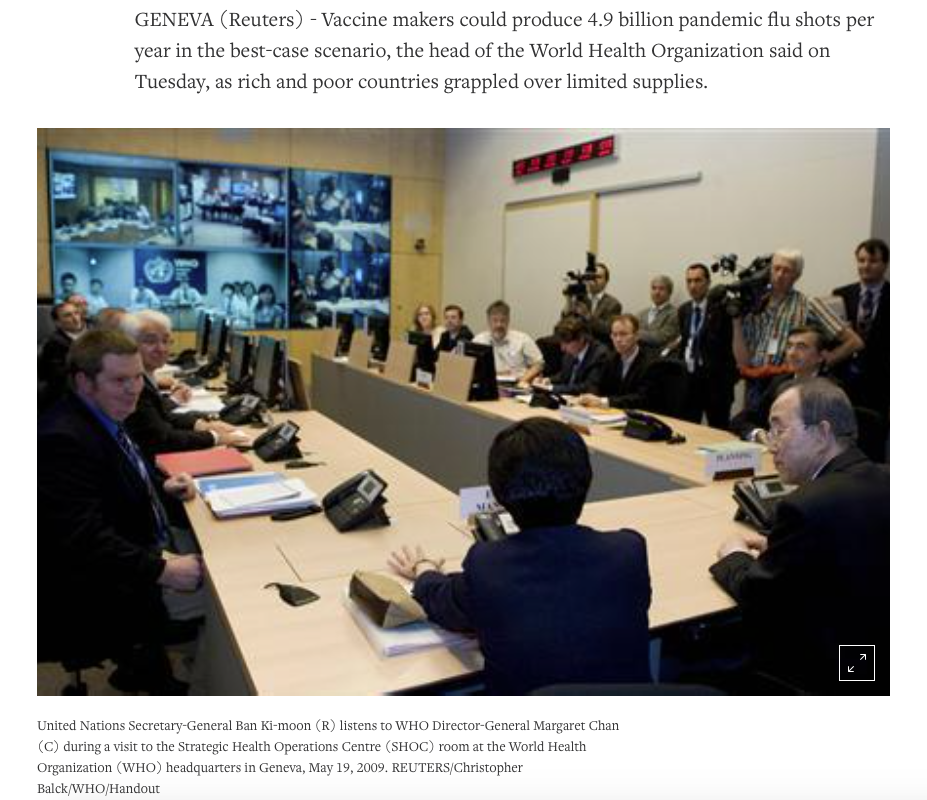
It was a multibillion bonanza for Big Pharma supported by the WHO’s Director-General Margaret Chan. 

In June 2009, Margaret Chan made the following statement:

“On the basis of … expert assessments of the evidence, the scientific criteria for an influenza pandemic have been met. I have therefore decided to raise the level of influenza pandemic alert from Phase 5 to Phase 6.  The world is now at the start of the 2009 influenza pandemic. … Margaret Chan, Director-General, World Health Organization (WHO), Press Briefing  11 June 2009)

What “expert assessments”?

In a subsequent statement she confirmed that:

“Vaccine makers could produce 4.9 billion pandemic flu shots per year in the best-case scenario”,Margaret Chan, Director-General, World Health Organization (WHO), quoted by Reuters, 21 July 2009)

A  financial windfall for Big Pharma Vaccine Producers including GlaxoSmithKline, Novartis, Merck & Co., Sanofi,  Pfizer. et al.


CORONAVIRUS TIMELINE 

September 2019: The official US-WHO position is that the coronavirus originated in Wuhan, Hubei Province and was first discovered in Late December. This statement is questioned by Chinese and Japanese virologists who claim that the virus originated in the US.

A renowned Taiwanese virologist pointed to evidence that the virus could have originated at an earlier stage, stating : “We must look to September of 2019”.

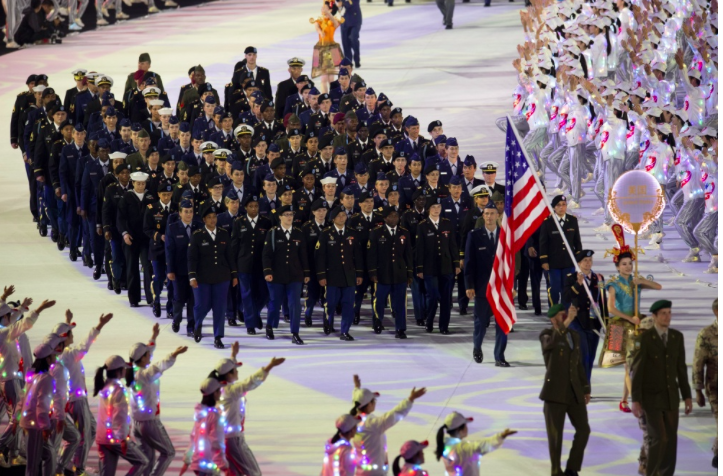
October 18-27 2019: Wuhan 2019: CISM Sport Military World Games

Chinese media intimates (without corroborating evidence) that the coronavirus could have been brought to China “from a foreign source” during the CISM Military World Games.

10,000 soldiers from 109 countries will participate

200 American military personnel participated in this 10 day Event.

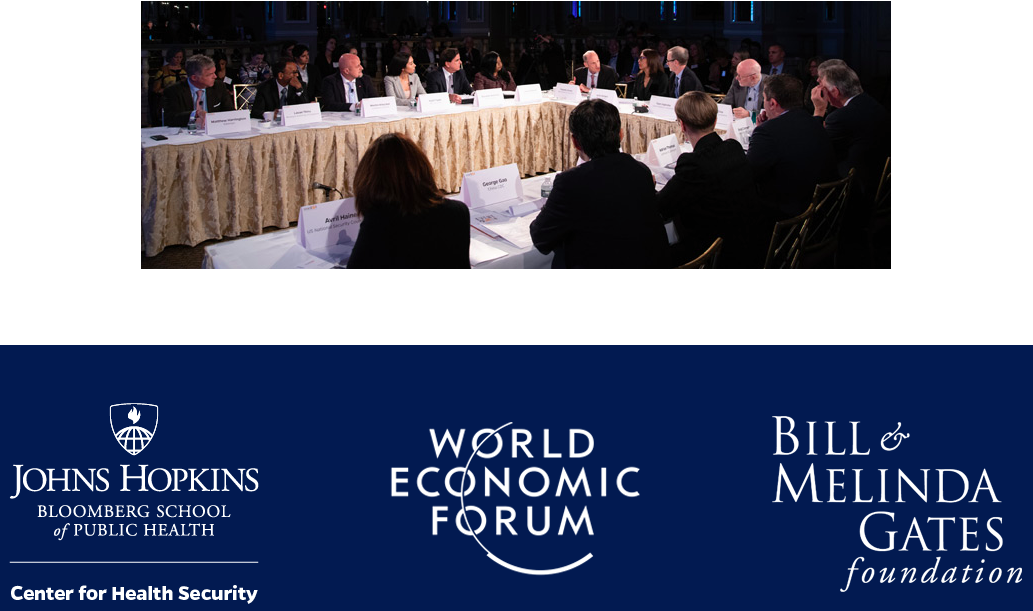
October 18, Event 201. New York. Coronavirus nCoV-2019 Simulation and Emergency Preparedness Task Force, John Hopkins Bloomberg School of Health Security. 

Big Pharma-Big Money Simulation Exercise sponsored by WEF and Gates Foundation 

Simulation Exercise of a coronavirus epidemic which results in 65 million dead. Supported by the World Economic Forum (WEF) representing the interests of Financial institutions, the Bill and Melinda Gates Foundation representing Big Pharma:

In October 2019, the Johns Hopkins Center for Health Security hosted a pandemic tabletop exercise called Event 201 with partners, the World Economic Forum and the Bill & Melinda Gates Foundation. …  For the scenario, we modeled a fictional coronavirus pandemic, but we explicitly stated that it was not a prediction.

Instead, the exercise served to highlight preparedness and response challenges that would likely arise in a very severe pandemic. We are not now predicting that the nCoV-2019 outbreak will kill 65 million people.

Although our tabletop exercise included a mock novel coronavirus, the inputs we used for modeling the potential impact of that fictional virus are not similar to nCoV-2019.“We are not now predicting that the nCoV-2019 [which was also used as the name of the simulation] outbreak will kill 65 million people.

.Although our tabletop exercise included a mock novel coronavirus, the inputs we used for modeling the potential impact of that fictional virus are not similar to nCoV-2019.

Several of the occurrences of the nCoV-2019 exercise coincided with what really happened. In the Event 201 Simulation of a Coronavirus Pandemic, a 15% collapse of financial markets had been “simulated”.

It was not “predicted” according to the organizers and sponsors of the event.

Private sector initiative. Participation of corporate execs, foundations, financial institutions, Banks, Big Pharma, CIA, CDC, China’s CDC. No health officials (with exception of CDC and China CDC) present on behalf of national governments or the WHO. The simulation exercise was held on the same day as the opening of the CISM World Militaty Sports Games in Wuhan.

December 31, 2019: First cases of pneumonia detected and reported in Wuhan, Hubei Province. China.

January 1, 2020: Chinese health authorities close the Huanan Seafood Wholesale Market after Western media reports that wild animals sold there may have been the source of the virus. This initial assessment was subsequently refuted by Chinese scientists.

January 7, 2020: Chinese authorities “identify a new type of virus” which was isolated  on 7 January. The coronavirus was named 2019-nCoV by the WHO exactly the same name as that adopted in the WEF-Gates-John Hopkins October 18, 2019 simulation exercise. 

January 11, 2020 – The Wuhan Municipal Health Commission announces the first death caused by the coronavirus.

January 22, 2020: WHO. Members of the WHO Emergency Committee “expressed divergent views on whether this event constitutes a PHEIC or not”.

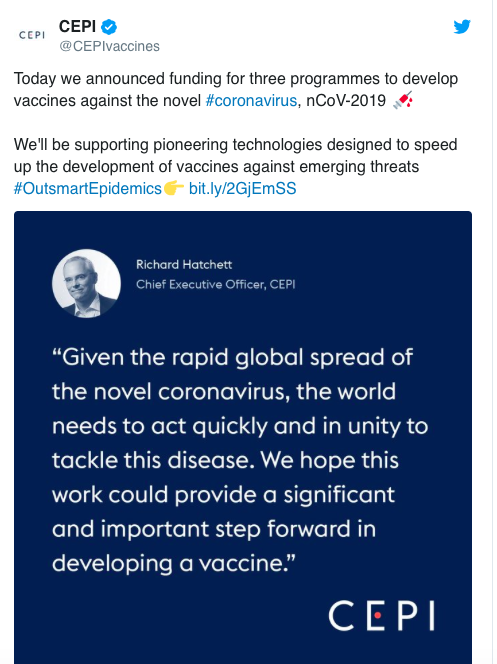
January 21-24, 2020: Consultations at the World Economic Forum, Davos, Switzerland under auspices of  the Coalition for Epidemic Preparedness Innovations (CEPI) for development of a vaccine program. CEPI is a WEF-Gates partnership. With support from CIPI, Seattle based Moderna will manufacture an mRNA vaccine against 2019-nCoV, “The Vaccine Research Center (VRC) of the National Institute of Allergy and Infectious Diseases (NIAID), part of NIH, collaborated with Moderna to design the vaccine.”

Note: The development of a 2019 nCoV vaccine was announced at Davos, 2 weeks after the January 7, 2020 announcement, and barely a  week prior to the official launching of the WHO’s Worldwide Public Health emergency on January 30.  The WEF-Gates-CEPI Vaccine Announcement precedes the WHO Public Health Emergency (PHEIC).

January  30, 2020Geneva: WHO Director General determines that the outbreak constitutes a Public Health Emergency of International Concern (PHEIC). This decision was taken on the basis of 150 confirmed cases outside China, First case of person to person transmission in US is reported, 6 cases in the US, 3 cases in Canada, 2 in the UK.

The WHO Director General had the backing of the Bill and Melinda Gates Foundation, Big Pharma and the World Economic Forum (WEF). There are indications that the decision for the WHO to declare a Global Emergency was taken on the sidelines of the World Economic Forum (WEF) in Davos (January 21-24) overlapping with the Geneva January 22 meeting of the Emergency Committee.

Both WHO’s Director Tedros as well as Bill Gates were present at Davos 2020. Bill Gates announced the Gates Foundation’s $10 billion commitment to vaccines over the next 10 years.

January 30, 2020 The Simulation Exercise Went Live. The same corporate interests and foundations which were involved in the October 18 John Hopkins Simulation Exercise became REAL ACTORS involved in providing their support to the implementation of the WHO Public Health emergency (PHEIC).

January 31, 2020 – One day later following the launch of WHO Global Emergency, The Trump administration announced that it will deny entry to foreign nationals “who have traveled in China in the last 14 days”. This immediately triggers a crisis in air transportation, China-US trade as well as the tourism industry, leading to substantial bankruptcies, not to mention unemployment.

Immediately triggers a campaign against ethnic Chinese throughout the Western World.

Early February: the acronym of the coronavirus was changed from nCoV- 2019 (its name under the October Event 201 John Hopkins Simulation Exercise before it was identified in early January 2020) to COVID-19.

February 28, 2020: A massive WHO vaccination campaign was announced by WHO Director General Dr. Tedros Adhanom Ghebreyesus  

Who was behind this campaign: GlaxoSmithKline in partnership with the Coalition for Epidemic Preparedness Innovations (CEPI). It is a Gates-WEF partnership, both of which were sponsors of the October 18, “Simulation Exercise”. The campaign to develop vaccines was initiated prior to decision of the WHO to launch a Global Public Health emergency. It was first announced at the WEF meeting at Davos (21-24 January).

Late February 2020. Collapse of the stock markets, surge in the value of the stocks of Big Pharma.

Early March devastating consequences for the tourist industry Worldwide.

February 24:  Moderna Inc supported by CIPI announced  that it experimental mRNA COVID-19 vaccine, known as mRNA-1273, was ready for human testing.

Late February 2020. Second wave of transmission of the virus (Worldwide) to a large number of countries.

Late February – Early March: China: More than 50% of the infected patients recover and are discharged from the hospitals. March 3, a total of 49,856 patients have recovered from COVID-19 and were discharged from hospitals in China.  What this means that the total number of  “confirmed infected cases” in China is 30,448. (Namely 80,304 minus 49856 = 30,448  (80 304 is the total number on confirmed cases in China (WHO data, March 3, 2020). These developments concerning “recovery” are not reported by the Western media.

March 5WHO Director General confirms that outside China there are 2055 cases reported in 33 countries. Around 80% of those cases continue to come from just three countries (South Korea, Iran, Italy).

These figures suggested that we are not facing a global health emergency, that the probability of infection was low. And Based on China’s experience  the treatment for the virus infection was effective.

March 7: USA: The number of “confirmed cases” (infected and recovered) in the United States in early March is of the order of 430, rising to about 6oo (March 8). Rapid rise in the course of March.

Compare that to the figures pertaining to the Influenza B Virus: The CDC estimates for 2019-2020 “at least 15 million virus flu illnesses… 140,000 hospitalizations and 8,200 deaths. (The Hill)

Early March:  IMF and World Bank To the Rescue 

The WHO Director General advises member countries that “the World Bank and the International Monetary Fund have both made funds available to stabilize health systems and mitigate the economic consequences of the epidemic”. That is the proposed neoliberal  “solution” to COVID-19. The World Bank has committed $12billion in so-called “aid” which will contribute to building up the external debt of developing countries.

March 7:  China: The Pandemic is Almost Over

Reported new cases in China fall to double digit99 cases recorded on March 7.  All of the new cases outside Hubei province are categorized as  “imported infections”(from foreign countries). The reliability of the data remains to be established:

99 newly confirmed cases including 74 in Hubei Province, … The new cases included 24 imported infections — 17 in Gansu Province, three in Beijing, three in Shanghai and one in Guangdong Province. 

March 10-11, 2020: Italy declares a lockdown, followed by several other countries of the EU.  Deployment of 30,000 US troops in the EU as part of the “Defend Europe 2020” war games directed against Russia.

March 11, 2020: the Director General of the WHO officially declares the COV-19 Pandemic. Bear in mind the global health emergency was declared on January 3oth without stating officially the existence of a pandemic outside Mainland China.

March 11:  Trump orders the suspension for 30 days of all transatlantic flights from countries of the European Union, with the exception of Britain. Coincides with the collapse of airline stocks and a new wave of financial instability. Devastating impacts on the tourist industry in Western Europe.

March 16: Moderna  mRNA-1273 is tested in several stages with 45 volunteers in Seattle, Washington State. The vaccine program started in early February:

“We don’t know whether this vaccine will induce an immune response, or whether it will be safe. That’s why we’re doing a trial,” Jackson stressed. “It’s not at the stage where it would be possible or prudent to give it to the general population.” (AP, March 16, 2020)

March 21, 2020: Secretary of State Mike Pompeo while addressing the American people from the White House stated that COVID-19 is a live military exercise.

This is not about retribution, … This matter is going forward — we are in a live exercise here to get this right.”

With a disgusted look on his face, President Trump replied: “You should have let us know.”

April 8, 2020: Mounting fear campaign led by Western media. Very rapid increase in so-called “confirmed cases”. “1,282,931 confirmed cases of COVID-19, including 72,776 deaths, reported to WHO” (April 8). Mounting doubts on the reported “confirmed cases” of COVID-19. Failures of the CDC’s categorization and statistical estimates.

March- April: Planet Lockdown. Devastating economic and social consequences. The economic and social impacts far exceed those attributed to the coronavirus. Cited below are selected examples of  a global process: 

  • Massive job losses and layoffs in the US, with more than 10 million workers filing claims for unemployment benefits.
  • In India,  a 21 days lockdown has triggered a wave of famine and despair affecting millions of homeless migrant workers all over the country. No lockdown for the homeless: “too poor to afford a meal”.  
  • The impoverishment in Latin America and sub-Saharan Africa is beyond description. For large sectors of the urban population, household income has literally been wiped out.
  • In Italy, the destabilization of the tourist industry has resulted in bankruptcies and rising unemployment. 
  • In many countries, citizens are the object of police violence. Five people involved in protests against the lockdown were killed by police in Kenya and South Africa.


The World Health Organization (WHO) a “criminal medical organization” for creating worldwide fear and chaos without providing objectively verifiable proof of a pandemic.

A high-profile European pathologist is reporting that he and his colleagues across Europe have not found any evidence of any deaths from the novel coronavirus on that continent.

Dr. Stoian Alexov called the World Health Organization (WHO) a “criminal medical organization” for creating worldwide fear and chaos without providing objectively verifiable proof of a pandemic.

Another stunning revelation from Bulgarian Pathology Association (BPA) president Dr. Alexov is that he believes it’s currently “impossible” to create a vaccine against the virus.

He also revealed that European pathologists haven’t identified any antibodies that are specific for SARS-CoV-2.

These stunning statements raise major questions, including about officials’ and scientists’ claims regarding the many vaccines they’re rushing into clinical trials around the world.

They also raise doubt about the veracity of claims of discovery of anti-novel-coronavirus antibodies (which are beginning to be used to treat patients).

Novel-coronavirus-specific antibodies are supposedly the basis for the expensive serology test kits being used in many countries (some of which have been found to be unacceptably inaccurate).

And they’re purportedly key to the immunity certificates coveted by Bill Gates that are about to go into widespread use — in the form of the COVI-PASS — in 15 countries including the UK, US, and Canada.

This presentation PROOVES WITHOUT DOUBT that America is in for a major fight that will put you and your family in the firing line, literally… So make sure you watch this presentation while it’s still online…

Dr. Alexov made his jaw-dropping observations in a video interview summarizing the consensus of participants in a May 8, 2020, European Society of Pathology (ESP) webinar on COVID-19.

The May 13 video interview of Dr. Alexov was conducted by Dr. Stoycho Katsarov, chair of the Center for Protection of Citizens’ Rights in Sofia and a former Bulgarian deputy minister of health. The video is on the BPA’s website, which also highlights some of Dr. Alexov’s main points.

We asked a native Bulgarian speaker with a science background to orally translate the video interview into English. We then transcribed her translation. The video is here and our English transcript is here.

Among the major bombshells Dr. Alexov dropped is that the leaders of the May 8 ESP webinar said no novel-coronavirus-specific antibodies have been found.

The body forms antibodies specific to pathogens it encounters. These specific antibodies are known as monoclonal antibodies and are a key tool in pathology. This is done via immunohistochemistry, which involves tagging antibodies with colours and then coating the biopsy- or autopsy-tissue slides with them. After giving the antibodies time to bind to the pathogens they’re specific for, the pathologists can look at the slides under a microscope and see the specific places where the coloured antibodies — and therefore the pathogens they’re bound to – are located.

Therefore, in the absence of monoclonal antibodies to the novel coronavirus, pathologists cannot verify whether SARS-CoV-2 is present in the body, or whether the diseases and deaths attributed to it indeed were caused by the virus rather than by something else.

It would be easy to dismiss Dr. Alexov as just another crank ‘conspiracy theorist.’ After all many people believe they’re everywhere these days, spreading dangerous misinformation about COVID-19 and other issues.

In addition, little of what Dr. Alexov alleges was the consensus from the May 8 webinar is in the publicly viewable parts of the proceedings.

But keep in mind that whistleblowers often stand alone because the vast majority of people are afraid to speak out publicly.

Also, Dr. Alexov has an unimpugnable record and reputation. He’s been a physician for 30 years. He’s president of the BPA, a member of the ESP’s Advisory Board and head of the histopathology department at the Oncology Hospital in the Bulgarian capital of Sofia.

On top of that, there’s other support for what Dr. Alexov is saying.

For example, the director of the Institute of Forensic Medicine at the University Medical Center Hamburg-Eppendorf in Germany said in media interviews that there’s a striking dearth of solid evidence for COVID-19’s lethality.

“COVID-19 is a fatal disease only in exceptional cases, but in most cases it is a predominantly harmless viral infection,” Dr. Klaus Püschel told a German paper in April. Adding in another interview:

In quite a few cases, we have also found that the current corona infection has nothing whatsoever to do with the fatal outcome because other causes of death are present, for example, a brain hemorrhage or a heart attack […] [COVID-19 is] not particularly dangerous viral disease […] All speculation about individual deaths that have not been expertly examined only fuel anxiety.”

Also, one of us (Rosemary) and another journalist, Amory Devereux, documented in a June 9 Off-Guardian article that the novel coronavirus has not fulfilled Koch’s postulates.

These postulates are scientific steps used to prove whether a virus exists and has a one-to-one relationship with a specific disease. We showed that to date no one has proven SARS-CoV-2 causes a discrete illness matching the characteristics of all the people who ostensibly died from COVID-19. Nor has the virus has been isolated, reproduced and then shown to cause this discrete illness.

In addition, in a June 27 Off-Guardian article two more journalists, Torsten Engelbrecht and Konstantin Demeter, added to the evidence that “the existence of SARS-CoV-2 RNA is based on faith, not fact.”

The pair also confirmed “there is no scientific proof that those RNA sequences [deemed to match that of the novel coronavirus] are the causative agent of what is called COVID-19.”

How much is it worth to you to literally have an unlimited water supply for your family? The Water Freedom System Will Completely Change Our World

Dr. Alexov stated in the May 13 interview that:

the main conclusion [of those of us who participated in the May 8 webinar] was that the autopsies that were conducted in Germany, Italy, Spain, France and Sweden do not show that the virus is deadly.”

He added that:

What all of the pathologists said is that there’s no one who has died from the coronavirus. I will repeat that: no one has died from the coronavirus.”

Dr. Alexov also observed there is no proof from autopsies that anyone deemed to have been infected with the novel coronavirus died only from an inflammatory reaction sparked by the virus (presenting as interstitial pneumonia) rather than from other potentially fatal diseases.

Another revelation of his is that:

“We need to see exactly how the law will deal with immunization and that vaccine that we’re all talking about, because I’m certain it’s [currently] not possible to create a vaccine against COVID. I’m not sure what exactly Bill Gates is doing with his laboratories – is it really a vaccine he’s producing, or something else?”

As pointed to above, the inability to identify monoclonal antibodies for the virus suggests there is no basis for the vaccines, serological testing and immunity certificates being rolled out around the globe at unprecedented speed and cost. In fact, there is no solid evidence the virus exists.

Dr. Alexov made still more important points. For example, he noted that, in contrast to the seasonal influenza, SARS-CoV-2 hasn’t been proven to kill youth:

[With the flu] we can find one virus which can cause a young person to die with no other illness present […] In other words, the coronavirus infection is an infection that does not lead to death. And the flu can lead to death.”

(There have been reports of severe maladies such as Kawasaki-like disease and stroke in young people who were deemed to have a novel-coronavirus infection. However, the majority of published papers on these cases are very short and include only one or only a small handful of patients. Moreover, commenters on the papers note it’s impossible to determine the role of the virus because the papers’ authors did not control sufficiently, if at all, for confounding factors. It’s most likely that children’s deaths attributed to COVID-19 in fact are from multiple organ failure resulting from the combination of the drug cocktail and ventilation that these children are subjected to.)

Dr. Alexov therefore asserted that:

the WHO is creating worldwide chaos, with no real facts behind what they’re saying.”

Among the myriad ways the WHO is creating that chaos is by prohibiting almost all autopsies of people deemed to have died from COVID-19. As a result, reported Dr. Alexov, by May 13 only three such autopsies had been conducted in Bulgaria.

Also, the WHO is dictating that everyone said to be infected with the novel coronavirus who subsequently dies must have their deaths attributed to COVID-19.

“That’s quite stressful for us, and for me in particular, because we have protocols and procedures which we need to use,” he told Dr. Katsarov. “…And another pathologist 100 years from now is going to say, ‘Hey, those pathologists didn’t know what they were doing [when they said the cause of death was COVID-19]!’ So we need to be really strict with our diagnoses, because they could be proven [or disproven], and they could be checked again later.”

He disclosed that pathologists in several countries in Europe, as well as in China, Australia and Canada are strongly resisting the pressure on them to attribute deaths to COVID-19 alone:

I’m really sad that we need to follow the [WHO’s] instructions without even thinking about them. But in Germany, France, Italy and England they’re starting to think that we shouldn’t follow the WHO so strictly, and [instead] when we’re writing the cause of death we should have some pathology [results to back that up] and we should follow the protocol. [That’s because] when we say something we need to be able to prove it.”

(He added that autopsies could have helped confirm or disprove the theory that many of the people deemed to have died of COVID-19 in Italy had previously received the H1N1 flu vaccine. Because, as he noted, the vaccine suppresses adults’ immune systems and therefore may have been a significant contributor to their deaths by making them much more susceptible to infection.)

Drs. Alexov and Katsarov agreed that yet another aspect of the WHO-caused chaos and its fatal consequences is many people are likely to die soon from diseases such as cancer because the lockdowns, combined with the emptying of hospitals (ostensibly to make room for COVID-19 patients), halted all but the most pressing procedures and treatments.

They also observed these diseases are being exacerbated by the fear and chaos surrounding COVID-19.

We know that stress significantly suppresses the immune system, so I can really claim 200% that all the chronic diseases will be more severe and more acute per se. Specifically in situ carcinoma – over 50% of these are going to become more invasive […] So I will say that this epidemic isn’t so much an epidemic of the virus, it’s an epidemic of giving people a lot of fear and stress.”

In addition, posited Dr. Alexov, as another direct and dire result of the pandemic panic many people are losing faith in physicians.

Because in my opinion the coronavirus isn’t that dangerous, and how are people going to have trust in me doing cancer pathology, much of which is related to viruses as well? But nobody is talking about that.”

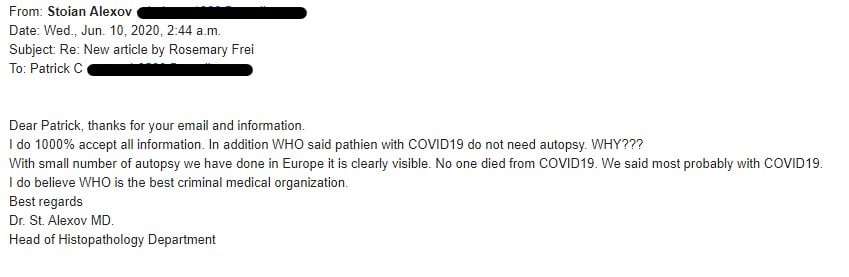
We emailed Dr. Alexov several questions, including asking why he believes it’s impossible to create a vaccine against COVID-19.

He didn’t answer the questions directly. Dr. Alexov instead responded:

We also emailed five of Dr. Alexov’s colleagues in the European Pathology Society asking them to confirm Dr. Alexov’s revelations. We followed up by telephone with two of them. None responded.

Why didn’t Dr. Alexov or his five colleagues answer our questions?

We doubt it’s due to lack of English proficiency.

It’s more likely because of the pressure on pathologists to follow the WHO’s directives and not speak out publicly. (And, on top of that, pathology departments depend on governments for their funding.)

Nonetheless, pathologists like Drs. Alexov and Püschel appear to be willing to step out and say that no one has died from a novel-coronavirus infection.

Perhaps that’s because pathologists’ records and reputations are based on hard physical evidence rather than on subjective interpretation of tests, signs and symptoms. And there is no hard physical evidence that COVID-19 is deadly.

If you’re interested in learning more old remedies, you should read The Lost Book Of Remedies.

Lost Book of Remedies pages

The physical book has 300 pages, with 3 colored pictures for every plant and for every medicine.It was written by Claude Davis, whose grandfather was one of the greatest healers in America. Claude took his grandfather’s lifelong plant journal, which he used to treat thousands of people, and adapted it into this book.

Lost Book of Remedies cover

Learn More…

“Russia is Paying the Taliban”: Afghan Bounty Scandal Comes at Suspiciously Important Time for US Military Industrial Complex

The latest scandal, like others before it, is based on scant testimony by anonymous officials and has had the effect of pushing liberal opinion on US foreign policy into a far more hawkish direction.

***

Based on anonymous intelligence sources, The New York TimesWashington Post, and Wall Street Journalreleased bombshell reports alleging that Russia is paying the Taliban bounties for every U.S. soldier they can kill. The story caused an uproar in the United States, dominating the news cycle and leading presumptive Democratic presidential candidate Joe Biden to accuse Trump of “dereliction of duty” and “continuing his embarrassing campaign of deference and debasing himself before Vladimir Putin.” “This is beyond the pale,” the former vice-president concluded.

However, there are a number of reasons to be suspicious of the new reports. Firstly, they appear all to be based entirely on the same intelligence officials who insisted on anonymity. The official could not provide any concrete evidence, nor establish that any Americans had actually died as a result, offering only vague assertions and admitting that the information came from “interrogated” (i.e. tortured) Afghan militants. All three reports stressed the uncertainty of the claims, with the only sources who went on record — the White House, the Kremlin, and the Taliban — all vociferously denying it all.

The national security state also has a history of using anonymous officials to plant stories that lead to war. In 2003, the country was awash with stories that Saddam Hussein possessed weapons of mass destruction, in 2011 anonymous officials warned of an impending genocide in Libya, while in 2018 officials accused Bashar al-Assad of attacking Douma with chemical weapons, setting the stage for a bombing campaign. All turned out to be untrue.

“After all we’ve been through, we’re supposed to give anonymous ‘intelligence officials’ in The New York Times the benefit of the doubt on something like this? I don’t think so,” Scott Horton, Editorial Director of Antiwar.com and author of “Fool’s Errand: Time to End the War in Afghanistan,” told MintPress News. “All three stories were written in language conceding they did not know if the story was true,” he said, “They are reporting the ‘fact’ that there was a rumor.”

Horton continued:

“There were claims in 2017 that Russia was arming and paying the Taliban, but then the generals admitted to Congress they had no evidence of either. In a humiliating debacle, also in 2017, CNN claimed a big scoop about Putin’s support for the Taliban when furnished with some photos of Taliban fighters with old Russian weapons. The military veteran journalists at Task and Purpose quickly debunked every claim in their piece.”

Others were equally skeptical of the new scandal.

“The bottom line for me is that after countless (Russiagate related) anonymous intelligence leaks, many of which were later proven false or never substantiated with real evidence, I can’t take this story seriously. The intelligence ‘community’ itself can’t agree on the credibility of this information, which is similar to the situation with a foundational Russiagate document, the January, 2017 intelligence ‘assessment,’” said Joanne Leon, host of the Around the Empire Podcast, a show which covers U.S. military actions abroad.

Suspicious timing

The timing of the leak also raised eyebrows. Peace negotiations between the U.S. and the Taliban are ongoing, with President Trump committing to pulling all American troops out of the country. A number of key anti-weapons of mass destruction treaties between the U.S. and Russia are currently expiring, and a scandal such as this one would scupper any chance at peace, escalating a potential arms race that would endanger the world but enrich weapons manufacturers. Special Presidential Envoy in the Department of the Treasury, Marshall Billingslea, recently announced that the United States is willing to spend Russia and China “into oblivion” in a new arms race, mimicking the strategy it used in the 1980s against the Soviet Union. As a result, even during the pandemic, business is booming for American weapons contractors.

“The national security state has done everything they can to keep the U.S. involved in that war,” remarked Horton, “If Trump had listened to his former Secretary of Defense James Mattis and National Security Advisor H.R. McMaster, we’d be on year three of an escalation with plans to begin talks with the Taliban next year. Instead Trump talked to them for the last year-and-a-half and has already signed a deal to have us out by the end of next May.”

“The same factions and profiteers who always oppose withdrawal of troops are enthusiastic about the ‘Bountygate’ story at a time when President Trump is trying to advance negotiations with the Taliban and when he desperately needs to deliver on 2016 campaign promises and improve his sinking electoral prospects,” said Leon.

If Russia is paying the Taliban to kill Americans they are not doing a very good job of it. From a high of 496 in 2010, U.S. losses in Afghanistan have slowed to a trickle, with only 22 total fatalities in 2019, casting further doubt on the scale of their supposed plan.

Ironically, the United States is accusing the Kremlin of precisely its own policy towards Russia in Syria. In 2016, former Acting Director of the C.I.A. Michael Morell appeared on the Charlie Rose show and said his job was to “make the Russians pay a price” for its involvement in the Middle East. When asked if he meant killing Russians by that, he replied, “Yes. Covertly. You don’t tell the world about it. You don’t stand up at the Pentagon and say, ‘We did this.’ But you make sure they know it in Moscow.”

Like RussiaGate, the new scandal has had the effect of pushing liberal opinion on foreign policy to become far more hawkish, with Biden now campaigning on being “tougher” on China and Russia than Trump would be. Considering that the Bulletin of Atomic Scientists recently set their famous Doomsday Clock — an estimation of how close they believe the world is to nuclear armageddon — to just 100 seconds to midnight, the latest it has ever been, the Democrats could be playing with fire. The organization specifically singled out U.S.-Russia conflict as threatening the continued existence of the planet. While time will tell if Russia did indeed offer bounties to kill American troops, the efficacy of the media leak is not in question.

Technocrats Will Thus Be Able To Build A Global Society And Control Its Every Facet, But In Order To Achieve These Lofty Goals, They Need To Re-Program Humans

“Well, boys, we’ve got this strange thing called THE INDIVIDUAL. Could somebody tell me what he is? He’s not conforming to our algorithms. He’s all over the place. And while we’re at it, what the hell is this IMAGINATION? It keeps slipping out of our grasp, it doesn’t fit the plan…”

PART ONE

Technocrats say they want to wipe out poverty, war, and inequality. But in order to achieve these lofty goals (or pretend to), they need to re-program humans

Technocracy is the basic agenda and plan for ruling global society from above, so we need to understand it from several angles.

Consider a group of enthusiastic forward-looking engineers in the early 20th century. They work for a company that has a contract to manufacture a locomotive.

This is a highly complex piece of equipment.

On one level, workers are required to make the components to spec. Then they must put them all together. These tasks are formidable.

On another level, various departments of the company must coordinate their efforts. This is also viewed as a technological job. Organizing is considered a technology.

This presentation PROOVES WITHOUT DOUBT that America is in for a major fight that will put you and your family in the firing line, literally… So make sure you watch this presentation while it’s still online…

When the locomotive is finished and delivered, and when it runs on its tracks and pulls a train, a great and inspiring victory is won.

And then…the engineers begin to think about the implications. Suppose the locomotive was society itself? Suppose society was the finished product? Couldn’t society be put together in a coordinated fashion? And couldn’t the “technology of organizing things” be utilized for the job?

Why bother with endlessly arguing and lying politicians? Why should they be in charge? Isn’t that an obvious losing proposition? Of course it is.

Engineers could lay out and build a future society that would benefit all people. Disease and poverty could be wiped out. Eliminating them would be part of the blueprint.

This “insight” hit engineers and technicians like a ton of bricks. Of course! All societies had been failures for the same reason: the wrong people were in charge.

Armed with this new understanding, engineers of every stripe began to see what was needed. A revolution in thinking about societal organization. Science was the new king. And science would rule.

Of course, for an engineered world to work, certain decisions would have to be made about the role of the individual. Every individual. You couldn’t have an air-tight plan if every human were free to pursue his own objectives. Too many variables. Too much confusion. Too much conflict. Well, that problem could be solved. The individual’s actions would be tailored to fit the coordinated operations of the planned society.

The individual would be “one of the components of the locomotive.” His life would be connected to other lives to produce an exemplary shape.

Yes, this could imply a few problems, but those problems could be worked out. They would have to be worked out, because the overriding goal was the forming of a world organization. What would you do if one bolt (an individual human) in one wheel of a locomotive was the wrong size? You would go back and correct the error. You would re-make the bolt.

Other people entered the game. High-echelon Globalists saw technocracy as a system they could use to control the population.

Essentially, an already-misguided vision of a future technocratic utopia was hijacked. Something bad was made much worse.

In a nutshell, this is the history of technocracy.

A locomotive is a society? No. That was the first fatally flawed idea. Everything that followed was increasingly bizarre.

Unfortunately, many people in our world believe in Globalism, if you could call a partial vague view a legitimate belief. They dreamily float on all the propaganda cover stories—greatest good for the greatest number of people; no more poverty; equality of sharing; reducing the carbon footprint; a green economy; “sustainable development”; international cooperation; allotting production and consumption of goods and services for the betterment of everyone; and all of this delivered from a central platform of altruistic guidance.

If you track down the specifics that sit under these cover stories, you discover a warped system of planning that expresses control over the global population.

The collective utopia turns out to be a sham.

Waking up is hard to do? Breaking up is hard to do? They must be done.

A workable technological fix is a very nice achievement when the project is a machine. But transferring that glow of victory to the whole of society is an illusion. Anything that calls itself education would tackle the illusion as the first order of business.

Engineering society requires engineering humans.

That is the fatal flaw.

It’s called mind control.

The Lost Ways is a far–reaching book with chapters ranging from simple things like making tasty bark-bread-like people did when there was no food-to building a traditional backyard smokehouse… and many, many, many more!

PART TWO

Any genuine artist, any builder of communities, any sane activist, any honorable visionary stands outside technocracy, and is not part of this program.

Instead, his thrust is toward more individual freedom and a more open society with greater decentralization of power.

Decentralization is the key.

The use of technology does not imply living inside its control. The use of technology does not imply that society should be laid out like a giant machine with fitted parts.

Those futurists who have offered “overall plans” for the disposition of society generally ignore or sidestep the issue of who is going to administer the plan. To say this is an error is a vast understatement.

Where is one far-reaching center of power in our world that would run society?

All such centers of power are, first and foremost, dedicated to their own survival. And after that, they are dedicated to control of the territory they believe they own. THE INDIVIDUAL is a messy thing that needs to be sidelined or dealt with as a disruptive element.

I speak to those people who understand that the idea of the free, independent, powerful, and creative individual is being sidelined, shelved, and sent down the memory hole. This is no accident. This isn’t just a devolutionary trend. Technocrats see this as a necessary action, in order to “clean up” their equation for the civilization they’re building. The individual is a slippery variable that throws a monkey wrench into formulas.

PART THREE

Imagination never dies.

It belongs to the individual. It isn’t property of the group.

It enables solutions that eradicate problems and get out ahead of problems before they raise their heads.

Time and time again, the individual, as he wends his way through life, encounters persons and organizations that consider imagination a negative. In the clearly defined shapes of society, imagination must take a back seat to planning.

Is the individual resistant to such manipulations, or does he give in?

This is the key question.

Does the individual view society as an operation that can potentially lift up individuals and empower them? Or does he give in to the idea that society should create more and more dependent people?

The individual can be a source of spreading freedom, or he can defend the notion that there are an endless number of “entitlements” that must be honored.

Technocracy promotes entitlements as a doorway into the future. Its ultimate entitlement goes this way: you have the right to be re-programmed to believe you have a slot in the future world; we will make this slot as attractive as possible; you will serve the overall good as we engineer it.

That is the fundamental justification for the Welfare State. It’s the justification for a future technocratic policy which will assign citizens energy quotas. A citizen would be permitted to consume a set amount of energy in a given time period. (So-called smart meters are a step in that direction. The meters enable more specific measurements of energy consumption.)

This is how technocracy views the future…your future.

The ultimate technocratic vision? Your brain is a processor, and your brain is your mind. That’s all your mind is. Therefore, connecting your brain to a super-computer, or to the Cloud, will magically expand your mind and make it “more than human.”

You will become trans-human. A hybrid of human and machine.

This is the fairy tale to end all fairy tales.

It’s wishful fantasy dressed up as science.

The idea is: you will become More. You will overcome the limits and problems associated with being an individual.

Every individual will receive the same information and the same answers and the same solutions from the Cloud. AUTOMATICALLY.

This is the programmer’s wet dream.

Technocrats will thus be able to build a global society and control its every facet.

That’s the revolution.

The counter-revolution is YOU.

The free individual.

Never forget it.

Even SWAT Teams are Helpless Against This – WATCH THIS VIDEO and you will find many interesting things!

SvMD-In-Article-New-Cover

America Is Ripe for Russian Interference This Election Season

Russians didn’t actually manipulate ballots in 2016, but that doesn’t mean it can’t happen in 2020

Among the seemingly infinite controversies since President Trump took office in 2016, perhaps none have persisted as singularly as the concern of Russian interference in our elections. In his new book, Rigged: America, Russia, and One Hundred Years of Covert Electoral Interference, reporter David Shimer assesses the history of election meddling between the two nations, from post–World War II to Vladimir Putin’s current shadow over U.S. elections.

While Russia didn’t manipulate actual ballots and voting systems in 2016, Shimer says pandemic conditions could make such interference possible this year. And there’s the continued threat of social media manipulation by the Moscow-backed Internet Research Agency, which has a history of playing on American racial tensions to divide voters.

GEN spoke with Shimer about Russia’s carefully orchestrated campaign of chaos and how current political flashpoints — especially the Black Lives Matter protests and the Covid-19 pandemic — may play a role in covert interference efforts come November.

GEN: What were the primary facets of Russia’s electoral interference campaign in 2016?

David Shimer: Russia did three things to manipulate America’s presidential election. First, Russian military intelligence covertly scanned, probed, and penetrated our electoral systems — inside our voter databases, inside our voting systems. All available evidence indicates they didn’t actually manipulate our systems. However, they were inside them, and that’s something the U.S. intelligence community was aware of at the time.

The second prong was the hack and release of the private correspondence, the emails, of John Podesta and the Democratic National Committee.

The third component was what is called an information warfare campaign across social media, where a Russian factory basically, with a monthly budget in the millions, had a bunch of Russian operatives sitting in a troll farm in Russia. The reach of those accounts ended up being over 100 million Americans.

While the Obama administration was intensely focused on the first facet going into the 2016 election, the Internet Research Agency’s information warfare campaign was largely unknown. What was the IRA’s objective, and why was its use of social media distinct?

What social media presented the IRA an opportunity to do was, you don’t have to work through actual people. You can just make fake accounts, and then suddenly you are an American. You had Russians in a factory in St. Petersburg in an organization that was run by a close ally of Vladimir Putin presenting themselves as Americans on a wide scale across Instagram, Facebook, Twitter, TikTok, LinkedIn, Reddit—all over the social media landscape.

The first objective the IRA pursued was to sow discord in America. What does that mean? We are going to spread content that scares people — things about vaccines, about pandemics, about the sanctity of our voting systems. We’re going to target specific racial and religious groups. One of the IRA’s main focuses was on targeting Black Americans in order to suppress the Black vote, because Black voters typically tend to align with Democrats. And the other objective of the IRA, the secondary objective, was to help Donald Trump and hurt Hillary Clinton. The IRA also spread divisive racist content toward different audiences to try to turn out voters perceived to be more likely to vote the way it would want. But it went beyond just voting one way or another to the point of dividing Americans.

“What is happening today in America, Russia is probably pleased about.”

If a primary focus of the IRA was to suppress the Black vote and exacerbate racial tension, is the recent nationwide movement following George Floyd’s death something Russia is happy about?

What’s happening today is obviously not caused by Russia. It’s caused by systemic issues and failures in the United States over time. But it suits Russia’s interest, because the objective of Russian foreign policy is to degrade American democracy and to portray American democracy as a dysfunctional system to the rest of the world.

I spent about half a day with Oleg Kalugin, who was a KGB general, and he said to me just exactly that: “We spent all of the Cold War trying to show the world that America’s actually just a hotbed of racism or a hotbed of hatred in order to show that it’s not something to desire, that America should not be a leader in the international system, and that its democracy is just a dysfunctional mess.” What is happening today in America, Russia is probably pleased about.

In that sense, ironically, while many view these protests as a positive paradigm shift in American society, in Russia’s eyes it actually aligns with the country’s interest in making the United States seem weak and divided.

What Russia wouldn’t be pleased about is if we implemented effective policy reforms to make progress on these issues. Because if we do, if our democracy is functioning well, then Russia doesn’t have its propaganda, and if our democracy is functioning well, then it’s [easier] for us to lead abroad rather than get captivated by our own inequities at home. So it’s ironic in that we can do two things at once, which is we can vet our own democracy, and we can make progress in our competition with Russia.

So, in a sense, Russia is pleased with this national reckoning only to the extent that it doesn’t produce meaningful change. How would Russia then be responding to the moment to theoretically prevent that?

It’s hard to say for sure what they’re doing. The best indicator — that’s the whole point of my book — is the past. One example is a former employee at the IRA [who] said, “When there were Black people rioting about abuses in the United States, we would spread propaganda saying that policy toward Black Americans had failed and that America was just a racist mess.” So, it’s that kind of idea, which is spreading the propaganda around fissures, around divisions, around failures that already exist. That’s something Russia did in 2015 and 2016; that’s something Russia can be doing now.

But Russia could also go bigger than that, hypothetically. There’s a story that comes to mind — I talked to one of the KGB officers who helped orchestrate this. In 1960, there was a letter that arrived in the mailboxes of the UN delegates from a bunch of African and Asian countries that was signed by the Ku Klux Klan. This letter to these delegates said all these awful, racist things. It caused an international outrage, showing the world how Americans perceive all these people of these different counties. A delegate from Nigeria actually read the contents of the letter out loud in the UN General Assembly, saying that this is a letter we received from the KKK. But the truth was that that letter was actually a forgery. It was produced by the KGB in order to create just that kind of controversy — to showcase to the world that America is, in the words of one of the people who executed that operation, just a hotbed of hate.

How does the coronavirus play into this? How is Russia weaponizing the pandemic?

My concern about the pandemic is slightly different. Yes, I’m concerned about propaganda being spread around Covid-19 and around pandemic diseases.

But the thing that I am much more mindful of is that, in 2016, the leading if not exclusive concern of President Obama and his inner circle was that Russia was going to cause chaos on Election Day, was going to sabotage our voting systems. If we get to Election Day and there’s no actual plan for voting nationally — if you already have chaos at polling places, hours-long lines, people unsure how to cast their ballots safely without jeopardizing their health, uncertainty across the nation about whether this vote is actually legitimate — you have a real problem. Especially when the sitting president is saying that the vote’s going to be rigged.

How legitimate is the threat of Russia’s tampering in the voting process itself?

It’s extraordinarily legitimate. And the legitimacy of it is reflected in the actions that our governing officials took the last time around. What were President Obama, folks like John Brennan, Jim Clapper, Susan Rice doing in the fall of 2016? They were desperately seeking to stop Russia from taking advantage of its access into our election infrastructure and manipulating the tally and the voter data of the American people. On Election Day, there were crisis teams in the White House, in the Department of Homeland Security, bracing for that sort of attack.

Since then, we haven’t had a national response to the exposure of our voting systems in a mandated way. The way our election infrastructure works is that each state controls its voting system and controls its voting registration databases. So, the Department of Homeland Security can offer Georgia help with securing its voter databases, but Georgia could say to the Department of Homeland Security, “We’re not interested. Leave us alone.”

If, as I wish he would and hope he would, President Trump were to say, “If you interfere in our elections, you’ll pay a steep price,” Russia might actually reconsider how it was going to proceed.

If Trump has taken no action — and, in fact, has only invited interference in the past — where does that put the security of our electoral systems in 2020? Is anything being done?

I think the DHS is trying to make progress behind the scenes. Again, it can implement a nationwide response. Congress should pass mandatory cybersecurity requirements. Not to say to states that you need to hold your elections this or that way, but rather to just say, “You can’t have unencrypted voter databases that are easily accessible and manipulatable.” To do that sort of thing, that’s not on President Trump—that’s on Congress. They haven’t done that.

Many Americans still consider the notion of Russian interference in our elections as a partisan myth. How would you respond to them?

In 1960 and 1968, the Soviet Union interfered in our elections to try to destroy the candidacy of Richard Nixon, a Republican. In 1976, the Soviet Union again interfered in our election to destroy the candidacy of Ronald Reagan, a Republican. They did the same thing in 1984, trying to take down Ronald Reagan. In 2015, there’s evidence of Russian social media accounts spreading content that’s hostile to folks like Ted Cruz or Lindsey Graham. So, it’s not partisan. What the Soviet Union did, what Russia is now doing, is helping candidates who align with its interests and trying to sow discord and destabilize our democracy as an end to itself.