What Happens One Second After an EMP Attack: No Power, No Food, No Transportation, No Banking and No Internet, and According to Congressional Reporting, Upward of 90% of the Population Will Be Dead

William R. Forstchen is a literary hero of mine going back to grade school. The prolific author and historian has written some of the finest speculative fiction of our time, and in recent years, he has achieved superstardom with the novel ONE SECOND AFTER. It is the story of how a father of two and his small, North Carolina community respond to an electromagnetic pulse (EMP) attack on the United States.

His book has become a touchstone work in the “SHTF” (s— hits the fan) genre, and triggered a national conversation that remains ongoing. An EMP strike would involve a hostile power detonating one or more nuclear weapons over the U.S. at high altitudes. As Congressional testimony described, the explosion would interact with the ionosphere (the electrically conducting layer of the atmosphere) and the Earth’s magnetic field. The resultant surge in electromagnetic currents would essentially fry electronics from coast to coast, cripple the power grid, and cause cascading failures in American infrastructure. The United States is woefully unprepared for such an attack.

Next month, FIVE YEARS AFTER, the fourth book in Forstchen’s exploration of a post-EMP America, hits store shelves. We spoke recently about how an EMP attack would work, what its consequences would be, and how best to prepare for what happens one second after. This interview has been lightly edited for length and clarity.

Where is the EMP threat most likely to come from?

North Korea, followed by Iran. Long ago for nuclear weapons, there was a concept called ‘mutual assured destruction.’ If we launched at the Russians, the Russians would launch at us. Everybody would get blown up and so nobody would win.

But for an EMP, the use of a nuclear weapon is a game changer. It’s known as an ‘asymmetrical first strike.’ All you need is one, two, three small warheads, loft them up over the United States, pop them, and you’ve blinded your enemy. You’ve shut down the power grid. It’s a catastrophic situation.

If that happened, we could find ourselves in a scenario where we don’t even know who the hell launched it. It would be as easy as them using a container ship off the coast of Florida. Launch the weapon, blow the ship up, and where are the fingerprints? Who did it? So this is a very different type of warfare.

What would it take to wipe to fundamentally cripple the United States of America? And how precise do you have to be in detonating these things?

Good question. Really good question. When North Korea launched its first attempts at intercontinental ballistic missiles, I started asking some questions. And people, including from the White House, responded that North Korea doesn’t have EMP capability because ICBMs require a successful launch—it’s got to get up there—and then the warhead has to have a precise guidance system to bring it to its target. Seattle, for instance. It needs a precision reentry for a precision strike.

But you don’t need that with an EMP. All you have to do is launch the weapon up there and get it over the western United States—doesn’t matter at that point if it’s over Seattle, San Francisco, whatever. You don’t need any precision guidance. Therefore they already have the capability.

The ideal scenario is three of them. One in the western United States, one somewhere over the middle—it doesn’t matter if it’s over in Nebraska or Iowa, just pop it—and then one over the eastern United States, say, over Pennsylvania. Pop it. You don’t need precision guidance to do this. It’s like horseshoes: As long as you’re in the general area, you’re going to get some kind of points.

What’s terrifying—and you’ve written great literature on the subject—is what happens next. The real enemy becomes human nature.

Yes, exactly. For a lot of people, you go to the sink and fill a glass of water, and it’s almost miraculous. You turn a faucet and water comes out. If you shut down the electricity, though, you are going to lose your water supply—and that’s true for every major city in the country, because it requires pumping and filtration. What happens to the general populace, within two days, if there is no water? People will be willing to kill to put a bottle of water into their kid’s hand.

Society just starts to break down. The food supply? Twenty days you’re out of food. Medication? The pharmacies are closed. We turn on each other to try and survive, and according to Congressional reporting, upward of 90% of the population will be dead a year later. 

One of the strengths the United States has historically enjoyed is geography: we’re just so spread out. How does that play into any sort of post-EMP scenario?

You know, people have this fantasy that if we get hit by an EMP, four or five days into it, you could decide to get the hell out of the city and head to the country. Why? Because there’s a fantasy that out in the country you’ll find food and you’ll find water. Well, even in Nebraska, what do you think they’re dependent upon to bring in the harvest? To plant the seeds? To do all of it? Electricity. But without electricity, all bets are off whether you are in Montana or you are in New York City—it’s all the same.

Does an EMP attack have to be 100% successful to be fundamentally destabilizing? How would we even know we have been hit?

You have to detonate the weapon in the upper atmosphere, the rarefied atmosphere, 200 miles up. The nuclear detonation sets up an electrostatic discharge that then cascades down to the Earth’s surface and blows us out. But it’s not a lightning bolt. You won’t see it, except maybe if you were looking at the point of detonation. Then you’d see a flash, but it wouldn’t even bother your eyesight. You don’t need precision: just put it two hundred miles up, pop it, and it’s a game changer. It’s over.

Tell me about defense policy with respect to retaliation for this sort of thing.

At the end of my book ONE SECOND AFTER, some military people finally come into the town a year later, and one of them says, ‘Oh, yeah, it was the North Koreans who did this to us and we flattened them—we turned their whole country into glass.’ And my main character says, ‘So? What difference does that make now?’

So if this really happened and we retaliated? It would make no difference to any of us because we’d have already lost the war, literally in one second. What we do afterward, it doesn’t matter to you and to me.

So what is Congress doing about this?

I started thinking and writing about the EMP question about 20 years ago, and I based a lot of my book, initially, on Congressional testimony. A number of experts were going up there, all saying the same thing: We’ve got to harden the grid, or we’re waiting to get our butts kicked. There was an attempt at legislative action, but it was killed in committee, particularly thanks to Lisa Murkowski from Alaska, because the bill didn’t have the perks she wanted.

We’ve had at least two or three major efforts to put a bill through. A very strong leader on the issue was Congressman Roscoe Bartlett from Maryland. He was the only person with a PhD in the hard sciences in Congress, and rather than listen to him, they gerrymandered his district to eliminate him. So for 20 years, it’s been gridlocked, and every legislative action has failed.

Now, what are we going to tell those people the day after? Gee, thanks? I had someone say to me more than once that the elite will take care of their own, but the rest of us slobs, we’re doomed. it’s kind of frightening, isn’t it?

So what do you recommend to people who read your book, or who attend your lectures, about what they should be doing in their own lives to prepare for something like this?

To the person who hasn’t done anything: What’s preventing you from getting a month’s worth of supplies in your home? You can do it even if you’re just in a little apartment. Take some two-liter bottles of soda, and when you’re done, clean them out, fill them up with water, and stick them in a closet. You should have at least a couple of gallons of water per day per person in your household.

Next time you go to the market, you don’t need to buy the fancy twenty-five-year shelf life stuff. Just simply pick up Campbell’s Soup and such. That stuff’s good for three or four years. Buy them on sale. Spend fifty bucks a month more than usual to get food, get water.

The third thing I’d say, if you are on medication, don’t wait until the day before the medication comes due to get a refill. If possible, try to keep a three month supply on hand. Next: security. I do not advise people one way or the other regarding guns, but if you decide to do that, I beg you to get trained—and not by your neighbor. Get trained by a professional. I’ve seen too many cases of people getting hurt or killed because of stupidity with guns.

Transportation-wise, you should have a G.O.D. bag in your car: Get Out of Dodge. Just take a backpack, fill it up with two liters of water, a couple of days’ worth of food, one of those space blankets, and keep it in your car. And put some silver in there—actual real silver coins. Because the day after something happens, you could be waving hundred dollar bills and nobody would care. But if you pull out a silver coin, you might be able to trade enough to get what you need. So very basic things like that. They can make a big difference.

There’s this assumption among the public, I think, that if something goes wrong, someone else—likely the government—will take care of everything. But we’ve never encountered a situation where the mechanisms necessary to take care of everything also stop working. Your car stops in the street, and the tow truck that can move it is also stopped. Suddenly, that’s one move too many in a chess game for people to think ahead.

It’s called the expectation of normality. The way things are at this very moment is “normal,” and we expect it will be that way tomorrow and the day after. That’s true for all of us. But if the rug gets pulled out from under us, then what? Suppose on September 10, 2001, a bunch of people started pointing at the sky saying, you know, you could take a couple of jets and turn them into giant cruise missiles. The reaction would be “Oh, you’re crazy. That will never happen.” And then the next day it did.

I keep telling people not to expect normalcy forever. Sooner or later something will happen.

If there’s one consistent, recurring motif in the story of human existence, it is that “something” happens constantly.

Our civilization is temporary. All civilizations are. If you went to the streets of Rome in 150 AD and said, “Guys, it ain’t always gonna be this way. Someday it’s gonna change,” no one would believe you. American civilization, we’ve had 250 years, and we’re doing pretty good. But don’t expect it to run for another 250 years. Something will replace it. Maybe for the better, possibly for the worse. You can’t live on the expectation of normality forever. Every civilization rises, reaches a peak, and collapses. Who’s to say we’re different? We’re not.
No One Is Coming To Save You: You’re on Your Own When it Comes to Civil Defense-Government Will Not Do Anything to Protect You as That is Counterproductive to Their ‘Strategy’

Sometime between the First World War and the start of the Second World War the concept of civil defense or civil protection was born. The original purpose was to protect civilians from aerial bombing. After World War Two, the United States dismantled its civil defense corps. With the US the sole possessor of atomic weapons, there was no perceived need to spend money on civil defense. That perception did not last long due to the Soviet Union testing their first nuclear weapon in 1949. President Truman re-established civil defense with the goal of protecting the civilian population against a nuclear attack.

Over the next 29 years there would be several renditions of civil defense until the Federal Emergency Management Agency (FEMA) was formed. President Carter empowered FEMA to prepare for disasters and to continue civil defense efforts. In 1994, with the repeal of the Civil Defense Act of 1950, FEMA suspended preparations for nuclear attack. Without the federal mandates and grant requirements many states started to follow suit. Following the terror attacks of 2001 and the advent of the Department of Homeland Security (DHS), FEMA started to plan for a nuclear terrorist attack. The problem with the current DHS/FEMA nuclear terrorist attack planning is that DHS/FEMA assumes that only one city will be attacked. Other assumptions include a relatively low-yield weapon and that the unaffected surrounding areas can assist with the response. The current DHS/FEMA guidance is totally insufficient to address the needs from multiple nuclear weapons detonating across the nation.

With the current situation in Eastern Europe it is extremely important to understand both the past civil defense capabilities and the current non-existent civil defense capabilities of the United States but we also need to understand the civil defense capabilities of the former Soviet Union and those of Russia today.

It is important to understand past civil defense capabilities so that as the war in Eastern Europe widens, we can understand why our elected officials will do nothing to protect our nation. We also need to understand that the Russians will take steps to protect their population.

To start with, we a;; probably have heard of the concept of Mutually Assured Destruction (MAD). The basic premise of MAD was that if two adversaries started to launch nuclear weapons at each other, both sides would suffer massive damage to both its population and its economy, thus fighting the war doesn’t gain either nation anything. The United States adopted this theory, however the Soviet Union did not. There were great debates about whether or not the United States should pursue an extensive civil defense program. This brings up the concept that a nation’s Civil Defense capabilities can play into the nation’s strategic capabilities just like nuclear weapons. To be clear, when a nation chooses to have, or not to have, a robust national civil defense program it isn’t necessarily about protecting people but rather “the system”. The United States believed that if it took prudent civil defense steps then that would somehow diminish our nation’s vulnerability, hence we would not be subscribing to MAD because we, in fact, have not assured our destruction. More on this later.

MUST WATCH! THE HUNGER GAME HAS BEGUN: THE ELITE HAVE BEGUN THEIR FULL SCALE EXECUTION AND DECIMATION OF THE MIDDLE CLASS! FAMINE OF GODS WORD IN AMERICAS PULPITS ,WILL LEAD TO LITERAL FAMINE AND STARVATION IN THE U.S.A

The Soviets on the other hand had a much more robust civil defense program. The Soviets spent about ten times as much money on their civil defense than the US. Why? Simply because the Soviets never subscribed or followed the concept of vulnerability, in other words, the Soviets never believed in the MAD theory. While the US decided to be weak, so as to say look if we exchange nuclear weapons we looe so we really don’t want to play that game, the Soviet Union actively planned not only to fight a nuclear war but took steps to “win” it. This is extremely important to understand. Those in the upper echelons of the current Russian government are products of the Cold War and Cold War strategies and tactics run through their sins and brains.

At this point in time, the US still holds dear its strategy of being vulnerable. We have heard Biden state that Putin isn’t bluffing about using nuclear weapons and that we are facing Armageddon, so why is thee no big push to dust off old civil defense plans and not just by the executive branch or the democrats but the GOP is silent on the issue of civil defense? So the US government is still subscribing to the “let’s be vulnerable” theory within MAD while the Russians are planning to win. Basically, the two nations are planning for and practicing two different “games”, and when they meet for “game day” it won’t be good for us.

Since people are creatures of habit we can assume that both Russian and US leaders will fall back to the concepts of the Cold War as tensions escalate to the nuclear level. Back in the Cold War era the anti-civil defense crowd actually argued that no American president would contemplate America’s civil defense capabilities when making a decision to launch nuclear weapons. This is not only wrong, nut we can actually prove that it is wrong! During the Cuban Missile Crisis President Kennedy specifically asked about our civil defense status and how those capabilities would have us fair if Soviet missiles hit the US. Going back to the concept of Civil Defense, as a strategic capability, we can see that when the closest thing we have had to a nuclear war played out, civil defense was in the equation. And just so you know, the answer President Kennedy received wasn’t a good one. While the Soviet Union prepared blast shelters for their nation the US focused on “fallout” shelters. The fallout shelter system was specifically designed to protect people from radiation not the other blast effects from a nuclear weapon such as the fireball and shockwave.

With the Soviets not following the vulnerability concept of MAD, the US government believed that about 90% of the Soviet Union’s population would survive an attack by the US with nuclear weapons, compared to about 20% for the US. At least that was the US number up until the US government started what is known as “Crisis Relocation” in the 1980s. With crisis relocation, that is, evacuating urban areas to rural areas, the US government believed it could increase the survival of the population to around 80%. The only problem with the concept of crisis relocation for nuclear attack is that the plans assumed we would have one-week advance warning before the missiles started to fly, from what I understand, at the time, Soviet nuclear missiles were liquid-fueled and the missiles were not kept fueled due to corrosions issues with the fuel and it would take about a week to fuel them for an attack.

So how does this all relate to the current situation?

Understand that Russia’s new 5th-generation warfare strategy has an “escalate to de-escalate” component. That is Russia plans to “escalate” tensions with the threat of nuclear attack in order to have the other side come running to the negotiating table. This escalation could be achieved by mere threat however the US/NATO are not buying into the threat which means that the risk for Russia to have to resort to some type of actual use of nuclear weapons increases. The thing about nuclear arsenals is sort of like in the movies when one person shoots, everyone lets loose.

Russia still believes it can win a nuclear war. The old communist lead anti-nuclear weapons crowd liked to say that nuclear war was “unthinkable”, but we should think about nuclear war critically, considering the destructive power and the number of nuclear weapons on the planet and we also better be prepared for when they are launched. Since the US has no real civil defense capability, it is conceivable that the US could be placed in a very bad geopolitical bargaining situation since our population is so vulnerable and the Russian population is not.

Both Russia and the US will revert back to the Cold War strategies when they face the next “Cuban Missile Crisis” arising out of the Ukraine war. Russia will perceive that it can win a nuclear war while the US will perceive that Russia will not launch since they too will loss a lot of people and economic capability. Keep this in mind, the Soviets were expected to lose 20 million people in a US retaliatory nuclear strike, that is 10 million fewer people than they lost in all of World War Two. Sounds like a win to me.

If the situation gets bad enough you will see an evacuation out of the cities. Polls conducted in the late 1970s indicated that there would be two distinct evacuation waves. First would be the spontaneous evacuees who leave the cities without there being an official evacuation order. The second wave will be those leaving when the official order is given. According to the polling data, many of the spontaneous evacuees in the first wave would be going to “friends and relatives” in the country. What isn’t identified in the polling data is whether or not those relatives and friends in the county know those people are coming their way. Crisis relocation when implemented will have profound effects on those living in rural areas. One other thing to keep in mind about crisis relocation is that there was a debate that as soon as one nation saw the other nation evacuating their cities an attack would be launched. There was no indication that either the Soviets (Russians) or the US targeted the evacuation “reception” area with nuclear weapons, however Russian nukes are somewhat larger in there megatons of TNT power. I suspect that this was done due to the Soviet missiles not being as accurate as the US missiles.

This presentation PROOVES WITHOUT DOUBT that America is in for a major fight that will put you and your family in the firing line, literally… So make sure you watch this presentation while it’s still online…

The reason why you should pay attention now is that is because these techniques don’t come from books, they’re taken from actual 21st century warzones, from lawless states where social chaos is the name of the game… … and where not having enough time or money to prepare doesn’t stop real-world preppers from creating virtually impenetrable defenses for their families.

With today’s hypersonic missiles the concept of crisis relocation may or may not be moot. I suspect there may be a few people who still self-evacuate out of the cities before a warning. I would, however, suspect that if one side did order an official evacuation of cities that then that would trigger an immediate attack. If you even hear discussion of crisis relocation or evacuation you should take this as warning that the crisis is spiraling closer to missile launch.

Stop believing that survival isn’t possible, that is if you don’t live in a large city or military target. Location is one of the best factors helping to ensure your survival in a nuclear exchange.

There is a belief, or hope, that nuclear weapons will not be used. Just remember that “hope” is not a plan. Government will not do anything to protect you as that is counterproductive to their “strategy”. That means You’re on Your Own (YOYO) when it comes to civil defense.

Take steps to plan for and implement a fallout shelter in your home now. There are still a number of good sources of information on this on the internet today. Start looking for in now and reading it. Second, locate and acquire any needed equipment and supplies you may need. I have a gun range on the property with a large backstop that is filled with sand. We will use the loader on the tractor to scoop out the sand and bring it closer to the house where we will then fill feed sacks up with the sand and place them inside the house on the floor above where we will be sheltering. We have on hand, wood and jack post to beef up the support of the floor joist due to the added weight of the sand. We will also put dirt up against the foundation for added protection. In the basement we will construct an area where we can sit and lay that will have additional dense materials (things like ammo cans) on top for additional shielding. Planning and preparing for the protection against fallout now will give you and your family an immense leg up when the time comes to act.

We can anticipate that at some point Russia will give the West an ultimatum. Russia has already told the West to stop interfering or else. The ultimatum that we should be looking for is one with a specific date and time. Of course the West will not comply with the ultimatum and this will probably mean the end of Putin’s power or Putin will push the button.

Never underestimate the power of stupid people. There are people on both sides who train regularly to launch or drop nuclear weapons at a moment’s notice. They go through quick reaction drills so that the motions become second nature, so that when the order is given these people resort to just going through the motions like they have hundreds of times before, verses thinking about the ramification of what they are about to do.

The old Cold War analysis predicted that most Americans would need to shelter from radiation for a two-week period. That means literally staying in a very confined area for sleeping, food prep, going to the bathroom and everything else. I’m sure with our current generation’s addiction to electronic devices the mere withdrawal from these games due to the combination of the effects of EMP, no power and no Internet connectivity will be just as challenging as trying to live in cramped quarters for two weeks. Statistically speaking, I have lived over half my life. What this means is I can afford to absorb a little more radiation than my kids who are in their teens still. This won’t mean anything the first week since radiation level will be so high that it could cause radiation sickness even with only a few minutes of exposure. The second week, depending upon actual radiation reading, I could probably do a quick task like taking out garbage or human waste. Perhaps I would even go out to the barn and throw a few bales of hay out for any surviving animals. The most likely farm animal to survive will be chickens, since they can withstand an impressive amount of radiation.

Fortunately, we have metering for measuring radiation. I have sat my daughter down and taught her how to use them. I have taken background radiation readings in areas where we are going to shelter. It is good to know what your normal level of radiation is. The background levels of radiation were written down for several areas. One where we are going to actually shelter, then a reading at the door to the room that has the door to the outside and the third reading was at the door itself. The readings were annotated and then laminated and attached to the handles of various meters.

Nuclear war is survivable but you need to take action to be prepared. If you live in a location that isn’t a target but will probably be affected by radioactive fallout it would be a shame to die slowly from radiation poisoning that could have been avoided with some very simple preparedness.

Regardless of what does or doesn’t happen with the current war in Europe, the notion that we will not be confronted with another geopolitical crisis where the chances of a nuclear war increase is very naive. At some point we will be in the same situation with China. Perhaps that will be sooner than anyone realizes. Prepare now.

In this short VIDEO, I will unearth A lost super-food will bulletproof you against any food shortage or famine. It’s a food that vanished with the Incas over 6 centuries ago

In the next crisis these lost skills will be more valuable than gold, food supplies and survival equipment combined. These skills have been tested and proven to work for centuries.

Here’s just a small glimpse of what you’ll find in The Lost SuperFoods:

Learn More…

Prepare for a Nuclear Blast: EDC Gear for the Nuclear Threat

For a generation and a half, young people have lived their lives free from the specter of nuclear attack. People were not compelled to contemplate the horrors of nuclear war and how they would survive a nuclear blast or fallout, what food would be safe to eat or drink, or whether the air would be safe to breathe.

Unfortunately, the U.S.A. has scant preparations to protect its citizens from nuclear attack. While politicians have gone to great lengths to ensure the continuity of government, there are no fallout shelters for common citizens, only advice and plans to build your own.

You could build and stock a fallout shelter and there are ways to inexpensively improve the protection factor any building already provides, but the average American spends over a third of their workday away from home. What could you possibly carry with you during your day that would improve your chances of survival if a nuclear weapon is detonated on U.S. soil?

How Would You Know a Nuclear Attack Has Occurred Elsewhere or is Imminent?

Who attacks the U.S., what their objective is, what nuclear weapon systems they have at their disposal, how many they use, and how they deliver them, would all affect how much notice there is or whether there is any notice at all.  

A nuclear attack by a nation state with a nuclear arsenal and a space program would likely begin with a HEMP attack to blind our radar, take out much of out command and control and cripple our power grid. We may not see such an attack coming at all, much less in time to do anything about it or warn the populace by issuing a warning via WEAS (the Wireless Emergency Alert System). Nuclear weapons optimized for HEMP are probably orbiting the earth in satellites as you read this. Here is a link to a previous article of mine on how to tell if an EMP has happened.  

Even if the federal government could warn the citizenry of such an attack, I doubt that they would. Their reasoning being, “Why cause panic and clog the roads and airports and prevent the almighty brass, politicians, and bureaucrats from getting safely to their shelters?” What good would it do to tell the average citizen anyway? Afterall, in their eyes, we are all helpless, defenseless, and utterly dependent on them in every way.

Most of them probably couldn’t care less whether the tiny fraction of the population who is prepared makes it to their fallout shelters or not. They are afraid of us and see us as more of a problem than an asset.

Radiation Meter

You can’t see, hear, smell, taste, or feel ionizing radiation. It can only be detected with specially designed instruments, such as a radiation meter. Without one, you won’t know whether it is safe to stay where you are or whether staying where you are means certain, and very painful, death.

If your local emergency services have radiation detection equipment, have had it calibrated at the proper interval, know how to use it, are able to broadcast measurements to the public, and you are able to receive their transmissions, then you’ll know the severity of radiation exposure inside or outside the fire station or wherever they took, their measurements. You need to know how intense the exposure is where you and your family are sheltered so you don’t die… terribly. Once you are home, you’ll also need to know the intensity of exposure outside to know when it’s safe to go outside.

If HEMP effects have damaged the power grid and radio stations, using radiation detection equipment will likely be the only way to know if you are safe where you are or whether you need to get to someplace safer.

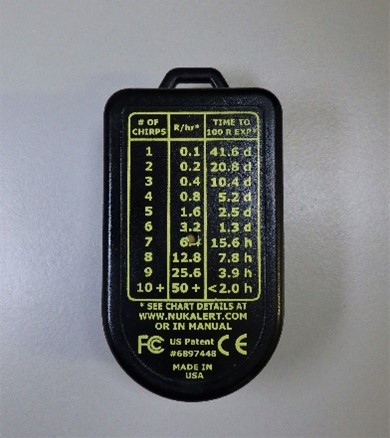
I carry a small radiation monitor and alarm called the NUKALERT that is designed to be carried on a keychain. This radiation monitor is always on and constantly samples about every two seconds and has a battery life of 10+ years.

Chart on back of NUKALERT

The monitor produces a series of beeps when radiation is detected. By counting the number of beeps and referencing the chart on the back of the device, you can quickly calculate how long you have to find, improvise or improve shelter.

Cellphone, Small Amateur Radio with Wide Band Receiver

If there is any warning preceding a nuclear attack and the government does warn the public, then you may receive an alert on your cellphone. However, if the nuclear attack is preceded by a HEMP attack, it is likely that your cellphone may not work.

If your local emergency responders have their act together, they will break out their radiation meters, take readings and report them for broadcast to the public so folks can know whether they need to seek shelter or whether it is safe to be outside. Of course, their ability to get this information out to the public may be degraded if the power grid is down, cell towers are down, and radio stations are down. But do not fear, before long, radio operators will soon get radio back up and transmitting.

The beauty of radio is that you only need a transmitter and receiver to get the word out and they can run on batteries so little infrastructure is needed. That’s why it’s a shame that several auto manufacturers are trying to build vehicles without AM radios. No other technology would reach as many people as quickly in a catastrophic event that takes down the power grid.

Some amateur radios with wide band receive can also receive AM, FM, and shortwave frequencies, giving you the ability to receive broadcasts in addition to monitoring local amateur radio traffic and potentially communicating with family and friends even if phones, SMS, the internet, and the grid are all down.

Faraday Bag

Most handheld transceivers are well shielded and may work even after a HEMP depending on many factors. If radios weren’t well-shielded, they would damage their own circuits when they transmit. You can greatly improve the odds of having a working radio and/or cellphone by storing it in a non-conductive bag and then storing that inside a Faraday bag.

Some tests indicate that many handheld transceivers would likely survive a HEMP with a field strength at or below 50kV/m. However, it is possible that super-HEMP weapons may generate much higher field strengths (Russian military literature references field strengths of up to 200kV/m), so storing sensitive microelectronics you may need to survive in a Faraday pouch that provides at least 73dB of shielding is a reasonable and inexpensive protective measure. It might not protect sensitive electronics if the weapon went off directly above you, but it would improve your chances in much of the rest of the country.

Dosimeters

A dosimeter measures how much radiation you have been exposed to over a given period. This is important to know and, if you have the money, this greatly simplifies tracking. Ideally, each member of your group should have their own dosimeter.

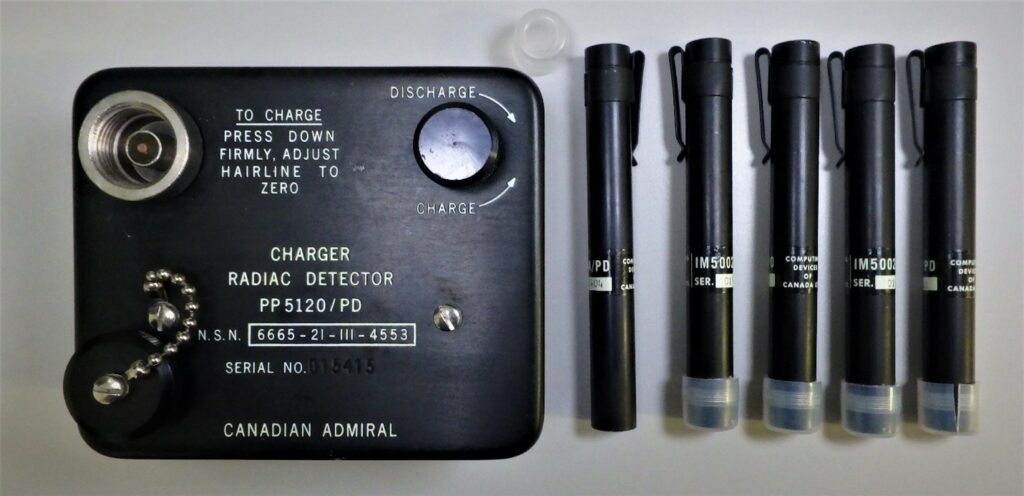
Dosimeter charger and analog quartz fiber dosimeters

You don’t need to carry the charger constantly, but you will need it to periodically zero dosimeters as gamma rays pass through the ionization chamber, bleeding off the charge at a measured rate. To read them, you hold the tube up to a light source and look through it. If you buy these old surplus dosimeters, you’ll need to have them tested and calibrated.

Watch, Notebook, & Pen

If you only have a radiation meter and don’t have a dosimeter, you’ll need to record the total REMs you have been exposed to and over what period of time. If you have older analog dosimeters that look like pen, they only record exposure within a specific range. You must record when you charge them, how much radiation you have been exposed to, over what time period, and then they need to be recharged and zeroed.

Even if you have a newer digital dosimeter that tracks your total exposure, I recommend making a copy of the exposure scale so you will know how many REMs you and others in your care can be exposed to before they become ill and how many are fatal. This information may help you make important decisions, such as when you really shouldn’t spend any more time outside the shelter, when you need to try to move someplace safer, when you are safe and when it’s time to get your affairs in order.

Potassium Iodide

If you receive notice that a nuclear attack is eminent, you should begin taking potassium iodide. One of the effects of exposure to fallout is that radioactive isotopes of iodine can build up the thyroid gland increasing the risk of thyroid problems, tumors, or thyroid cancer.

When unpredictable winds caused a little over 60 indigenous inhabitants to be exposed to fallout during nuclear testing in the Bikini Atoll, approximately one third of them eventually developed thyroid problems, tumors, or cancer over the next 20 years.

Outerwear & PPE

If there is a chance that you may be directly exposed to fallout before are able to get someplace safe or improvise shelter, protect yourself as best you can.

  • Lightweight Outerwear – Lightweight outerwear is no substitute for a fallout shelter, but it can keep fallout particles from sticking to your skin and help ensure that they they do not stick to you during the decontamination process. Outwear with a zipper is best. You don’t want to contaminate your head and neck by pulling of you top over your head.
  • Gloves – Gloves will help protect your hands.
  • Hat – A hat will help keep fallout particles off of the head and out of the hair, where they can be difficult to remove. When you wash, use tepid water and do not use conditioner which will cause particles to bond to proteins in your hair.
  • Eye Protection – Because your eyes are moist, fine particles can stick to them and eyte protection can help prevent this.
  • N95 Mask – Fine fallout particles can be inhaled and ingested, and they are far more damaging once inside the body. Fortunately, the largest and most dangerous particles drop out of suspension the fastest.

World War III is on the Horizon, Russian and Chinese Both Nations Have Been Systematically Strengthening and Updating Their Nuclear Forces to Strike Usa: What U.S. Targets and Cities Might a Nuclear Adversary Most Likely Attack First?

The United States now faces the real and regular prospect of fighting adversaries strong enough to do Americans immense harm. The post-Sept. 11 forever wars have been costly, but a true great power war — the kind that used to afflict Europe — would be something else, pitting the United States against Russia or even China, whose economic strength rivals America’s and whose military could soon as well.

For four decades, America’s postwar presidents appreciated that the next hot war would likely be worse than the last. In the nuclear age, “we will be a battlefront,” Truman said. “We can look forward to destruction here, just as the other countries in the Second World War.” This insight didn’t keep him or his successors from meddling in third world countries, from Guatemala to Indonesia, where the Cold War was brutal. But U.S. leaders, regardless of party, recognized that if the United States and the Soviet Union squared off directly, nuclear weapons would lay waste to the American mainland.

Nuclear terror became part of American life, thanks to a purposeful effort by the government to prepare the country for the worst. The Federal Civil Defense Administration advised citizens to build bomb shelters in their backyards and keep clean homes so there would be less clutter to ignite in a nuclear blast.

What cities would be nuked first? What U.S. targets and cities might a nuclear adversary most likely attack first? Although the answer would depend largely on the sought-after strategic outcome.

For example, the adversary may decide (first?) to strike the U.S military in order to limit the ability of counterstrike. In that scenario, the most likely first strike nuclear targets would likely be larger military bases and nuclear mission facilities. More on that below…

The adversary may also decide to hit major U.S. cities. According to the U.S. Census Bureau, American cities comprise less than 4 percent of the nation’s land mass, however they are home to nearly two-in-three Americans, approximately 63 percent of the population.

Would they need to nuke a lot of cities to get their desired outcome of defeat? Maybe not. Would a nuclear exchange be a tit-for-tat, or equivalent retaliation? Maybe, maybe not…

Will a nuclear exchange every actually happen, given the certainty of mutually assured destruction? Hopefully not. However, one never knows, especially given the proxy-nation-states who also have nuclear weapons – and a hatred for the U.S.

What countries have nuclear weapons, and how many? See the list below.

6 Cities To Be Nuked

This is an update section to the original post. Consider this… Let’s say the following seven cities were on the first nuclear strike list:

  • New York City
  • Chicago
  • Houston
  • Los Angeles
  • San Francisco
  • Washington, D.C.

They’re some of the most population-dense and largest cities in the country (see the larger list below). But even more so, their unique critical infrastructure value. For example, Energy, Financial, Tech, Government.

A nuclear strike on these U.S. cities would create a chaotic follow-on effect. As a result there would be widespread panic and chaos throughout other cities descending into mayhem.

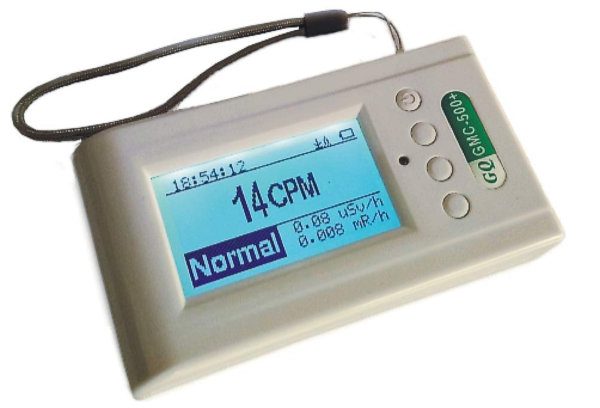
GQ GMC-500 PLUS Geiger Counter Dosimeter
(view on amzn)

radiation detector

[ Read: 5 Nuclear Radiation Detector Choices ]

After the primary military command & control have been nuked…

After (or while) all of the primary military command and control centers have been nuked (Military Nuclear Targets), have you ever wondered which cities would be nuked first?

It’s an unpleasant thought! Therefore it is something that most people believe would never happen. Note that at one time between Russia and the United States alone, there were more than 20,000 nuclear warheads. Though apparently fewer these days, there are enough to destroy us all! See the list below…

Not that long ago during the years of the Cuban missile crisis, every American feared the worst, while the U.S. and the USSR were seemingly ready to end the world as we know it…

Since then, stockpiles have been reduced somewhat, but in the big picture it is mostly irrelevant. If anything, the world is more dangerous today as radical nations add their own nuclear weapons to the world’s nuclear arsenal.

Depending on the engagement (who, what, and to what end), military and/or key infrastructure targets may likely be hit first, but it won’t be long down the target list until major cities may be taken out.

In a worst case all-out nuclear engagement, we might consider that many or all cities could be hit, given the number of nukes that are available to countries like Russia and even China.

Top 30 Most Populated Cities

Regardless, most or many of us are at risk. However, a logical place to start the thought process may be this…

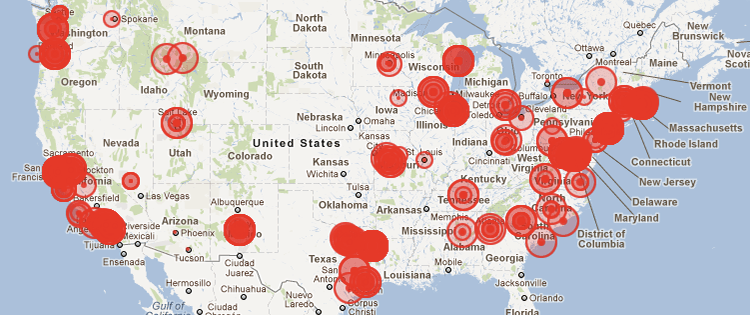
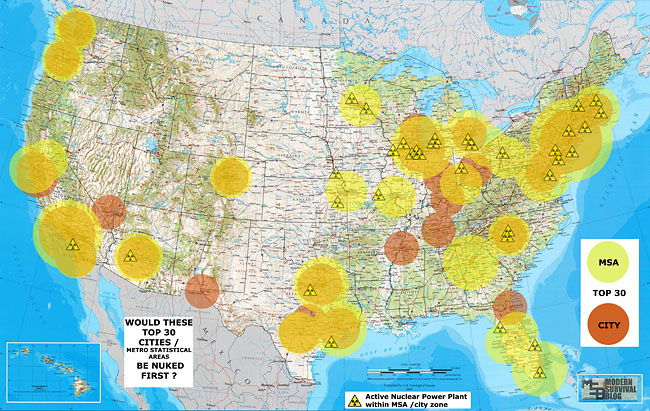
The following is a map highlighting the Top 30 most populated cities (and Metropolitan Statistical Areas – MSA) in the United States, followed by the population list for each.

The metro areas themselves are located in the middle of the yellow highlighted regions, and some of them overlap with the cities from the top-30 list (red).

The diameter of the colored regions simply represent a potential evacuation perimeter to escape nuclear fallout, although this will be widely variable depending on wind patterns, detonation (ground burst vs. air burst) and payload. It is a general illustration to help visualize an exodus.

First 30 Cities To Be Nuked

Full size map (3MB)

I have included the locations of any operating nuclear power plants that happen to be located within any of the MSA’s and cities listed. They are highlighted for added risk assessment.

To see where all of the nuclear power plants are located within the United States, I’ve written the following article (and map)…

What Cities Would Be Nuked First?

Simply food for thought. An ordered list based on population.

CITY LIMITS POPULATION
1. New York (8,175,133)
2. Los Angeles (3,792,621)
3. Chicago (2,695,598)
4. Houston (2,099,451)
5. Philadelphia (1,526,006)
6. Phoenix (1,445,632)
7. San Antonio (1,327,407)
8. San Diego (1,307,402)
9. Dallas (1,197,816)
10. San Jose (945,942)
11. Jacksonville (821,784)
12. Indianapolis (820,445)
13. San Francisco (805,235)
14. Austin (790,390)
15. Columbus (787,033)
16. Fort Worth (741,206)
17. Charlotte (731,424)
18. Detroit (713,777)
19. El Paso (649,121)
20. Memphis (646,889)
21. Baltimore (620,961)
22. Boston (617,594)
23. Seattle (608,660)
24. Washington (601,723)
25. Nashville (601,222)
26. Denver (600,158)
27. Louisville (597,337)
28. Milwaukee (594,833)
29. Portland (583,776)
30. Las Vegas (583,756)

METRO AREAS (population – millions)
1. New York (19.6)
2. Los Angeles (12.8)
3. Chicago (9.5)
4. Dallas-Fort Worth (6.4)
5. Houston (5.9)
6. Philadelphia (5.9)
7. Washington (5.6)
8. Miami (5.6)
9. Atlanta (5.3)
10. Boston (4.6)
11. San Francisco (4.3)
12. Riverside (4.2)
13. Phoenix (4.2)
14. Detroit (4.2)
15. Seattle (3.4)
16. Minneapolis-St. Paul (3.3)
17. San Diego (3.1)
18. Tampa-St. Petersburg (2.8)
19. St. Louis (2.8)
20. Baltimore (2.7)
21. Denver (2.5)
22. Pittsburgh (2.4)
23. Charlotte (2.2)
24. Portland OR (2.2)
25. San Antonio (2.1)
26. Orlando (2.1)
27. Sacramento (2.1)
28. Cincinnati (2.1)
29. Cleveland (2.1)
30. Kansas City (2)

IMPORTANT!
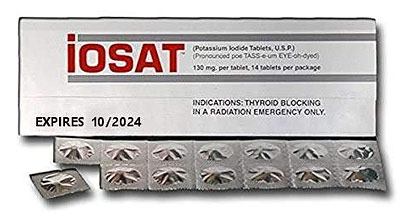
Following a nuclear detonation and fallout in your region, protect your thyroid from nuclear fallout:

iOSAT Potassium Iodide Tablets, 130 mg (14 Tablets)
(view on amzn)

iosat nuclear radiation tablets for thyroid blocking

World Nuclear Weapon Stockpile

Hans Kristensen and Matt Korda of the Federation of American Scientists are the leading experts in estimating the size of global nuclear weapons inventories. The table is a compilation of their estimates.

Total Nuclear Weapons by Country

Number of nuclear warheads worldwide as of 2022

  1. Russia — 6,257 (1,458 active, 3039 available, 1,760 retired)
  2. United States — 5,550 (1,389 active, 2,361 available, 1,800 retired)
  3. China — 350 available (actively expanding nuclear arsenal)
  4. France — 290 available
  5. United Kingdom — 225 available
  6. Pakistan — 165 available
  7. India — 156 available
  8. Israel — 90 available
  9. North Korea — 40-50 available (estimated)

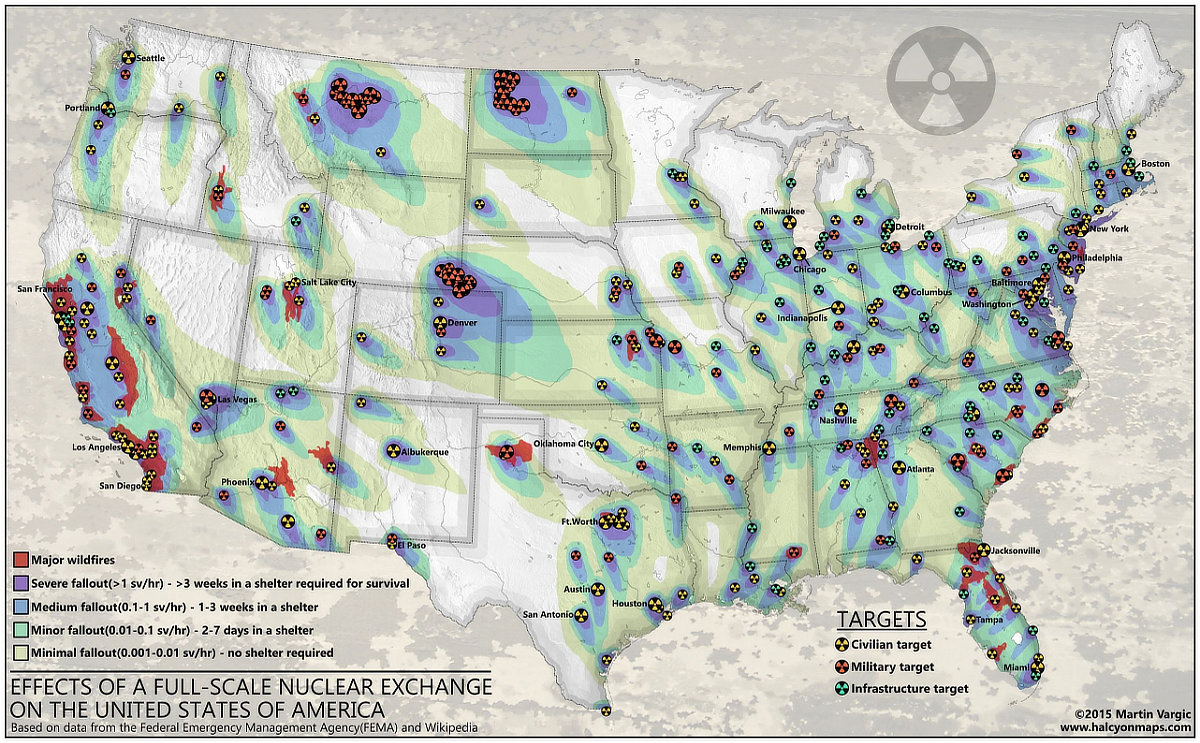
Effects of a full-scale nuclear exchange on the United States of America

The following map is fascinating. I found it sourced from Martin Vargic of halcyonmaps.com who makes infographics and various maps. It’s based on data from the Federal Emergency Management Agency (FEMA) and Wikipedia.

He takes into account the normal prevailing wind direction as it may affect nuclear fallout. Food for thought…

(click for Full Scale)

“A list of United States military targets likely to be hit first compared with others. Although there are lots of military installations, the following military nuclear targets logically seem more likely than others to be on primary target lists.”

“Based on a number of factors while looking at other maps and data including military installations, nuclear weapons storage and silo locations, bases, cities, etc..”

This is all simply food for thought. The talk of nuclear exchange has been hitting the news once again lately, so, I updated this original post from 2013. Since then, the article has hundreds of comments.

In my personal opinion, mutually assured destruction puts a HUGE damper on all this. After all, what crazy ‘leader’ would push the button knowing his own nation is going to get it next?

Although, on the other hand, it certainly would help with the globalists depopulation agenda, right?

Final Hour – Nuclear War, First Responders Will Have To Wait For The Deadly Fallout To Decay Before They Enter A Hot Zone So The More You Prepare, The Better Your Odds Of Surviving A Nuclear Crisis

No one wants to think about a nuclear crisis – and hopefully it will never happen – but we all must accept the fact nuclear tensions are rising globally with North Korea (and others are seeking nukes) so we should prepare ourselves and our loved ones in the event the unthinkable strikes our soil.

For decades, movies and some in the media have portrayed a nuclear attack as a “doomsday” event implying most people would be killed on impact … and survivors would want to die once they come out of their shelters.

In reality, unless you are actually at ground zero or within a several mile radius of the blast zone (depending on the size of the nuke, of course), there is a very high probability you’ll survive as long as you…

  • limit your exposure to radiation and fallout,
  • take shelter with proper shielding, and
  • wait for the most dangerous radioactive materials to decay.

In other words, you CAN survive a nuke attack … but you MUST make an effort to learn what to do! By learning about potential threats, we are all better prepared to know how to react if something happens.

Please realize this is being written with small nuke devices in mind (like a 1-kiloton to 1-megaton device). A larger device, ICBM or a nuclear war would cause more wide-spread damage but some of this data could still be helpful. These are some very basic tips on sheltering for any type of nuclear (or radiological) incident.

What happens when a nuke explodes?

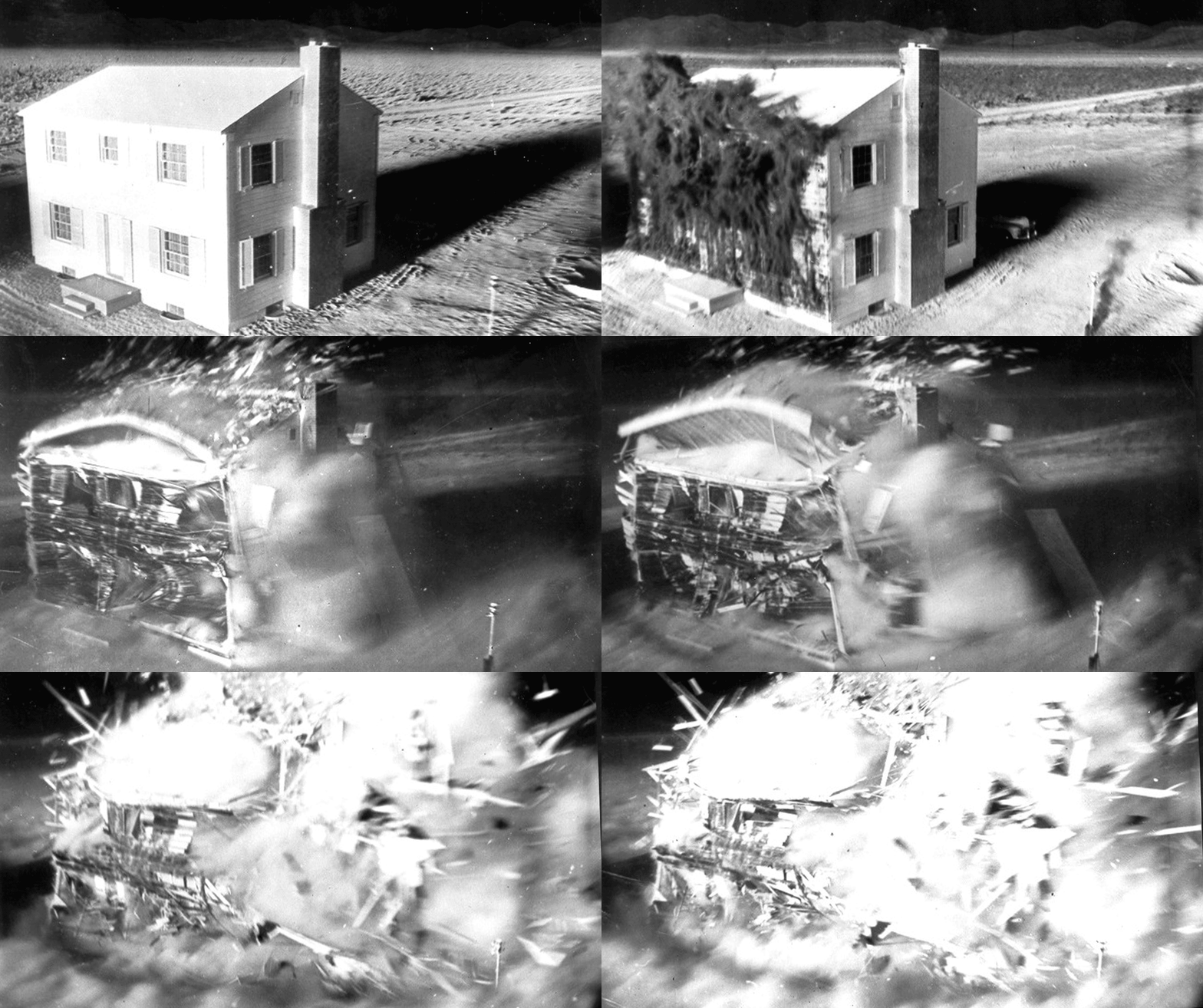
A nuclear blast produces a blinding light, intense heat (called thermal radiation), initial nuclear radiation, 2 explosive shock waves (blasts), mass fires, and radioactive fallout (residual nuclear radiation).

The below graphic shows the destruction of a test home by an atomic blast on March 17, 1953 at the Nevada Proving Ground. The structure was located 3,500 feet from ground zero, and the time from the first to last picture was 2.3 seconds.  It shows the force of the blast wave then the radiating energy set it on fire.

Also, if a nuke is launched over our continent and explodes miles above the earth, it could create an electromagnetic pulse (EMP). An EMP is a split-second silent energy burst (like a stroke of lightning) that can fry electronics connected to wires or antennas like cell phones, cars, computers, TVs, etc. Unless electronics are grounded or hardened, an area or nation could experience anything from minor interference to crippled power, transportation, banking and communications systems.

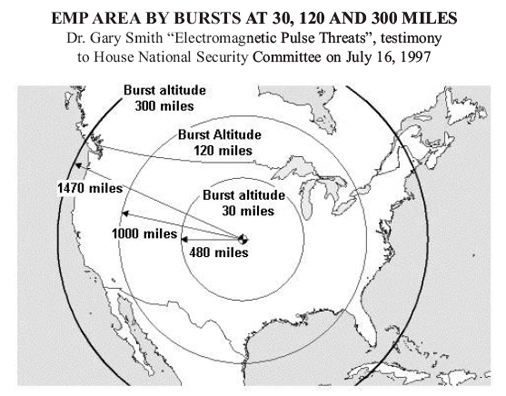
An EMP from a high-altitude nuke (where a nation or group succeeds in detonating a nuclear device carried miles into the atmosphere) could affect electronics within 1,000 miles or more as shown below. (Evidence suggests some countries and groups are working on enhanced and non-nuclear EMP weapons or e-bombs.)

high altitude emp or electromagnetic pulse threat

What is the most dangerous part of a nuclear attack?

Both the initial nuclear radiation and residual nuclear radiation (also called radioactive fallout) are extremely dangerous.

Initial nuclear radiation is penetrating invisible rays that can be lethal in high levels.

Radioactive fallout (residual nuclear radiation) is created when the fireball vaporizes everything inside it (including dirt and water). Vaporized materials mix with radioactive materials in the updraft of air forming a mushroom cloud.

Fallout can be carried by winds for hundreds of miles and begin falling to the ground within minutes of the blast or take hours, days, weeks or even months to fall. The heaviest fallout would hit ground zero and areas downwind of that, and 80% of fallout would occur within 24 hours. Most fallout looks like grey sand or gritty ash and the radiation given off cannotbe seen, smelled, tasted or felt which is why it is so dangerous. But as the materials decay or spread out radiation levels will drop.

More about radiation

Types of radiation – Nuclear radiation has 3 main types of radiation…

  • alpha – can be shielded by a sheet of paper or by human skin. If alpha particles are inhaled, ingested, or enter body through a cut, they can cause damage to tissues and cells.
  • beta – can be stopped by skin or a thicker shield (like wood). Beta particles can cause serious damage to internal organs if ingested or inhaled, and could cause eye damage or possible skin burns.
  • gamma – most dangerous since gamma rays can penetrate the entire body and cause cell damage throughout your organs, blood and bones. Since radiation does not stimulate nerve cells you may not feel anything while your body absorbs it. Exposure to high levels of gamma rays can lead to radiation sickness or death, which is why it is critical to seek shelter from fallout in a facility with thick shielding!

Radiation detection devices – You cannot see, smell, taste or feel radiation, but special instruments can detect even the smallest levels of radiation. Since it may take days or weeks before First Responders could get to you, consider having these devices handy during a crisis or attack since they could save your life.

Measuring radiation – Radiation was measured in units called roentgens (pronounced “rent-gens” and abbreviated as “R”) … or “rads” or “rem”. An EPA document called “Planning Guidance for Response to A Nuclear Detonation 2nd Edition June 2010” explains … 1 R (exposure in air) ≅ 1 rad (absorbed dose) ≅ 1 rem (whole-body dose). Although many measuring devices and older documentation use R and rem, officials and the media now use sievert (Sv) which is the System International or SI unit of measurement of radiation. The formula to convert sieverts to rems is quite simple … 1 Sv = 100 R (rem).

How many rads are bad? – High doses of radiation in a short span of time can cause radiation sickness or even death, but if that high dose is spread out over a long period of time, it’s not as bad.

According to FEMA, an adult could tolerate and recover from an exposure to 150R (1.5 Sv) over a week or 300R (3 Sv) over a 4-month period. But 300R (3 Sv) over a week could cause sickness or possibly death. Exposure to 30R (0.3 Sv) to 70R (0.7 Sv) over a week may cause minor sickness, but a full recovery would be expected. But radioactive fallout decays rapidly so staying in a shelter with proper shielding is critical!

The “seven-ten” rule – For every sevenfold increase in time after the initial blast, there is a tenfold decrease in the radiation rate. For example, a 500 rad level can drop to 50R in just 7 hours and down to 5R after 2 days (49 hours). In other words, if you have shelter with good shielding and stay put for even just 7 hours … you’ve really increased your chances of survival. Your detection devices, emergency radio or cell phone [if the last 2 are working, that is] can assist you in knowing when it’s safe to come out.

So how do I protect myself and my family?

Basic shelter requirements – Whether you build a shelter in advance or throw together an expedient last-minute shelter during a crisis, the area should protect you from radiation and support you for at least 2 weeks. Some basic requirements for a fallout shelter include …

  • shielding
  • ventilation
  • water and food
  • sanitation and first aid products
  • radiation monitoring devices, KI (potassium iodide), radio, weapons, tools, etc

Reduce exposure – Protect yourself from radioactive fallout with …

  • distance – the more distance between you and fallout particles, the better
  • shielding – heavy, dense materials (like thick walls, earth, concrete, bricks, water and books) between you and fallout is best. Stay indoors or below ground. (Taking shelter in a basement or a facility below ground reduces exposure by 90%. Less than 4 inches of soil or earth can reduce the penetration of dangerous gamma rays by half.)
  • time – most fallout loses its strength quickly. The more time that passes after the attack, the lower the danger.

Indoor shelter locations – If you don’t have a fallout shelter, these options could provide protection from dangerous radiation by using proper shielding materials.

  • basement – find the corner that is most below ground level (the further underground the better)
  • 1-story home / condo / apartment – if no underground facility, find a spot in center of home away from windows
  • trailer home – find sturdier shelter if possible (like a basement or brick or concrete building)
  • multi-story building or high-rise – go to center of the middle section of building (above 9th floor if possible). Note: if rooftop of a building next to you is on that same floor, move one floor up or down since radioactive fallout would accumulate on rooftops. Avoid first floor (if possible) since fallout will pile up on ground outside.

Shielding materials – All fallout shelters must provide good protection from radioactive particles. FEMA suggests having a minimum of several inches of concrete or 1 to 2 feet of earth as shielding around your shelter, if possible, and the more the better. Per FEMA, the following shows examples of shielding materials that equal the protection of 4 inches (10 cm) of concrete …

  • 5 – 6 inches (12 – 15 cm) of bricks
  • 6 inches (15 cm) of sand or gravel
  • 7 inches (18 cm) of earth
  • 8 inches (20 cm) of hollow concrete block
  • 10 inches (25 cm) of water
  • 14 inches (35 cm) of books or magazines
  • 18 inches (46 cm) of wood

Make an expedient shelter – Some very basic ways to build an expedient last-minute shelter in your home, apartment or workplace to help protect you from dangerous radiation include…

  • Set up a large, sturdy workbench or table in location you’ve chosen. If no table, make one by putting doors on top of boxes, appliances or furniture.
  • Put as much shielding (e.g. furniture, file cabinets, appliances, boxes or pillowcases filled with dirt or sand, boxes of food, water or books, concrete blocks, bricks, etc.) all around sides and on top of table, but don’t put too much weight on tabletop or it could collapse. Add reinforcing supports, if needed.
  • Leave a crawl space so everyone can get inside and block opening with shielding materials.
  • Leave 2 small air spaces for ventilation (about 4-6″ each) – one low at one end and one high at other end. (This allows for better airflow since warm air rises.)
  • Have water, radiation detection devices, KI, battery operated radio, food and sanitation supplies in case you have to shelter in place for days or weeks.
build an expedient shelter for protection from radioactive fallout

In summary, those within the blast zone of Ground Zero (depending on the size of the nuke) won’t make it .. BUT .. if you are a few miles outside the zone your chances of surviving it are high but you MUST have detection devices to monitor levels of radiation and a plan to stay sheltered for at least 48 hours or up to a few weeks. First Responders will have to wait for the deadly fallout to decay before they enter a hot zone so the more you prepare, the better your odds of surviving a terrorist nuke.

Electronic Armageddon: The Carrington Event Then and Now. If many of these large transformers went down, it would take down our high tech society with it.

In 1859, an event unlike anything experienced before by modern man, occurred. A massive Coronal Mass Ejection occurred on the sun sending vast quantities of solar particles on a collision course with Earth. The result of this collision caused severe disruptions with the only major electrical equipment then in existence, the telegraph system. Magnetic observatories recorded disturbances in the Earths magnetic field that were literally off the scale.

Auroras were seen as far south as the Caribbean, gold miners in the Rocky Mountains were awakened by a light so bright they thought it was morning and those in the northeast could read news papers by the light.

Telegraph systems throughout Europe and North America failed and in some cases shocked telegraph operators. Telegraph lines threw sparks, paper in some telegraph offices caught fire and some lines continued to send messages even after the battery power had been removed from the line. The electrical effects were severe but the lack of electrical devices in use at this time allowed society to continue as normal and this disturbance was viewed as nothing more than a curiosity.

Scientists believe events of this size can occur every 500 years and events of a lesser but still destructive magnitude can happen several times per century. Scientists are getting better at predicting space weather but mother nature often times ignores our best forecasting and throws us a curve.

What would happen if a storm of this magnitude were to strike the Earth today? The biggest worry we have is the power grid. Satellites would be affected preventing most communications and financial transactions but if the grid goes down due to transformer blowouts, it could be a long time before we get it back up. The larger transformers 500+ KV in size cost millions of dollars and take 1 to 3 years to get even in normal times. Very few of these are kept in supply and the loss of dozens or hundreds at one time could be a disaster as only a small number are made every year and none are currently made in the U.S.

If many of these large transformers went down, it would take down our high tech society with it. Many of our cars and computers and appliances would probably still work, but how would we run them without power? How would we pump water to cities and pump fuel so trucks and trains could deliver food and medicine? How would our medical system operate without the high tech gadgets we depend on to keep people alive and diagnose them? How would we communicate and conduct financial business without our computers? Yes, we have backup generators but how long will they last before they run out of fuel that we can no longer process, pump and deliver?

This is the nightmare scenario we need to address before it happens. Currently we can detect CMEs about 20 hours before they reach Earth. The current plan is to notify power companies of the danger so they can shut down parts of the grid and protect the transformers before they get burnt out. It’s a plan but I feel the need to ask, is this really the best plan we can come up with? What happens if mother nature throws us a curve and we don’t have time to power down the transformers? A report from the EMP commission stated that it would cost about $60 to $100 million to protect the 300 largest transformers that power the grid and an additional $400 to $600 million to protect an additional 3,000 transformers but our leaders don’t think that would be the best use for our money. A NASA report indicates that within 90 seconds of a Carrington Event reaching Earth, the 300 largest transformers in the U.S. would go down and recovery would take 4 to 10 years and some estimates place the death toll in the tens of millions of people.

If the grid goes down civilized society as it is will disintegrate rapidly due to the lax moral standards we now have as a society. The pictures of Japanese citizens patiently waiting in line to get supplies after the 2011 tsunami is a stark difference from what you could expect in the U.S. As with many potential problems, if the government would only discuss it in public and offer the public some simple preparedness tips and discuss how we as a nation would repair the damage, the public knowledge would help mitigate the damage and aid in recovery operations. Unfortunately, that’s not how we do things in the 21st century.

So how do we know how bad it was in 1859 if we didn’t have electronic devices back then to measure it?

To be maximally geoeffective , ie: to drive a magnetic storm, a CME must
(1) be launched from near the center of the sun onto a trajectory that will cause it to impact Earths magnetic field,
(2) be fast (1000 km/sec + ) and massive, thus producing large kenetic energy and
(3) have a strong magnetic field where orientation is opposite that of Earth.

Solar Energetic Particle events dominated by shock-accelerated particles traveling near the speed of light are channeled along geomagnetic field lines into the upper atmosphere above the poles where they can initiate ozone depleting chemistry in the middle atmosphere. Nitrates produced by SEP bombardment settle out of the atmosphere within weeks and are preserved in polar ice, allowing the magnitude of the SEP to be estimated many years later. This is how we can estimate the magnitude of the Carrington Event and apply it to modern technology.

Some scientists fear that the solar maximum that will peak in 2020 will spawn another CME similar to the Carrington Event causing catastrophic results on Earth (SOURCE). The recent uptick in solar storms may give some credence to our newfound concerns. The problem with a solar event as opposed to a man-made event is the possibility that we could be hit multiple times over the course of months before it diminishes. This could make recovery efforts many times more difficult. It is possible for individuals to prepare for an event like this to limit the hardships but this is something that must be done well in advance. The problem is that the vast majority will not prepare and they will cause this disaster to become a catastrophe if it happens. Those that are not prepared to live through a situation like this face a life threatening situation. Those that are prepared, face the danger posed by the unprepared.

One thing everyone needs to keep in mind is that an event of this magnitude will necessitate a plan that spans multiple years in order to get through it. As I always stress, knowledge is the most important thing to have in a disaster and everyone needs to develop a plan that will work best for them. If the grid goes down besides not being able to travel or communicate, banking records could be frozen or destroyed taking your electronic money along with it. In this situation, the only money you may have access to is what you have on hand in cash and even then you may be limited as to what you will be able to buy. The only safe position is to already have supplies on hand. For this type of disaster, there is no such thing as being prepared too early or having too many supplies.

One final item that you need to plan for is the potential for a nuclear incident following a grid down event. The loss of power to maintain coolant can result in a meltdown of reactor fuel and the more serious problem of spent fuel coolant ponds going dry igniting radioactive fires. In this situation you have two choices, evacuate or shelter in place. Evacuation would be difficult at best and sheltering in place would present its own problems. An uncontrolled radioactive fire can spew radiation for decades so each person would need to evaluate the hazard to their location and plan accordingly. A modern day Carrington Event would be nothing short of Armageddon for the people of this planet

The Nuclear Holocaust: How To Survive One Second After

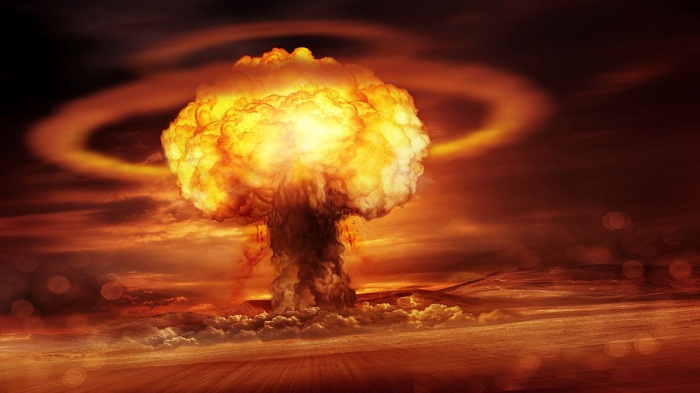
When it comes to a social collapse based on a nuclear crisis, mushroom clouds created during a ground based incident may well come to mind.

Even though most people think they know what an exploding nuclear device may look like, there are actually many sources of based nuclear contamination. Each source of nuclear material will cause different visual, auditory, and other effects.

Therefore, when it comes to preparing for a nuclear incident, you must be aware of where the radiation will come from as well as how to deal with it as safely as possible.

 The Air Based Nuclear Incident

Oddly enough, even with a full scale hostile detonation of a nuclear device, you may first need to recognize that an incident has occurred.

Consider a situation where a 1 kiloton bomb exploded in the air 30 or 40 miles away. Chances are, you would not even hear the blast let alone see the cloud rising up. Unfortunately, streams of radiation will already be headed your way. Even though they may not deliver lethal doses of radiation, you may still suffer from burns and mild to moderate radiation sickness if you are outdoors.

Since an air based explosion may well trigger an EMP, your first indicator may be that your car or cell phone stops working. If you are indoors, do not go outside to see if you will get a better reception.

Instead, ask others if their cell phones are working. If everyone seems to have lost service, stay indoors and head for the basements and lower levels as quickly as possible.

Without communications and information about where the blast has occurred, you could be running deeper into the radiation belt. You are better served by putting as much concrete and dirt between you and the fallout as you can. Needless to say, if you are in a vehicle, get into a building and to the lower levels as quickly as you can.

Once you reach a suitable shelter, follow the usual routine of squatting facing a wall with your forehead resting on knees and arms shielding the back of your neck. If you have Potassium Iodide and other cellular shields on hand, be sure to take those.

An air based nuclear incident will spread contaminated material further, and since air tends to be much lighter than dirt and ground based debris, it may also take longer for it to finish falling to the ground.

In small scale, relatively localized scenario, it is likely that you can get medical attention and reasonable care without fear of larger plans and complex scenarios. You may also be given information about where you can pick up Potassium Iodide tablets and other cellular shields.

With regard to air based nuclear explosions, your first few days will primarily be concerned with coping with radiation sickness, finding food, finding water, and washing as much radioactive material from your body as you can.

You will more than likely find it harder than usual to travel because cars will literally be stopped in the streets. If you have to leave a city, try to do so using underground subway, storm water, and old tunnel systems.

Try to avoid going above ground as much as possible. Even though heavy rains will come down as a result of a nuclear explosion, tunnels and similar systems may still protect you from some of the radiation. Just make sure that rainwater and sewage are not actively being shifted into the system or you will wind up with all kinds of nuclear debris in the same tunnels that you are in.

It is also important to realize that tunnel systems and subways may be shut off by government agencies that want to prevent nuclear waste from getting into underground chambers. Whether they know of your presence or not, you may simply become collateral damage because they feel the “big picture” they have been trained to uphold is more important.

And if you are planning to leave an area, be prepared to travel 5 – 6 times the distance that you would travel to get out of the radiation bands created by water and ground based nuclear incidences.

The Nuclear Detonation on the Ground

Over the years, prevailing views on what to do during an attack have changed. In particular, older advice revolved around staying in place and trying to get as far below ground as possible. Today, most experts say that you have approximately 1/2 hour after a blast to reach a place of safety. Instead of staying in place, you should use that time to get as far away from ground zero as possible. This makes sense if you are in a mid to outer area of the incident site.

Depending on how fast you travel, it may be possible to get into a less dangerous band, or away from the problem altogether. Once you reach the 20 – 25 minute post incident mark, you will need to take cover and then stay in that location for at least 24 hours, after that time the worst of the radiation will be dispersed. You may want to stay an additional 2 – 3 days depending on supplies and the durability of your shelter.

When you cannot get to a shelter, any standing object will have to do. Make sure that your shield is between you and the explosion point being affected by the nuclear blast so that it will absorb as much radiation as possible. If you think about how shadows work, then you can readily understand why your position in relation to the blast is so important.

Never look at the flash from a nuclear explosion as it can cause blindness in less than a second. Individuals living in cities or areas with larger populations can also try taking refuge in subways, sewer systems, and any other areas where there is plenty of concrete, brick, or dirt to absorb the radiation.

Once you reach the shelter, squat down on the floor as far away as possible from windows, doors, and beams. Sit so that you are facing a main wall and put your head on your knees. Use your hands and arms to shield your neck. Look downward as much as possible. If you look upward, your eyes may be blinded by the flash from any detonation that happens to occur.

Unfortunately, there are many situations where you may be stuck outside and have no shield or building to hide in. The best thing you can do is get as close to the ground as you can. If the ground is soft, then dig with rocks or your hands to get as far into the ground as possible. While you are working, do not look at the incident site.

During the first few hours, you are very likely to experience heavy winds and thermal blasts. The thermal blasts can set just about anything on fire as they pass.

Keep non-flammable, white or silver heat shields on hand. Put those on to try and keep as much heat as possible away from your body. As you work, also be aware that objects from miles away can easily strike you. Should concrete or something else suitable land nearby, do not take shelter behind it unless you know that it is not contaminated by radioactive debris.

If you receive warning of a pending nuclear blast, and you are indoors, you will need to get underground or into a basement as quickly as possible. Brick and cement structures will absorb the most radiation, so they are likely to offer the best shelter. Just remember to put as many walls or as much dirt as possible between you and the explosion point.

Always aim to be as close to the ground or below it as possible. Needless to say, if you are building a homestead, you can always insulate walls with dirt and lead, or just build your home as far underground as possible.

No matter whether you are indoors or out, it is very important to limit the amount of dust that gets into your nose, mouth, and on your skin. While a dust mask will be of immense benefit, even a handkerchief over your nose and mouth is better than nothing.

You should also cover up your skin as much as possible using white or the lightest colors possible. Remember that black and dark colors will absorb radiation. This, in turn, can easily lead to burns on parts of your body where the darker colors were covering.

You should also carry Potassium Iodide, Vitamin C, and Vitamin E tablets with you at all times. Take them as directed on the bottle as soon as you learn of a nuclear blast in your area. This medication will protect your thyroid from uptaking nuclear materials.

Typically, the thyroid is the first organ that determines how sick you will get from the radiation. One small pill can truly make the difference between serious radiation sickness and death even if your exposure levels are in the upper ranges.

You can obtain free Potassium Iodide tablets and instructions for taking them if you live near a nuclear power plant. Representatives in charge of readiness for nuclear emergencies in these areas may also have the tablets available for free. While these tablets may not be recommended for “prophylactic” or daily use, having them with you at all times is extremely important.

Just make sure that you follow dosing instructions because taking too much Potassium Iodide can poison the thyroid. Use iodized table salt or Himalayan Salt before nuclear blasts to ensure you are getting enough iodine in your diet. It should be noted that Vitamin C and Vitamin E can also shield other cells from some radiation damage.

Typically, radiation sickness will start within the first few hours after exposure to nuclear radiation. If you are not dealing with a detonation or large scale crisis scenario, it is very important to get medical attention as quickly as possible.

When it comes to a larger scale nuclear crisis, you will need to take a shower as soon as possible after the blast. Use soap that does not contain conditioners or oils that prevent dust and radioactive debris from being washed away. If you have scissors it may be of some use to cut your hair.

Shaving after a shower can also help get rid of some debris. Just take extra care to avoid razor burn as you don’t want to embed more radioactive material into your skin. Follow up with another shower using plenty of soap and water. If you have plenty of water pressure and water, then go ahead and shave while you are washing.

Do not put old clothes back on. Try to get rid of them so that you do not have radioactive materials in your living space. This includes getting rid of shoes, jewelry, weapons, and anything else that you were wearing during the incident. Once you are ready to leave the shelter, it will be time to think about long term survival. You may need to get medical attention or find your way out of the area.

It is fair to say that anyone growing up during the Cold War era is very aware of nuclear power, nuclear war, and all the chaos that it can bring. Regardless of your age, knowing how to survive both hostile and non-hostile releases of nuclear material are extremely important.

Never overlook the hazards associated with nuclear medicine, nuclear power plants or other industries just because they don’t make huge mushroom clouds or kill in a matter of moments. In fact, the slow, hidden damage and death from these sources may be far worse and far more troublesome than a nuclear war.

As you learn more about the daily hazards of exposure to land based nuclear radiation, you may well conclude that you need to be as prepared for these issues as you would be for a full blown war situation.

The Nuclear Incident on Water

If you happen to be swimming, in a boat, or otherwise in the water during a nuclear event, your first task will be to head for land. Depending on your distance from the explosion, you may only have a few minutes to half an hour to reach land and find suitable shelter.

During your escape from the explosion site, try to put anchors made of lead or brick between your body and the explosion. If possible, squat down and cover yourself with plastic or anything else that will keep water from seeping through your garments and onto your skin. The plastic should also be thick enough to prevent as much water vapor as possible from seeping in.

You should also have a mask on hand that will allow you to breathe without absorbing steam or water vapor into your lungs. While these aides will not stop radiation from passing through your body, it will limit the ability of radioactive debris from binding to your skin. This, in turn, will make it easier to wash the debris away later on.

As with land based explosions, you should always have Potassium Iodide tablets on hand. Take one as soon as you know an explosion or other event has occurred. If you are in marine or brackish waters, this precaution is even more important because these bodies of water may have higher levels of iodine in them.

As radiation moves out from the initial incident area, it will contaminate iodine present in the water. This iodine, in turn, can be quickly absorbed by the thyroid. Since the half-life of most iodine isotopes is under 10 days, you may need to take the potassium iodide tablets for a few weeks if you are exposed to a water based nuclear incident.

This may be distinctly different from land and air based explosions where the nuclear material may not produce as much iodine, or lower amounts are available to contaminate.

It should be noted that Potassium Iodide is not recommended for prophylactic treatment unless you are directed to do so during a nuclear power plant leak or there is other creditable reason to believe that some type of nuclear strike is going to occur in a matter of minutes or hours.

If you want to protect your thyroid from radioactive iodine before an event, simply make sure that you are getting enough iodine in your diet. Even though most people consume large amounts of table salt, there is also a high tendency towards deficiencies in the diet.

During a nuclear explosion or active leak scenario, radiation in the form of heat and light will be absorbed more readily by dark or black colors than white and light colors. Therefore, it is very important to keep white tarp, or even white bed sheets on hand to cover yourself with. If land is involved in the blast, this one minor thing may save you from more serious burns.

Once you reach land and a safe location, it is very important to shower. Make sure that you use soap and shampoo that do not contain skin conditioners, softening oils, or hair conditioners. All of these chemicals will only make it harder to wash radioactive materials away from your body.

You should also dispose of all contaminated clothing and jewelry. While this may be difficult, remember that even a single spec of dust can be radioactive for thousands of years and wreak mayhem during that time.

A Different Scenario – A Nuclear Power Plan: Defending Against Radiation and Fallout From a Nuclear Nightmare

One of the classic doomsday scenarios, often inappropriately given way more prominence than it deserves, is some type of nuclear event that results in a massive release of radiation.

Let’s understand the nature of radiation and fallout risks – from that understanding can follow a better appreciation of what one needs to protect against and how to do so.  The two terms are sometimes used interchangeably, but they are importantly different.

What is Radiation

The term ‘radiation’ covers a lot of different things.  Light is a form of radiation.  So are radio waves.  But for our purposes, radiation can be split into two types.  The first type is relatively safe, and is termed ‘non-ionizing’ radiation, and this includes radio and light waves, plus heat, sound, and various other things.  Non-ionizing radiation is a type of radiation that isn’t thought to make changes to the atomic structure of things it comes into contact with, but it may cause other sorts of changes or side-effects (as you’ll know any time you stick something in a microwave oven, which uses non-ionizing radiation to cook the food you placed in it), so it is not necessarily completely safe.

Our discussion in this article however is about ionizing radiation.  This is radiation that can change the make up of the individual atoms in things it comes into contact with.  That is almost always a bad thing, and in particular, it can break up DNA in living tissues, which can lead to the formation of cancers.

There are five major and relevant types of ionizing radiation, termed alpha, beta, gamma, neutron and X-ray.  Cosmic rays (primarily protons) are also ionizing, but they are a constant thing that does not change with a nuclear explosion, and so we can ignore them for this article’s purposes.

Let’s consider the main properties of these five types of radiation (and for the nuclear physicists reading, yes, we have simplified things somewhat, but hopefully have not compromised the overall accuracy of the article).

Alpha radiation

Alpha particles are the same as Helium-4 nuclei.  They comprise two protons and two neutrons.  They travel at about 5% of the speed of light (ie at a speed of about 10,000 miles in a second) but they are very short range – they typically only travel a couple of inches in air, and can be stopped by a single sheet of paper.

Because of their short-range and low penetration, alpha particles are not much of a problem.

Beta radiation

Beta particles are typically electrons (if you wanted to be fastidious you could say there may be some anti-matter positrons briefly present too, but let’s not dwell on that).  They are typically very fast-moving, and can travel greater distances than alpha particles, and will penetrate further as well (which is sort of implied by their greater range, of course).  They will be blocked by about 1/10th of an inch of aluminum or other metal, or by an inch or more of plastic.

Gamma radiation

Gamma rays are ‘highly energetic photons’.  In case that doesn’t explain much to you, they are fast-moving things (they travel at almost the speed of light) with no mass and no electric charge.  This makes them hard to block, and they can penetrate a considerable distance through most materials.  As a simplification, the more mass of material between you and the gamma rays, the better the material will act to attenuate (ie reduce) the amount of gamma radiation passing through it.

Gamma rays have an effective danger range of only a few miles, by which stage so few will remain as to no longer be harmful.  Depending on the magnitude of the original explosion and the amount of gamma rays released, this danger range is anywhere from under one mile to perhaps three miles.

Neutron radiation

Neutron radiation is – as its name implies – a stream of the sub-atomic particles we call neutrons.  It is also fast-moving, at a similar speed to that of alpha particles.

This type of radiation is nasty.  When a neutron hits an atom, it can change the atom into a different substance, and it can change a stable substance into an unstable (and therefore radioactive) substance.  Neutron radiation of a given level is generally said to be ten times more damaging than gamma or beta radiation.  Oh – and did we mention that they also penetrate very well, requiring a substantial thickness of material to block them.

Water and concrete are good blocking materials.

Neutron radiation has slightly less range than gamma radiation.

X-rays

X-rays are similar to gamma rays and are sometimes released as secondary radiation as part of a radiation event, but are not a primary product released by radioactive material, and so can be ignored for the purpose of this article.

The Shared and Relevant Characteristics of Radiation

The previous section looked at five different types of ionizing radiation, all of which is harmful to living creatures.  They share a couple of important properties – they are all very fast-moving (even the slowest moves at a rate of about 10,000 miles per second) and they are all very small – some are so small as to have no mass or size at all (yes, we know that doesn’t sound sensible, but it is what it is).

They also have moderately short ranges – generally less than 5 miles, and sometimes less than 5 inches.

A nuclear explosion will almost instantly release lots of radiation, and in only a second or so, not only will this radiation have been released, but it will have also traveled as far as it is going to go.  In other words, if you see a nuclear explosion, by the time your eyes have blinked from the bright flash, you’ve already received all the radiation you’re going to get from the immediate explosion itself.

Depending on where you are, that is either a good thing or a bad thing.

What is Fallout

So, what is fallout?  Fallout is all the ‘stuff’ that was in and around the bomb.  Some of this was radioactive to start with – by which we mean, it was emitting ionizing radiation.  Some of the rest of it has become radioactive, as a result of neutron radiation changing the properties of the elements and making them into new radioactive elements.  To be pedantic, you could term this ‘radioactive fallout’ but it seems to often be referred to merely as ‘fallout’, even though not all fallout is necessarily radioactive (but, to a greater or lesser extent, most of it is).

In the case of a bomb that is exploded in the air, most of this fallout material is simply the remains of the bomb itself.  But if a bomb is exploded close to, on, or in the ground, then the neutrons from the initial explosion will react with the soil and any other materials close at hand (buildings, cars, people, whatever) and will make some of that material radioactive, and the force of the explosion will blow all this material up into the air as well, massively increasing the amount of radioactive stuff up in the air.

So far so good.  Now for the ‘fall’ part of the word fallout.  All that stuff in the air is going to gradually settle back down to earth.  An air explosion will typically blow its remaining ‘stuff’ way up into the upper atmosphere, and it will spread perhaps all around the world and gradually settle, more or less evenly, over a huge portion of the earth’s surface.  This is actually a good thing – there is unlikely to be any massive concentration of radioactive fallout in any one place as a result.

But the ground and near ground bursts are very different.  Some of the material will be hurled up into the upper atmosphere, and will slowly fall down over the weeks and months that follow, all around the world, the same as air burst type fallout.  But some of it will only go up a relatively small distance and will fall back to earth more quickly (usually within 24 hours), and more intensely.  Depending on things like wind and rain, this material is likely to come back down to earth in the area downwind of the explosion, and perhaps spread out over 50 – 300 miles.

A ground burst not only creates a massively greater amount of radioactive fallout, but it deposits it more quickly and in a more concentrated pattern.  This is all bad.

Fallout particles range in size from less than 0.1 microns in diameter up to many microns in diameter.  They are dangerous because wherever they land, they are emitting whatever type of radiation it is they will emit.  They can potentially be breathed in to your lungs, and – for example – if you then have an alpha radiation emitter in your lungs, it doesn’t matter that the alpha particles only travel an inch or two and are stopped even by a sheet of paper, because wherever it is they stop, and whatever damage they then do, it will be inside you and to part of you.

Not only can you breathe fallout particles in, you can ingest them from the water you drink, and the food you eat.  Plus, the vegetables and animals you in turn eat or take milk from are doing the same things, and so your food may not only have surface contamination, but may have internal contamination too.  You can reasonably wash fallout off the outside of some food, but you can’t get rid of it once it has become a part of the thing, itself.

How Long is Fallout Dangerous For?

There’s no exact answer to this, any more than there’s an answer to the question ‘How high is up?’.  The danger life of fallout depends on several things – the level of radiation being emitted, and the half-life of the radioactive materials in the fallout.  Fall-out has a veritable soup of different radioactive substances in it, all with different properties.

The ‘half-life’ of something is the time it takes to reduce in activity by 50%.  Half-lives can range in duration from the tiniest fraction of a second at one extreme, to thousands of years at the other extreme.

To give an example of how half-lives work, let’s say there is a product with a 10 day half-life.  If it is emitting 1024 units of radiation a second at the start of the measuring period, then in 10 days it will be emitting half that rate, 512 units/second.  Now for the trick.  In another ten days time, it doesn’t use up the other half, and drop to zero.  Instead, it uses up half of what remains, so it loses half of the 512 units, and at the end of the 20 days, it will be emitting 256 units of radiation/second.

In another 10 days (30 days total), it will be down to 128 units of activity per second.  At the 40 day point it is down to 64 units, at 50 days it is 32 units, and at 60 days – two months – it is now down to 16 units.

So the rate of reduction of radioactivity slows down.  The first 10 days saw a drop from 1024 units of radiation a second down to 512 units/second.  But the ten days from 60 days to 70 days sees a reduction from 16 down to 8 units – not really much of a change at all.  Furthermore, it sort of never ever gets all the way to zero.  When it is down to 1 unit, the next half-life period takes it to 0.5 units, then to 0.25, and so on down and down but never quite reaching zero.

If the acceptable level of radiation is, say, 10 units/second, then at the 70 day point, when it is down to 8 units a second, it has become relatively ‘safe’, and at the 80 day point and only 4 units a second, it is even safer still, and at 100 days (1 unit/second) you sort of forget about it entirely.

The good news is that many of the most radioactive substances have relatively short half-lives – their half-lives are short because they are so radioactive.  So while you read about radioactive contaminated materials with half-lives of thousands of years, it is usually the case that these very long-lived substances only emit low levels of radiation.

Defending Against Radiation and Fallout From a Nuclear Explosion

Your best defense against the initial release of radiation is to choose your location carefully, so you’re not within range of any likely targets.  If you’re a ‘glass half full’ kinda guy, the ‘good news’ is that if you are within range of the initial radiation release from a nuclear explosion, that is probably the least of your worries.  You’ll probably be toasted to death from the heat, or crushed by the blast, long before the radiation kills you.

The bigger risk is the fallout from the blast.  Again, you should choose your location as wisely as you can.  As long as you can keep at least 20 miles from all air-burst targets, you’re probably going to be okay from air burst effects.  Unfortunately, the ground bursts are much more troublesome, because who is to really know which direction for sure will be downwind on the day?  You don’t want to be within several hundred miles of targets that are likely to receive ground bursts.

What types of targets will qualify for ground bursts?  Only specialized targets, because for general effect and damage, air bursts are much more effective.  But things like missile silos will definitely get ground bursts, and depending on their nature, other ‘hardened targets’ may also get ground bursts.

There’s another factor at play, too.  Fratricide and general errors, failures and mistake.  Not all missiles that are sent in our direction are guaranteed to explode exactly on their designated targets, and at the heights programmed into their warheads.  Some may explode high, others low, and some might go way off target.  Not only are ICBMs a little-tested technology, but routes over the North Pole are difficult to navigate, and with the very high re-entry speeds, even  a slight second of delay can mean a missile is way off course or too high or too low.  Add to that possible distortions caused by anti-missile events, and also what is termed ‘fratricide’ – the result of one missile’s detonation impacting on other missiles close to it, and a high intensity exchange of warheads could well end up with explosions going off hundreds of miles from where they were planned.

So the further away you are from anywhere that might receive any type of attack, the better you’ll be.

Now, for the fallout protection.  If you end up getting a bucket load of high intensity fall-out dumped on you, and survive the initial experience, then you’re just plain completely out of luck for the next some decades, possibly even hundreds of years.  Your only strategy will be to shelter until the fallout has all settled, and then to evacuate to a safer area, probably tens or even hundreds of miles away.

If you however get only a mild level of fallout, you’d be well advised to stay inside and to filter your air supply until the fall-out has done its thing and settled.

Your initial forays outside (ie to sample the area for radioactivity levels) should involve you wearing protective clothing (ideally exposing no skin at all), a breathing mask and goggles, and a decontamination process outside your dwelling prior to re-entering it, so you don’t bring in any radioactive material upon your return.

Opinions differ as to how long to expect radiation levels in fallout to subside – perhaps because different types of nuclear weapons, and different scenarios for their use, result in different mixes of radioactive materials, with different levels of radiation being emitted and different half-lives..  It seems that using three to five weeks as a prudent period to allow for levels to appreciably drop might be appropriate, and so you should factor the ability to survive, entirely inside, for at least twice that period of time, so as to be reasonably well prepared for such situations.

You should also be measuring radioactivity levels yourself, and keeping a record of them so you can try to see what the trend lines suggest (although this is difficult because there are a mix of different materials with differing half-lives, so there is no simple curve that you can plot and extrapolate).

Note also that radiation will probably not be evenly distributed everywhere on your property.  You’ll want to survey the property, and to map out ‘hot spots’ and safe zones, and to then keep away from the hot spots (and/or take steps to mitigate the dangers they pose) while concentrating your ongoing activities in the safer areas.

Beyond that point, practical considerations also intrude.  If it is winter, and there’s no need to be outside, then of course you can play it safer and stay inside more.  But if it is summer and there is work to be done outside, you need to decide what to do, and maybe rotate outside assignments between different people in your community, spreading the exposure more widely.

A Different Scenario – A Nuclear Power Plant Problem

The good thing about a bomb is that it does its work all in a fraction of a second, and after that fraction of a second, it is done and finished.  Sure, you might have to live with the consequences for a long time, but at least the initial event that created the problem has ceased.

But a nuclear power plant problem can be an ongoing issue, that releases nuclear material not just for a split second, but for hours or even days or weeks.  You may have ongoing releases of new material for an extended time.

Perhaps the best (worst?) example of such a scenario occurred in Japan in March 2011 at the Fukushima Daichii power plant in Japan.  An earthquake caused the working reactors at the multi-reactor site to shut down, and emergency diesel power generators started up to keep the cooling pumps circulating water through the power plant cores.  The subsequent tsunami flooded the generator rooms, causing the generators to fail, and without power, the cooling pumps stopped, allowing temperatures in the reactor cores to go dangerously high, with three reactors melting down.

The problems started on 11 March, and significant releases of nuclear materials continued for two weeks or longer (depending on where you draw the line on ‘significant’ releases), and material was still being released a month after the event started.  Here’s a great timeline.

It is probable that less radioactive material, in total, was released at Fukishima than at Chernobyl, but it occurred more recently, over a longer time line, and in full real-time view of the world’s news programs, making it a higher-profile event.

Furthermore, the Chernobyl disaster was relatively short-lived (pretty much all over and done with in less than a day), and we in the west only got wind of it (almost literally so) some time after the problem had been controlled, so there was less opportunity for angst and anguish.

There are a lot of variables at play with a nuclear power plant release of radioactive material.  It could involve any or all types of radiation, and it might be released into the upper atmosphere or instead have a short ride up and a fast ride down again, pooling in concentrated area.  Have a look at this map of contamination levels that were still in place in 1996, ten years after the event, to get a visual feeling for how strange the pattern of radiation concentration can be.

Try and locate up wind of nuclear power plants, and the further away you can be from them, the less risk you’ll run (although note the distribution pattern from Chernobyl where there was a relatively safe zone in the middle distance, with more dangerous areas both closer to the power plant, as you’d expect, but also further away, too).