10 Medical Supplies You Must Have at Home When WAR Begins

The United States has never been attacked on its own soil during a world war. For decades, many Americans treated that fact almost like a shield. Proof that distance, oceans, and military power would always keep catastrophe far away. That belief has lived in the public mind for generations.

But the world that created that illusion is gone.

Tensions with Iran continue to rise in the Middle East. Russia’s strategic ambitions remain unresolved and increasingly confrontational. Instability across parts of Latin America is spreading pressure through migration, organized crime, and political collapse. None of these crises exist in isolation anymore. They ripple through oil markets, military alliances, cyber systems, and fragile global supply chains.

And when one domino falls, others rarely stay standing.

Modern war does not begin the way people imagine. It doesn’t always start with armies marching or clear declarations. It can begin with cyberattacks. Infrastructure failures. Sabotage. Supply chains breaking apart overnight. Pharmacies empty. Hospitals overwhelmed. Emergency services stretched thin or completely paralyzed.

In that kind of moment, something simple becomes brutally clear: help may not arrive when you need it.

If a major conflict affecting the United States began tomorrow—really began—would you know what medical supplies you must already have inside your home?

Most families don’t think about that question until something bad happens. And by then it’s too late to prepare. Shelves empty. Panic spreads. Everyone suddenly realizes they should have planned sooner.

I learned that lesson the hard way years ago during a medical emergency in my own family. We needed basic supplies immediately. Not tomorrow. Not after a trip to the store. Right then. That moment forced me to understand something many people ignore: every home should have the ability to handle medical problems on its own, at least for a while.

Because when systems fail, your house becomes your first hospital.

Below are ten medical supplies every household should already have before a crisis begins.

1. First Aid Kit

This is the foundation. Nothing fancy—just complete.

A proper first aid kit should include antiseptic wipes, adhesive bandages of different sizes, sterile gauze pads, medical tape, scissors, tweezers, disposable gloves, and compression bandages. Small injuries happen constantly: cuts, scrapes, punctures, minor bleeding.

Normally you’d go to urgent care. During war or disaster, you won’t.

Cleaning a wound quickly and covering it properly prevents infection. And infection, if ignored, can become deadly in conditions where antibiotics or doctors are difficult to access.

Every home should have more than one kit. One in the house. One in a vehicle. One stored with emergency gear.

2. Digital Thermometer

It sounds simple. Almost trivial.

But fever is one of the first warning signs the body gives when something is wrong—bacterial infection, viral illness, internal inflammation. In chaotic situations, where hospitals are overloaded or unreachable, knowing whether someone has a mild fever or a dangerous one becomes critical.

A reliable digital thermometer gives you that information quickly.

It helps you decide: monitor the situation… or act immediately.

3. Blood Pressure Monitor

High blood pressure is often called the silent killer for a reason. Many people feel completely normal while their cardiovascular system is under dangerous strain.

During wartime stress—lack of sleep, poor diet, anxiety—blood pressure can spike dramatically.

A home monitor allows you to track it.

If someone in your household already struggles with hypertension, this device stops being optional. It becomes necessary. Monitoring regularly may prevent strokes, heart attacks, or sudden collapse when medical help is hours—or days—away.

4. Pain Relievers and Fever Reducers

Pain drains strength. Fever weakens the body. Both can make already difficult conditions unbearable.

Medications like acetaminophen and ibuprofen are basic tools that help control pain, inflammation, and fever. Headaches, muscle injuries, infections, dental pain—these issues don’t pause just because the world outside is unstable.

Having these medications stocked means you can keep people functioning when discomfort would otherwise shut them down.

Store more than you think you need. Crises often last longer than expected.

5. Antihistamines and Allergy Medications

Allergic reactions can appear suddenly and escalate fast.

A mild reaction might mean itching or swelling. A severe reaction can close airways and threaten someone’s life in minutes. Antihistamines such as diphenhydramine (Benadryl) help counter these reactions and buy precious time.

For families with known allergies, this is even more critical.

In a stable world you call emergency services. In a broken one, you may be the only response available.

6. Antiseptics and Disinfectants

One of the oldest killers in human history is infection.

A small untreated wound can turn into something serious within days if bacteria enter the body. Proper cleaning matters more than most people realize.

Keep supplies like hydrogen peroxide, iodine, alcohol wipes, and disinfectant solution. Use them immediately after an injury occurs.

Clean. Disinfect. Cover.

It sounds simple. Yet these three steps have saved countless lives long before modern hospitals existed.

7. Prescription Medications

This is the category many people underestimate.

If someone in your family relies on prescription medication—heart drugs, insulin, asthma inhalers, thyroid medication—you should never depend on a last-minute pharmacy refill.

Supply chains can collapse fast during war or national emergencies.

Try to maintain at least a 30-day reserve of essential medications if possible. Some preparedness experts recommend even longer if regulations and doctors allow it.

Without these medications, manageable conditions can become life-threatening in a matter of weeks.

8. Emergency Burn Treatment

Burns are among the most painful injuries people experience, and they are more common than most households realize.

Cooking accidents. Electrical problems. Fire hazards during blackouts or generator use. Improvised heating methods in winter. All of these increase burn risk during crises.

Burn ointments, sterile non-stick dressings, aloe vera gel, and cooling burn pads help stabilize the injury and reduce tissue damage until professional treatment becomes available.

Ignoring a burn can lead to infection, shock, or permanent injury.

9. CPR Mask and Protective Gloves

Cardiac arrest happens suddenly. Without oxygen, brain damage can begin within minutes.

A CPR mask with a one-way valve allows safe resuscitation while protecting both the rescuer and the victim from contamination. When paired with disposable medical gloves, it creates a safer environment for emergency care.

In chaotic conditions, professional responders may take far longer to arrive—if they arrive at all.

Knowing CPR and having the equipment nearby can mean the difference between life and death.

10. Tweezers and Splinter Removers

This one sounds small, almost insignificant. But small problems become serious when ignored.

Splinters, glass fragments, metal shards—these can embed in the skin and become infected if not removed properly. Tweezers, fine splinter removers, and small medical tools allow you to extract foreign objects safely.

During unstable conditions, even a tiny untreated wound can spiral into something far worse.

Preparedness is often about solving the little problems before they become big ones.

Additional Medical Supplies Worth Considering

The ten items above form a strong foundation. But depending on your situation, you may want to add a few more supplies that experienced preppers and emergency responders recommend:

  • Sterile saline solution for wound irrigation
  • Oral rehydration salts or electrolyte powders
  • Antibiotic ointment
  • Elastic compression wraps for sprains
  • Instant cold packs
  • Trauma bandages or Israeli bandages
  • Medical tourniquet for severe bleeding
  • Surgical masks and N95 respirators
  • A basic medical handbook for emergencies

None of these items are complicated. Yet together they dramatically increase your ability to care for injuries and illness when outside help is unavailable.

Be Ready Before the Emergency Begins

That moment years ago with my father forced me to understand something that many Americans never think about until a crisis hits.

Medical emergencies do not schedule appointments. They arrive suddenly. Sometimes violently. And when systems around you are under stress—war, infrastructure failure, civil unrest—you may be forced to handle situations that normally belong inside a hospital.

Preparation is not paranoia.

It is responsibility.

The families who already have these supplies will face emergencies with a measure of control. The families who wait until panic spreads will discover empty shelves and closed pharmacies.

And by then, the moment to prepare will already be gone.


Jack Metir

Jack Metir is the founder and editor of Survival Blog Science, where he shares insights on practical preparedness, everyday resilience, and self-reliant living. Since 2011, Jack has written warnings and survival strategies, helping readers stay ready for emergencies and real-world challenges.
WARNING: WW3 Is Spreading Faster Than Most People Realize! Oil Prices Are Exploding, and Millions Worldwide Are Blaming the United States

If you are paying attention these days, it is becoming harder and harder to deny what is unfolding in front of us. The world is sliding toward a war that could escalate far faster than most governments are willing to admit. What we are witnessing is not simply another regional conflict. It is the early stage of something far larger, a chain reaction of instability that could drag the entire global system toward a moment of reckoning that begins to resemble Armageddon.

What has been created is nothing less than a perfect storm. War in one of the most strategically sensitive regions on Earth is colliding with already fragile economic systems, unstable energy markets, rising geopolitical tensions, and supply chains that were never truly repaired after the last global crises. The result is the slow construction of what many economists are beginning to describe as a coming economic catastrophe—one fueled by war, energy disruption, and collapsing global confidence.

The ongoing conflict has already begun to rattle the energy markets. Analysts are warning that the world may be approaching the worst global oil crisis of our lifetime if the situation spirals further out of control. And for ordinary Americans, the warning signs are already visible. Grocery bills are climbing week after week. Basic necessities cost more every time families walk through the doors of a supermarket. Many people sense that something is wrong, but they do not yet understand how deep the consequences may run.

The pain is real. And the truth that many leaders refuse to speak openly is this: it is only just beginning.

The longer this war drags on, the more pressure will build across the global economy. Energy prices rise. Transportation costs climb. Manufacturing slows. Supply chains tighten. Every link in the economic chain begins to strain. What begins as a distant military conflict eventually works its way into the daily lives of ordinary people who had nothing to do with starting it.

Meanwhile, the perception around the world is becoming increasingly dangerous. America now finds itself entangled in a war that may not end quickly—and many nations already see Washington not as an independent stabilizing force, but as a power being pulled into the conflict by the strategic agendas of others. Whether that perception is fair or not may almost be irrelevant now. In geopolitics, perception often becomes reality.

And perception shapes alliances.

Perception shapes retaliation.

Perception shapes the willingness of other global powers to respond.

If the conflict expands into a direct confrontation involving Iran, Israel, and the United States, the chances that it remains limited to one region are extremely small. The Middle East has always been one of the most volatile and strategically explosive regions on the planet. When large-scale war ignites there, history shows it rarely stays contained.

The conflict could spread rapidly across neighboring states. Iraq, Syria, Lebanon, and the Gulf monarchies could find themselves pulled into the same battlefield through alliances, militia networks, and political pressure. Military bases, shipping routes, and oil infrastructure would immediately become targets. And once multiple states are involved, global powers would face enormous pressure to take sides.

That is how regional wars begin transforming into global crises.

One of the first shockwaves would hit the global energy system. The narrow passage known as the Strait of Hormuz is one of the most critical arteries of the modern world economy. A massive share of the planet’s oil and liquefied natural gas passes through this narrow corridor every single day. If missiles begin striking tankers, if naval mines appear in the shipping lanes, or if blockades begin to choke off maritime traffic, global energy markets could seize up almost overnight.

Oil prices would not simply rise. They could explode.

Transportation costs would surge across continents. Airlines, shipping companies, and trucking industries would face immediate pressure. Manufacturing industries dependent on stable energy supplies would slow or even halt production in some regions. Inflation, already painful in many countries, could accelerate into something far worse.

And from energy, the shock would spread quickly into the global food system.

Modern agriculture is deeply dependent on fuel, fertilizers, transportation networks, and predictable logistics chains. When oil prices skyrocket and shipping lanes become dangerous, the cost of growing, transporting, and delivering food increases dramatically. Nations already struggling with inflation, debt, and currency instability could suddenly find themselves facing severe shortages of grain, fuel, and fertilizer.

Food prices would surge.

Millions of families around the world could wake up one morning and realize that the food they relied on yesterday has become unaffordable today.

History has shown again and again what happens when food systems collapse. Hunger spreads. Protests erupt. Governments fall. Fragile regions across Africa, South Asia, and parts of Latin America could experience waves of unrest that spiral into full political instability.

But the danger does not end there.

A major war involving Iran would likely unleash a wave of asymmetric warfare far beyond the Middle East itself. For decades, Iran has developed relationships with allied militias and armed networks across several regions. In the event of a full-scale war, those networks could activate simultaneously.

Military bases. Energy pipelines. Shipping lanes. Strategic infrastructure.

All could become targets.

Major cities across the world could face heightened risks of terrorist attacks, sabotage operations, and cyber warfare campaigns designed to cripple electricity grids, banking systems, communications networks, and transportation systems. The battlefield would not remain confined to one region. It could appear almost anywhere.

Financial markets would react with immediate fear.

Investors hate uncertainty more than anything else, and a widening war in the Middle East could trigger massive sell-offs across stock markets, currency markets, and bond markets. Capital would begin fleeing unstable regions at breathtaking speed. Governments already burdened by enormous debt could find themselves unable to stabilize their own financial systems.

A new financial crisis could erupt—one that spreads faster than any previous crisis because the global economy today is more interconnected than ever before.

At the same time, geopolitical tensions between major powers could escalate dramatically. If rival powers begin supporting opposing sides—whether openly or through proxies—the risk of wider confrontation increases. Naval fleets move closer. Cyber warfare intensifies. Proxy battles begin appearing across multiple continents.

The world could once again begin dividing into rival blocs.

And history tells us what usually follows when that happens.

When regional war, disrupted energy supplies, global terrorism, economic instability, and food shortages begin colliding at the same time, the result is not simply another crisis. It becomes a cascade. A domino effect of instability that spreads faster than governments can respond.

Large conflicts almost never remain contained.

They expand.

They reshape economies.

They redraw alliances.

And they leave ordinary people paying the highest price.

For Americans, the time has come to start thinking seriously about preparedness—not panic, but clear-eyed preparation for a world that may become far more unstable than most people imagine. Wars that disrupt energy supplies, trade routes, and global financial systems eventually reach every household.

The modern system Americans depend on is fragile. Most grocery stores carry only a few days’ worth of food on their shelves. The system works only as long as trucks keep arriving and supply chains keep functioning. If global conflict begins to fracture those systems, shortages could appear faster than many people believe possible.

Preparing now means slowly building a reserve of basic necessities—non-perishable food, clean drinking water, essential medicines, and household supplies that could support a family for weeks or even months if disruptions occur.

Energy independence at the household level may also become increasingly important. If global conflict triggers fuel shortages or extreme price spikes, electricity and transportation costs could surge dramatically. Families should begin thinking about practical ways to reduce vulnerability—backup power sources, solar charging systems, alternative cooking methods, battery-powered radios, flashlights, and basic emergency equipment.

These are not luxuries in uncertain times. They are tools of resilience.

Financial preparedness matters as well. Major wars can trigger economic shocks that move faster than anyone expects. Markets crash. Credit tightens. Inflation erodes purchasing power. Reducing unnecessary debt and maintaining emergency savings—even modest reserves—can make a crucial difference when instability spreads.

But perhaps the most overlooked form of preparedness is community.

When national systems begin to strain, strong local networks become the true backbone of resilience. Neighbors who know each other, who communicate, who share resources and information, are far stronger than isolated households trying to face crisis alone.

Preparation is not only about supplies.

It is about relationships.

It is about awareness.

It is about rebuilding the kind of community strength that modern society has slowly forgotten.

And finally, Americans must prepare mentally for what may come. The greatest enemy during national crises is not always the event itself—it is panic, confusion, and misinformation. Calm thinking, reliable information, and practical action can help families navigate even very difficult circumstances.

But there is also a deeper truth that Americans must confront.

Great crises rarely appear suddenly. They build slowly. Warning signs accumulate. Small conflicts grow into larger confrontations. Economic pressures intensify until the system begins to fracture.

That is where we may be standing now.

A storm is gathering across the global horizon. War, energy shocks, economic instability, and political tension are converging at the same time. And when storms of this magnitude finally break, they do not simply shake the world—they reshape it.

The question is no longer whether the pressure is building.

The question is whether anyone is truly prepared for what happens when it finally breaks.

Because if this perfect storm fully erupts, history may one day look back on this moment and say: this was the beginning.

The beginning of the crisis that changed everything.


Jack Metir

Jack Metir is the founder and editor of Survival Blog Science, where he shares insights on practical preparedness, everyday resilience, and self-reliant living. Since 2011, Jack has written warnings and survival strategies, helping readers stay ready for emergencies and real-world challenges.
What Happens One Second After an EMP Attack: No Power, No Food, No Transportation, No Banking and No Internet, and According to Congressional Reporting, Upward of 90% of the Population Will Be Dead

William R. Forstchen is a literary hero of mine going back to grade school. The prolific author and historian has written some of the finest speculative fiction of our time, and in recent years, he has achieved superstardom with the novel ONE SECOND AFTER. It is the story of how a father of two and his small, North Carolina community respond to an electromagnetic pulse (EMP) attack on the United States.

His book has become a touchstone work in the “SHTF” (s— hits the fan) genre, and triggered a national conversation that remains ongoing. An EMP strike would involve a hostile power detonating one or more nuclear weapons over the U.S. at high altitudes. As Congressional testimony described, the explosion would interact with the ionosphere (the electrically conducting layer of the atmosphere) and the Earth’s magnetic field. The resultant surge in electromagnetic currents would essentially fry electronics from coast to coast, cripple the power grid, and cause cascading failures in American infrastructure. The United States is woefully unprepared for such an attack.

Next month, FIVE YEARS AFTER, the fourth book in Forstchen’s exploration of a post-EMP America, hits store shelves. We spoke recently about how an EMP attack would work, what its consequences would be, and how best to prepare for what happens one second after. This interview has been lightly edited for length and clarity.

Where is the EMP threat most likely to come from?

North Korea, followed by Iran. Long ago for nuclear weapons, there was a concept called ‘mutual assured destruction.’ If we launched at the Russians, the Russians would launch at us. Everybody would get blown up and so nobody would win.

But for an EMP, the use of a nuclear weapon is a game changer. It’s known as an ‘asymmetrical first strike.’ All you need is one, two, three small warheads, loft them up over the United States, pop them, and you’ve blinded your enemy. You’ve shut down the power grid. It’s a catastrophic situation.

If that happened, we could find ourselves in a scenario where we don’t even know who the hell launched it. It would be as easy as them using a container ship off the coast of Florida. Launch the weapon, blow the ship up, and where are the fingerprints? Who did it? So this is a very different type of warfare.

What would it take to wipe to fundamentally cripple the United States of America? And how precise do you have to be in detonating these things?

Good question. Really good question. When North Korea launched its first attempts at intercontinental ballistic missiles, I started asking some questions. And people, including from the White House, responded that North Korea doesn’t have EMP capability because ICBMs require a successful launch—it’s got to get up there—and then the warhead has to have a precise guidance system to bring it to its target. Seattle, for instance. It needs a precision reentry for a precision strike.

But you don’t need that with an EMP. All you have to do is launch the weapon up there and get it over the western United States—doesn’t matter at that point if it’s over Seattle, San Francisco, whatever. You don’t need any precision guidance. Therefore they already have the capability.

The ideal scenario is three of them. One in the western United States, one somewhere over the middle—it doesn’t matter if it’s over in Nebraska or Iowa, just pop it—and then one over the eastern United States, say, over Pennsylvania. Pop it. You don’t need precision guidance to do this. It’s like horseshoes: As long as you’re in the general area, you’re going to get some kind of points.

What’s terrifying—and you’ve written great literature on the subject—is what happens next. The real enemy becomes human nature.

Yes, exactly. For a lot of people, you go to the sink and fill a glass of water, and it’s almost miraculous. You turn a faucet and water comes out. If you shut down the electricity, though, you are going to lose your water supply—and that’s true for every major city in the country, because it requires pumping and filtration. What happens to the general populace, within two days, if there is no water? People will be willing to kill to put a bottle of water into their kid’s hand.

Society just starts to break down. The food supply? Twenty days you’re out of food. Medication? The pharmacies are closed. We turn on each other to try and survive, and according to Congressional reporting, upward of 90% of the population will be dead a year later. 

One of the strengths the United States has historically enjoyed is geography: we’re just so spread out. How does that play into any sort of post-EMP scenario?

You know, people have this fantasy that if we get hit by an EMP, four or five days into it, you could decide to get the hell out of the city and head to the country. Why? Because there’s a fantasy that out in the country you’ll find food and you’ll find water. Well, even in Nebraska, what do you think they’re dependent upon to bring in the harvest? To plant the seeds? To do all of it? Electricity. But without electricity, all bets are off whether you are in Montana or you are in New York City—it’s all the same.

Does an EMP attack have to be 100% successful to be fundamentally destabilizing? How would we even know we have been hit?

You have to detonate the weapon in the upper atmosphere, the rarefied atmosphere, 200 miles up. The nuclear detonation sets up an electrostatic discharge that then cascades down to the Earth’s surface and blows us out. But it’s not a lightning bolt. You won’t see it, except maybe if you were looking at the point of detonation. Then you’d see a flash, but it wouldn’t even bother your eyesight. You don’t need precision: just put it two hundred miles up, pop it, and it’s a game changer. It’s over.

Tell me about defense policy with respect to retaliation for this sort of thing.

At the end of my book ONE SECOND AFTER, some military people finally come into the town a year later, and one of them says, ‘Oh, yeah, it was the North Koreans who did this to us and we flattened them—we turned their whole country into glass.’ And my main character says, ‘So? What difference does that make now?’

So if this really happened and we retaliated? It would make no difference to any of us because we’d have already lost the war, literally in one second. What we do afterward, it doesn’t matter to you and to me.

So what is Congress doing about this?

I started thinking and writing about the EMP question about 20 years ago, and I based a lot of my book, initially, on Congressional testimony. A number of experts were going up there, all saying the same thing: We’ve got to harden the grid, or we’re waiting to get our butts kicked. There was an attempt at legislative action, but it was killed in committee, particularly thanks to Lisa Murkowski from Alaska, because the bill didn’t have the perks she wanted.

We’ve had at least two or three major efforts to put a bill through. A very strong leader on the issue was Congressman Roscoe Bartlett from Maryland. He was the only person with a PhD in the hard sciences in Congress, and rather than listen to him, they gerrymandered his district to eliminate him. So for 20 years, it’s been gridlocked, and every legislative action has failed.

Now, what are we going to tell those people the day after? Gee, thanks? I had someone say to me more than once that the elite will take care of their own, but the rest of us slobs, we’re doomed. it’s kind of frightening, isn’t it?

So what do you recommend to people who read your book, or who attend your lectures, about what they should be doing in their own lives to prepare for something like this?

To the person who hasn’t done anything: What’s preventing you from getting a month’s worth of supplies in your home? You can do it even if you’re just in a little apartment. Take some two-liter bottles of soda, and when you’re done, clean them out, fill them up with water, and stick them in a closet. You should have at least a couple of gallons of water per day per person in your household.

Next time you go to the market, you don’t need to buy the fancy twenty-five-year shelf life stuff. Just simply pick up Campbell’s Soup and such. That stuff’s good for three or four years. Buy them on sale. Spend fifty bucks a month more than usual to get food, get water.

The third thing I’d say, if you are on medication, don’t wait until the day before the medication comes due to get a refill. If possible, try to keep a three month supply on hand. Next: security. I do not advise people one way or the other regarding guns, but if you decide to do that, I beg you to get trained—and not by your neighbor. Get trained by a professional. I’ve seen too many cases of people getting hurt or killed because of stupidity with guns.

Transportation-wise, you should have a G.O.D. bag in your car: Get Out of Dodge. Just take a backpack, fill it up with two liters of water, a couple of days’ worth of food, one of those space blankets, and keep it in your car. And put some silver in there—actual real silver coins. Because the day after something happens, you could be waving hundred dollar bills and nobody would care. But if you pull out a silver coin, you might be able to trade enough to get what you need. So very basic things like that. They can make a big difference.

There’s this assumption among the public, I think, that if something goes wrong, someone else—likely the government—will take care of everything. But we’ve never encountered a situation where the mechanisms necessary to take care of everything also stop working. Your car stops in the street, and the tow truck that can move it is also stopped. Suddenly, that’s one move too many in a chess game for people to think ahead.

It’s called the expectation of normality. The way things are at this very moment is “normal,” and we expect it will be that way tomorrow and the day after. That’s true for all of us. But if the rug gets pulled out from under us, then what? Suppose on September 10, 2001, a bunch of people started pointing at the sky saying, you know, you could take a couple of jets and turn them into giant cruise missiles. The reaction would be “Oh, you’re crazy. That will never happen.” And then the next day it did.

I keep telling people not to expect normalcy forever. Sooner or later something will happen.

If there’s one consistent, recurring motif in the story of human existence, it is that “something” happens constantly.

Our civilization is temporary. All civilizations are. If you went to the streets of Rome in 150 AD and said, “Guys, it ain’t always gonna be this way. Someday it’s gonna change,” no one would believe you. American civilization, we’ve had 250 years, and we’re doing pretty good. But don’t expect it to run for another 250 years. Something will replace it. Maybe for the better, possibly for the worse. You can’t live on the expectation of normality forever. Every civilization rises, reaches a peak, and collapses. Who’s to say we’re different? We’re not.

Military Alphabet: A Must-Know For Preppers

We in the prepping and survival community have stolen much from the military.

That makes sense, if you think about it. On an individual basis, combat is the ultimate game of survival (although it’s not a game). Why reinvent the wheel, when there is so much that the military does, which we can use?

That’s not to say that everything the military does is perfect for our needs. Military equipment tends to be over-designed, so that it can withstand the strain of rough use by people who have more important things to think about than taking care of their equipment. That tends to make it heavy and bulky, often too heavy for our needs.

Even so, there is much that we can learn from our armed forces and much which can be adapted to our needs. A lot of this is the methodologies that soldiers use, whether in combat or in their barracks. One of these areas we can learn from is the military alphabet.

The Phonetic Alphabet

Have you ever tried to spell out a complicated name for someone else? How about doing that over a poor telephone connection? Those who have unusual names know what I’m talking about; they’re stuck doing it all the time. They also have to put up with other people’s misspellings and mispronunciations all the time as well.

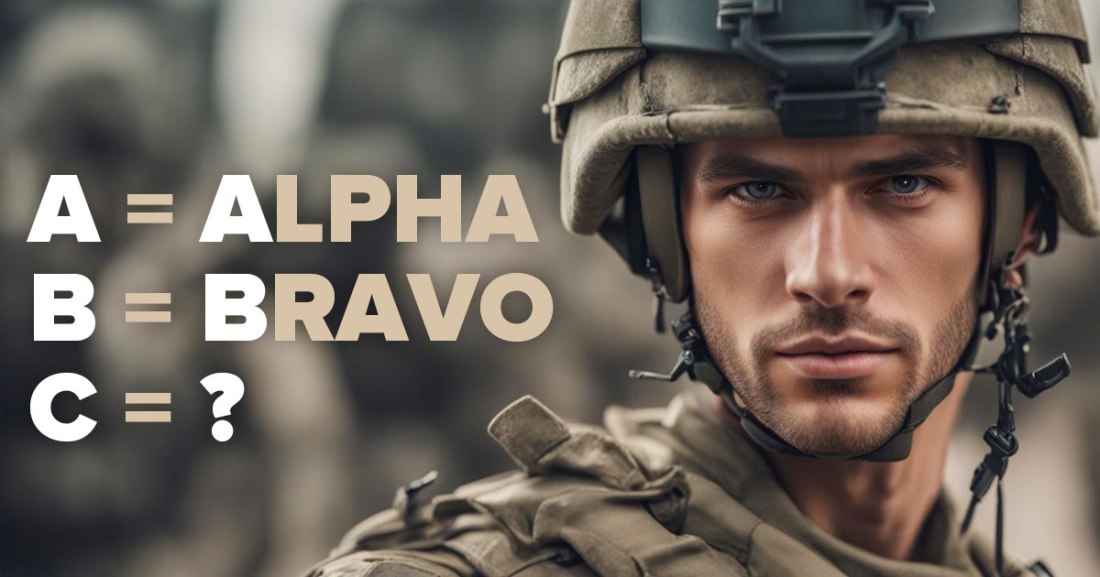
This problem doesn’t exist in the military, especially between communications specialists. That’s because they use the Phonetic Alphabet, often referred to as the Military Alphabet. In this alphabet each letter is assigned an easily recognizable word which starts with that letter.

This alphabet, is actually not the first version that the military has used. The history of these alphabets goes back to before World War I. The current iteration has remained relatively unchanged since 1956, although there have been spelling changes made to it as recently as 2008. One of the reasons for this has been that since World War II, the need was seen for an internationally recognized phonetic alphabet for military forces to use, which would be understood by all allied forces.

The birth of the US Army Air Corps increased the need for a unified phonetic alphabet as pilots often have to convey critical information, while flying in a noisy airplane cockpit. Even with the use of headphones, it was easy for communications to become garbled. By adopting the phonetic alphabet, pilots could communicate with each other, their control towers and ground forces they were supporting, without the errors that had been common beforehand.

While the phonetic alphabet may seem extremely simple, it is not. Countless hours of research has gone into selecting the words which are currently used. The key criteria for this was that they would be easily recognizable, regardless of what sort of English was spoken and what sort of accent the speaker had. The same understanding had to exist, regardless of whether the person spoke British English with a Cockney accent, sounded like they came from Down Under or spoke Midwestern American English.

The current iteration of this alphabet is called the International Code of Signals for Visual, Sound, and Radio Communications or more simply ICAO. It also includes numerals and some basic punctuation, which pretty much follow the same pronunciation that you and I use every day, with the exception of the period, which is referred to as a “full stop.”

While universally adopted by military forces, this version of the phonetic alphabet is not the one used by law enforcement, although most law enforcement officers will understand it. Their version differs in several details, so if you are communicating with a LEO, don’t be surprised if they substitute other words for the ones on that chart.

Using the Phonetic Alphabet

Image result for military phonetic alphabet

Obviously, it is slower to speak with this phonetic alphabet, than it is to speak normally. So it makes absolutely no sense to try and use it for all conversation. Rather, it is only used when necessary to avoid confusion. Some such examples might be:

  • Giving map coordinates or directions
  • Transmitting something in code
  • Spelling the name of a person or location
  • Ordering material by catalog number

When it is necessary to transmit this type of information by voice communications, the normal format is to say the word, spell it out with the phonetic alphabet and then continue on with the conversation. If there is a lot of noise or static, the phonetic spelling might be repeated:

“General Discussion’s unit, I spell Delta – India – Sierra – Charlie – Uniform – Sierra – Sierra – India – Oscar – November, is just over the hill.”

For those who know the phonetic alphabet, there is no possibility of misunderstanding this message. So, what the phonetic alphabet lacks in speed, it makes up for in clarity; and that’s its true purpose anyway. Miscommunications can be disastrous in warfare, causing things like blue on blue fire. This method helps eliminate those disasters, by providing a means of accurate communications.

Using the Phonetic Alphabet in Survival

While there may not seem like much use for the phonetic alphabet in survival, there are a number of situations where it could be extremely useful, especially when trying to transmit something in code.

All radio communications made by your survival team should be in some sort of code, even if you are just using deceptive descriptions and names of people, places and things. You don’t need to be giving information away to potentially hostile forces. Nor do you need to have miscommunications between your own team, because of noise or unclear radio contact. The phonetic alphabet will help eliminate this.

Probably the most important use of the phonetic alphabet for a survival team is in giving directions to team members. Such directions are one of the easiest things to miscommunicate, especially if they contain names which are not known by the receiving party. Spelling the names of streets and other landmarks phonetically will ensure that they receive the message clearly.

Another way that this could be useful to a survival team is to use it for conveying information about supplies. If you develop a simple code, with letter codes, such as “LVD,” for each supply item, then using the phonetic alphabet allows a scavenger team in the field to call back to base and report on what they’ve found, while still keeping that information secret.

Finally, learning the phonetic alphabet will keep others from using that information against you. It is actually rather easy to learn, if you just find a way to use it in your everyday life. Once you’ve learned it, you’ll probably never forget.

I still remember it, and I learned it 40 year ago.

WE ARE CURRENTLY IN THE MOTHER OF ALL FINANCIAL BUBBLES: WHEN TROUBLE ARRIVES, WHERE YOU ARE AT IS WHERE YOU WILL STAY-ARE YOU READY?

I once shared an article on Facebook about the potential for an economic collapse in the near future, and someone left a comment saying, “Why do I keep hearing this warning over and over for years, and yet nothing ever happens?” Good question. When people keep saying that the sky is falling and it never does, it’s hard not to be skeptical.

As I said in my response to him, “After the stock market crash in 2008, everyone started claiming an economic collapse was about to happen, but what they didn’t realize is that it DID happen… in 2008. Since then, the economy has slowly been recovering. But the systemic problems that led to the crash were never corrected, and the bubble has been re-inflating. It can’t re-inflate forever.”

To stop the economy from completely collapsing into chaos, the Federal Reserve had to print huge sums of money to prop up Wall Street. Then they had to do it again during the Covid recession. But every time they do this, they print even more money than before, and the bubble re-inflates and gets even bigger. The larger it gets, the larger the next crash will be.

Eventually, we’ll get to a point where the Federal Reserve can’t save the economy. They won’t be able to keep printing money because it causes too much inflation. But they won’t be able to raise interest rates because it causes the economy to grind to a halt. Basically, they’ve painted themselves into a corner.

We are currently in the mother of all financial bubbles. I believe the next depression (they’ll call it a recession) will begin within the next few years. Something will spook the markets, and even the Fed won’t be able to stop the economy from melting down.

All this is why I believe it’s more important than ever to prepare for a financial collapse, so in this article I’m going to cover 17 things you should do before that happens, starting with the most obvious ones.

1. Stockpile the Necessities

Having some extra food and water is a good idea in general, particularly if you live in an area where inclement weather can affect your daily life. To prepare for an economic collapse, however, you’ll need to have months of rations on hand.

Stockpile enough food, at a minimum, to survive a season without any incoming produce grown yourself. Store enough water for several months’ use and make sure you have multiple ways to purify future water supplies.

Also, stockpile plenty of medical supplies as doctors may be in short supply after a major collapse. Another thing that may be in short supply is electricity. Get all the things you’d need for a power outage, including ways to cook food and keep warm (or cool if it’s summertime). And don’t forget home security measures.

Desperate times means desperate people.

2. Build Some Bug Out Bags

Depending on the severity of the collapse, your town or city might become so dangerous that you have no choice but to leave it and head for a bug out location. But first, you’ll want to put together bug out bags for yourself and your family. You could even make bug out bags for your pets.

You should also consider getting a good bug out vehicle. If all you have is a small car, then you’ll have a hard time getting where you need to go.

3. Grow Your Own Food

Unless you have an underground vault the size of the Sistine Chapel in your backyard, you probably won’t be able to stockpile a lifetime of food for you and your loved ones. A more sustainable option is to grow your own food.

Growing your own food takes quite a bit of trial and error to reach a point where you can live off your own produce, which is all the more reason to start sooner rather than later.

4. Create Your Own Electricity or Learn to Live Without

In the event of an economic collapse, being dependent on the power grid is not the best situation to be in. The more you rely on electricity to accomplish your daily tasks, the more you’ll be behind when the power goes out. Solve this problem by learning to do as many daily activities without electricity as possible.

For example, start using kitchen gadgets and off grid lights that work without power. Combine this with a portable generator for the essentials and you’ll be self-reliant and comfortable.

5. Keep Cash on Hand

If the market tanks, you may still have some time to buy your way out of a sticky situation before inflation hits or the economy collapses altogether. Keep a hefty sum of cash on hand at all times so that you can make an emergency purchase without having to take a trip to the bank.

You never know when you might have to use it, especially if the electricity is out and no credit card transactions are possible.

6. Invest in Precious Metals

When other currencies lose their value, you can trust that gold and silver will still be viable for making purchases in a disaster scenario. In fact, when inflation hits, the price of gold and silver goes up tremendously because these precious metals keep their value despite economic changes.

Be sure to have them in a form that is easily tradable, like coins, rather than in a larger form such as bars.

7. Stock Up on Barter Items

I know, I know, I’ve mentioned cash, precious metals, and barter items now. So you’re probably wondering, which one should I get? Well, all three, if possible. In a deflationary collapse, you’ll want cash. In an inflationary collapse, you’ll want precious metals.

And in a total collapse, you’ll want barter items. Try to have a little bit of each so you’re prepared for every possibility.

8. Get Out of Debt

Once you’ve acquired at least a little bit of cash, precious metals, and barter items, it’s time to start getting out of debt. If the economic crisis isn’t catastrophic (i.e. society’s infrastructure is left intact), you’ll want to make your money go as far as possible.

To that end, get out of debt as fast as you can! You want to be able to respond to a rapid change in the economy as quickly as possible. If inflation hits, you lose your home, or scarcity becomes a real problem, you don’t want to owe your creditors the money you need to survive. To do that…

9. Lower Monthly Bills / Spend Less

In the same vein as paying off debts, lower your bills and try to spend less at the store, so you can spend your money on more important things. Having a monetary obligation to too many places can be a serious drawback in the event of a crisis.

Great ways to lower monthly bills are mentioned earlier: grow your own food, provide your own electricity, and pay off your debts.

10. Create an Emergency Fund

After you’ve gotten out of debt, create an emergency fund that will allow you to handle anything that comes up during a disaster. If the economy is in crisis but stable enough that your money still has value, having 3-6 months’ expenses saved can go a long way toward keeping you out of crisis mode yourself.

To do this, start learning new ways to save money.

11. Learn to Eat Healthy and Exercise Right

Getting in the habit of eating right and exercising is very important for preparing yourself for a survival situation. When the economy collapses, chances are you’ll be burning a lot more calories simply trying to survive than you normally do.

Similarly, knowing the proper fuel to put in your body will pay off later when you’re having to work to stay full.

12. Learn Self Defense

The best time to learn how to defend yourself is now. Start with firearms training and become proficient with rifles, shotguns, and pistols. You may need them to protect yourself, others, and to hunt with. Stockpile ammunition as well, preparing for a shortage or a time when you won’t be able to purchase or find any.

13. Beef Up Your Home Security

After an economic collapse, there are going to be a lot of desperate people out there who won’t think twice about breaking into your home and taking your supplies so they can feed their families.

Don’t make it easy for them. Reinforce your doors and windows, set up hobo alarms so they don’t catch you off guard, put up solar-powered motion lights to try and deter them, and get some guns and ammo in case they manage to break into your house.

14. Expand Your Skill Set

In times of economic turmoil, traditional job markets can become unstable. It’s essential to have a diverse set of skills that can be useful in various scenarios. Learn basic carpentry, plumbing, or mechanical repair skills.

These skills not only make you more self-reliant but could also provide a source of income or barter in a collapsed economy. Additionally, consider acquiring skills in first aid and basic medical care, as access to healthcare might be limited.

15. Establish a Strong Community Network

In difficult times, having a supportive community can make a significant difference. Build relationships with your neighbors and local community members. Consider forming or joining a mutual aid group where skills, resources, and responsibilities can be shared. In a major economic collapse, a strong community network can provide collective security, share food resources, and offer emotional support.

16. Preserve and Store Seeds

In addition to growing your own food, it’s crucial to think about long-term food sustainability. Learn about seed saving and storage techniques. Preserving a diverse variety of seeds ensures that you can continue to grow food even if commercial seeds become unavailable or unaffordable. Focus on heirloom varieties, as they are often more resilient and better adapted to local growing conditions.

17. Develop Alternative Communication Methods

In a severe economic collapse, conventional communication networks might be disrupted or overloaded. Prepare alternative ways to communicate with your family and community. This could include having a hand-crank or solar-powered radio, learning how to use a ham radio, or establishing a system of signals or messengers for local communication. It’s important to have a plan for staying informed and connected, especially in times of crisis.

We Create a World in Which Machines Are Telling Us What to Do or How to Think, Although We May Very Well End Up in a World Like That Where Algorithms Decide Who Lives or Who Dies

Algorithms are making hugely consequential decisions in our society on everything from medicine to transportation to welfare benefits to criminal justice and beyond. Subtly shifting the way our society is operating.

We can see them at work in the world. We know they’re shaping outcomes all around us.

Are we making a mistake by handing over so much decision-making authority to these programs?

This paradox—that the internet is both saviour and executioner of democracy is part of a massive unfolding social experiment.

The proliferation of algorithms is eroding our ability to think and decide for ourselves. They are turning people into products, and they don’t even realize it.

Billions of people around the world are interacting with these technologies, which is why the tiniest changes can have such a gigantic impact on all of humanity.

We will blindly follow them wherever they lead us. There is no one assessing whether or not they are providing a net benefit or cost to society.

WE DON’T HAVE TO CREATE A WORLD IN WHICH MACHINES ARE TELLING US WHAT TO DO OR HOW TO THINK, ALTHOUGH WE MAY VERY WELL END UP IN A WORLD LIKE THAT WHERE ALGORITHMS DECIDE WHO LIVES OR WHO DIES.

How you see the world matters.

————————

 Beliefs are the things we hold true, regardless of whether we have any proof of their objective truth.

You see, in time, beliefs become labels.

We plaster them on our foreheads and use them to justify our action or inaction. That belief will then drive how you behave as you interpret it as being damning or empowering.

We all would be a lot happier if everyone else around us had the same beliefs as we do, or at least, that they would not challenge us on them. Of course, that is impossible, and this is precisely what fuels most of the world’s conflicts.

And here comes the kicker:

You can decide the direction you take. Your beliefs do not control you, so long as you become self-aware and take charge of your life. Or maybe if you assume everything will fall apart, you never get disappointed.

So, herein lies the persistent conflict of our society:

All of us are driven by our life experiences and by merely being human, but the creeping influence of algorithms in our lives are fucking up the world. We’re increasingly moving towards government by algorithm.

Automated systems are being rolled out with little transparency or public debate, and risk exacerbating existing inequalities.

The algorithm takes the biases and prejudices of the real world and ‘bakes them in’, and gives them a veneer that makes it seem like a policy choice is actually neutral and technical. But it isn’t,”

The problem is, both beliefs and values have strong momentum and seem glued to our character.

How do these beliefs played out in real life?

Are we just becoming throwaway survival machines, following our genetic and neurological programming in an indifferent world?

I believe that human life and the world mean much more than that.

There’s beauty everywhere—we have only to open our eyes to see it.

——————–

When it comes to climate change, the science is settled.

When it comes to technology its all together the opposite.

The sobering truth is that both the climate and technology are out of control.

Given the difficulty of getting the human brain or our political system to tackle anything beyond immediate crises, our attempts to rectify what’s wrong are usual puny compared to what’s really needed.

If you listen to our politicians, there is a strong consensus on climate change.

It consists of four parts.

First, carbon emissions are causing significant changes to our climate. Second, we need to take urgent action to reduce those emissions, including reaching net zero by 2050. Third, we have already made good progress in reducing emissions. And fourth, the steps we need to take to reduce emissions further will also bring many positive benefits for society.

We have a pretty clear understanding of the threat climate change poses to us, our children and our grandchildren. We are already being forced to cope with more droughts, more floods, more extreme storms. At the same time, we have in our arsenal effective policies that are difficult for rational people to demagogue as crippling to the economy or as a subversion of our cherished way of life.

So why does climate misinformation continue to spread online and in our media?

Dire warnings of the looming climate disaster may just make people throw up their hands in despair, sink into denial, or dig their heels in deeper against government action.

Instead, we seem to firmly believe that climate solutions inevitably mean more government, higher taxes and less freedom — and thus are threats to all our core values and identity.

———————-

Technology’s benefits are numerous in all fields, however in the system’s that effect our daily lives it is becoming a threat to our core values, through the use of algorithms. Pushing us like a digital slave army to mindlessly, unwittingly and unwillingly livestream our digital existences into the commercial coffers of companies that see us as nothing more than walking dollar signs.

Examples:

Every time you pick up your smartphone, you’re summoning algorithms. At this point, they are responsible for making decisions about pretty much every aspect of our lives.

The right to an explanation of an algorithm-generated decision does little to fix “systemic injustices” Getting an explanation but no democratic say in how systems work is like getting a privacy policy without a ‘do not consent’ button.

Deciding who gets access to welfare. Using automated interviews with a virtual border guard, based on “deception detection algorithm. Using algorithms to model when and where crime will happen — an area known as predictive policing — is on the rise. Using algorithms to come up with a personality assessment. Having your credit rating scored decided by an algorithm based on questionable data.

Grading algorithm does not not relied solely on automated means. Substituting a mathematical approach for human judgment does not automatically make it fair.

Profit seeking algorithms. Market making algorithms. Execution algorithms Scheduled algorithms. Participation algorithms. VWAP and TWAP algorithms are time-slicing algorithms. Liquidity-seeking algorithms (a.k.a. opportunistic algorithms) Arrival price algorithms seek to trade close to market prices.

Recent developments in algorithmic trading include clustering and high-frequency market forecasting  are playing a central role in finance.

The worst-case scenario is that we fail to disrupt the status quo, in which very powerful companies develop and deploy AI in invisible and obscure ways.

We have no right to see all of the data these companies collect about us, no right to get a percentage when they resell our data without our knowledge or informed consent, no right to ask them to stop. We are for all purposes indentured servants, offered free digital room and board in return for paying with our digital souls and our real-world time.

Social media companies have managed only to create a toxic brew of horrific hate speech that they cannot seem to get rid of.

Algorithms really are so powerful that a few lines of code can push us into any behaviour.

The right message targeted at the right time could mass convert the entire population of a country into mindless zombies who would readily convert even their most deeply held beliefs in an instant.

 When it is obvious to all is that the world is changing, responding faster than expected to Technology’s

Why are we being such idiots?

What gives? It’s not that we are stupid or blind our core values are under attack.

If everything is a core value, then nothing is really a priority.

In this age where technology is dominant, core values may seem like something from the past. So core values may not seem like they have a place.

All of this data is used first and foremost to make money from us. 

There is a really frustrating lag between what AI is capable of and what it’s legislated for. 


Core values are the foundational beliefs held by an individual or an organisation.

Anyone can go to Google and search the meaning of core values,. There are another thing on your to-do list that you don’t have time for, but what about the bigger picture?

When you hear about core values, what comes to mind?

Core values make the biggest difference between successful and failure.

There are more than just words on a wall — it’s how you behave. It’s who you are at your core.

Everyone knows their role, what is expected of them, and they are empowered to act in accordance with their core values.

Once upon a time voting or making decisions in alignment with your core values were the foundation of who we are as individuals. Not any longer with Algorithms running social media.

——————–

To look at it simply, culture is just a collection of people. It is the environment created by the cumulative behaviour of the people.

We all have things that we value deeply, whether we realize it or not.

You remember values, don’t you? You know, those moral thoughts and behaviours we used to hold dear, like decency, civility, honesty and respect, as well as caring, optimism, empathy, and tolerance?

They were once a beacon of idealism. Rewarding behaviour based on them, and align all of our decisions with them.

Core values represent the lens which we view the world. They must be embedded in everything we do.

These “alt” credos and codes of behaviour are the trademarks of the incivility we witness on a daily basis, often expressed with rancour and rage. They have become commonplace on television, in social media and in everyday life. Of even more concern is that these new “moral standards” serve as models of behaviour for our impressionable children and youth.

Hold one another accountable for staying aligned with the values—it’s better not to profess any values at all.

———————

Education and knowledge were cornerstones of our achievement.

We are now living in society that at large looks to social media /television and film personalities for political advice.

You must ensure they are accurate, meaningful, relatable and fully operationalized.

If we continue our descent into callousness, selfishness and hostility, we negatively impact and harm the quality of our lives. We could lose sight of our basic human values and diminish the essence of what MAKES THE WORLD BEAUTIFUL.

Achieving a more transparent and less manipulative media may well be the defining political battle of the 21st century.

Just as we are using our formidable intellect and creativity to reduce our carbon footprint, we can similarly mobilize our resources to improve our emotional footprint, or how we treat and affect each other.

Values are the criteria by which individuals judge ideas, objects, people, situations, and actions as good, worthwhile, desirable, wrong, worthless, or undesirable

.Values are individuals’ embedded abstract motivations. They guide individuals to understand, justify, and explain norms, attitudes, and actions. One of the limitations of examining values is that values cannot  be generalized because they vary between a person and another, culture and another, society and another, even a country and another, thus scrutinizing values will be different in the future.

Core values can be only be fostered in Education, not in schools but with compulsory NATIONAL SERVICE.

The Countdown to Chaos: We Are Living Through Those Dark Times, and They Will Get Darker Before Things Start to Get Better

Peak chaos on the world stage is going to center around the United States presidential elections. It will define conditions in the nation, outside the nation, and the broader game plans of the rich and powerful. The fate of the world in the face of war will be largely dependent on who is in office and what choices they make.

This is particularly true these days since that silly old Declaration of War thing has been tossed out the window. America wages war through a collaboration between the Pentagon and the Executive branch. Period.

The timer is running. The countdown has begun. At any time in the next 10 months you must be prepared for your world to change dramatically.

WHAT REMAINS OF WINTER

Democratic Winter Meeting

In the United States we are facing an election where so much is up in the air. There is nothing particularly solid underfoot. The Democrats will have their winter meeting to discuss strategy amongst other things.

It would not be a surprise to Republicans or Democrats if the candidate in the 2024 election was not Joe Biden. What other curveballs could come from this meeting?

Israel Hamas Houthis & the US Military

The Countdown to Chaos

The declaration of war seems to have been eliminated in the US. We are now trading fire with Iranian proxies on a weekly basis.

We are effectively at war with these groups though we have not voted on it in congress.

Despite pressure from the White House, Israel has no intentions of slowing down their assault.

This is a full-scale war that the US refuses to admit it is in and will only add to the chaos abroad and at home.

Iran

Iran is watching things very closely. They know their proxies have killed Americans. We know it. The world knows it.  Most of all, the US Military is keeping eyes on Iran and they don’t like it. (source)

This is going to become a bigger issue as the 2024 gathers steam. Something tells me Iran is waiting for a wider war where America won’t be able to focus all its power on punishing the Persians.

A HIGH TENSION SPRING

Putin’s Election

There is something to be said about the DEVIL YOU KNOW but I am sure most people would like to see Putin dethroned. This is not a likely outcome though the election could create greater strife inside Russia. The public is already up in arms about the prolonged war and conscription.

Steadfast Defender NATO Exercise

The Countdown to Chaos

To call the Steadfast Defender a major military exercise is an understatement. It is the largest collection of NATO nations, military personnel, and vehicles in any exercise in the 21st century.

We are talking about 90,000 service members, 31 nations, 50 ships, 80 air vehicles and 1100 combat vehicles.

These are the maneuvers that would be used to mount a major attack on Russia. That is why they are practicing. This is one of those situations that could really heat up should anything unexpected happen.

A SUMMER OF WORLDWIDE CIVIL UNREST/TERROR

The Paris Olympic Games

If you were a terrorist, could you imagine a better target than the Paris Olympic Games. It’s in Europe, which we know is overrun with terrorists just waiting in the shadows, it’s going to garner massive attention, and with the war in the Middle East it will only embolden the lunatics.

Civil Unrest

As the weather warms, protests will increase. Wars, elections, and discrimination will give rise to even more unrest than what we are witnessing all over the world right now.

These events will stretch the resources of the government to their limits.

THE FALL… IT’S THE PERFECT NAME

Russia Hosts BRICS Summit

The Countdown to Chaos

Russia will be no doubt still sore from the Steadfast Defender will take this opportunity to push forward on BRICS and try to really hurt the West, particularly the US Dollar and its dominance. Protect your wealth. Understand that the US Dollar is part of the greater war and nations want to dethrone it.

Catholic Reexamination of Direction

This story is getting lost in the more exciting talks of war and world leaders but a massive reaffirmation of the Catholic faith, brought on by the Pope, is big news. How much change can the world endure in one year? How much chaos?

This is not a story on your dashboard yet but it very soon will be.

Massive Virus Digital Dark Age

China has staged its malware all throughout the United States’ digital infrastructure. I am sure we have done the same to them. (source)

Still, it could be the big attack waiting to happen. You have to imagine that when China moves on Taiwan they at least want something to hang over the heads of the Americans to give them pause.

Election Day in America

This is that moment when the ball is up in the air and the last seconds are winding down off the clock. What happens in the end? Who comes away with the victory. Truth is we are still not sure what election day might look like. We are not even sure who might be on the ballot for either side.

It will be an exciting day, to say the least but what’s come next will make it all look like a walk in the park.

THE AFTERMATH…

The Countdown to Chaos

Remember, the real chaos in America didn’t kick off till after the 2020 election.

We will see very much the same in 2024.

Should Donald Trump be elected president we are going to see calamity in the streets like nothing you have ever seen in America.

The chaos will reach its peak in the AFTERMATH of the 2024 election, particularly if Donald Trump becomes president.

This chaos will also be well funded by other nations and powerful people.

Elections, wars, and grid down chaos seem to be what’s on the menu for the rest of 2024. The countdown to chaos has already begun. I think what most people are struggling with is how much of it is out of their control.

You cannot stop the wars, NATO, the actions of Russia or Iran. There are a ton of things that will happen throughout this countdown that make you feel powerless and maybe even hopeless. That’s just the nature of this life.

Prepping, self-reliance, homesteading, off grid living, these are all things that render immense power unto you and yours. That power grows the more unstable things become.

For a long time, we used to talk about the future and how bad things might get one day. Well, it’s 2024, we are living through those dark times, and they will get darker before things start to get better.

As prepared people we can all be a little light in the darkness. Dig DEEP into preparedness in 2024. It’s an investment that will pay you back 10-fold.

This article was originally published by James Walton on www.askaprepper.com

No One Is Coming To Save You: You’re on Your Own When it Comes to Civil Defense-Government Will Not Do Anything to Protect You as That is Counterproductive to Their ‘Strategy’

Sometime between the First World War and the start of the Second World War the concept of civil defense or civil protection was born. The original purpose was to protect civilians from aerial bombing. After World War Two, the United States dismantled its civil defense corps. With the US the sole possessor of atomic weapons, there was no perceived need to spend money on civil defense. That perception did not last long due to the Soviet Union testing their first nuclear weapon in 1949. President Truman re-established civil defense with the goal of protecting the civilian population against a nuclear attack.

Over the next 29 years there would be several renditions of civil defense until the Federal Emergency Management Agency (FEMA) was formed. President Carter empowered FEMA to prepare for disasters and to continue civil defense efforts. In 1994, with the repeal of the Civil Defense Act of 1950, FEMA suspended preparations for nuclear attack. Without the federal mandates and grant requirements many states started to follow suit. Following the terror attacks of 2001 and the advent of the Department of Homeland Security (DHS), FEMA started to plan for a nuclear terrorist attack. The problem with the current DHS/FEMA nuclear terrorist attack planning is that DHS/FEMA assumes that only one city will be attacked. Other assumptions include a relatively low-yield weapon and that the unaffected surrounding areas can assist with the response. The current DHS/FEMA guidance is totally insufficient to address the needs from multiple nuclear weapons detonating across the nation.

With the current situation in Eastern Europe it is extremely important to understand both the past civil defense capabilities and the current non-existent civil defense capabilities of the United States but we also need to understand the civil defense capabilities of the former Soviet Union and those of Russia today.

It is important to understand past civil defense capabilities so that as the war in Eastern Europe widens, we can understand why our elected officials will do nothing to protect our nation. We also need to understand that the Russians will take steps to protect their population.

To start with, we a;; probably have heard of the concept of Mutually Assured Destruction (MAD). The basic premise of MAD was that if two adversaries started to launch nuclear weapons at each other, both sides would suffer massive damage to both its population and its economy, thus fighting the war doesn’t gain either nation anything. The United States adopted this theory, however the Soviet Union did not. There were great debates about whether or not the United States should pursue an extensive civil defense program. This brings up the concept that a nation’s Civil Defense capabilities can play into the nation’s strategic capabilities just like nuclear weapons. To be clear, when a nation chooses to have, or not to have, a robust national civil defense program it isn’t necessarily about protecting people but rather “the system”. The United States believed that if it took prudent civil defense steps then that would somehow diminish our nation’s vulnerability, hence we would not be subscribing to MAD because we, in fact, have not assured our destruction. More on this later.

MUST WATCH! THE HUNGER GAME HAS BEGUN: THE ELITE HAVE BEGUN THEIR FULL SCALE EXECUTION AND DECIMATION OF THE MIDDLE CLASS! FAMINE OF GODS WORD IN AMERICAS PULPITS ,WILL LEAD TO LITERAL FAMINE AND STARVATION IN THE U.S.A

The Soviets on the other hand had a much more robust civil defense program. The Soviets spent about ten times as much money on their civil defense than the US. Why? Simply because the Soviets never subscribed or followed the concept of vulnerability, in other words, the Soviets never believed in the MAD theory. While the US decided to be weak, so as to say look if we exchange nuclear weapons we looe so we really don’t want to play that game, the Soviet Union actively planned not only to fight a nuclear war but took steps to “win” it. This is extremely important to understand. Those in the upper echelons of the current Russian government are products of the Cold War and Cold War strategies and tactics run through their sins and brains.

At this point in time, the US still holds dear its strategy of being vulnerable. We have heard Biden state that Putin isn’t bluffing about using nuclear weapons and that we are facing Armageddon, so why is thee no big push to dust off old civil defense plans and not just by the executive branch or the democrats but the GOP is silent on the issue of civil defense? So the US government is still subscribing to the “let’s be vulnerable” theory within MAD while the Russians are planning to win. Basically, the two nations are planning for and practicing two different “games”, and when they meet for “game day” it won’t be good for us.

Since people are creatures of habit we can assume that both Russian and US leaders will fall back to the concepts of the Cold War as tensions escalate to the nuclear level. Back in the Cold War era the anti-civil defense crowd actually argued that no American president would contemplate America’s civil defense capabilities when making a decision to launch nuclear weapons. This is not only wrong, nut we can actually prove that it is wrong! During the Cuban Missile Crisis President Kennedy specifically asked about our civil defense status and how those capabilities would have us fair if Soviet missiles hit the US. Going back to the concept of Civil Defense, as a strategic capability, we can see that when the closest thing we have had to a nuclear war played out, civil defense was in the equation. And just so you know, the answer President Kennedy received wasn’t a good one. While the Soviet Union prepared blast shelters for their nation the US focused on “fallout” shelters. The fallout shelter system was specifically designed to protect people from radiation not the other blast effects from a nuclear weapon such as the fireball and shockwave.

With the Soviets not following the vulnerability concept of MAD, the US government believed that about 90% of the Soviet Union’s population would survive an attack by the US with nuclear weapons, compared to about 20% for the US. At least that was the US number up until the US government started what is known as “Crisis Relocation” in the 1980s. With crisis relocation, that is, evacuating urban areas to rural areas, the US government believed it could increase the survival of the population to around 80%. The only problem with the concept of crisis relocation for nuclear attack is that the plans assumed we would have one-week advance warning before the missiles started to fly, from what I understand, at the time, Soviet nuclear missiles were liquid-fueled and the missiles were not kept fueled due to corrosions issues with the fuel and it would take about a week to fuel them for an attack.

So how does this all relate to the current situation?

Understand that Russia’s new 5th-generation warfare strategy has an “escalate to de-escalate” component. That is Russia plans to “escalate” tensions with the threat of nuclear attack in order to have the other side come running to the negotiating table. This escalation could be achieved by mere threat however the US/NATO are not buying into the threat which means that the risk for Russia to have to resort to some type of actual use of nuclear weapons increases. The thing about nuclear arsenals is sort of like in the movies when one person shoots, everyone lets loose.

Russia still believes it can win a nuclear war. The old communist lead anti-nuclear weapons crowd liked to say that nuclear war was “unthinkable”, but we should think about nuclear war critically, considering the destructive power and the number of nuclear weapons on the planet and we also better be prepared for when they are launched. Since the US has no real civil defense capability, it is conceivable that the US could be placed in a very bad geopolitical bargaining situation since our population is so vulnerable and the Russian population is not.

Both Russia and the US will revert back to the Cold War strategies when they face the next “Cuban Missile Crisis” arising out of the Ukraine war. Russia will perceive that it can win a nuclear war while the US will perceive that Russia will not launch since they too will loss a lot of people and economic capability. Keep this in mind, the Soviets were expected to lose 20 million people in a US retaliatory nuclear strike, that is 10 million fewer people than they lost in all of World War Two. Sounds like a win to me.

If the situation gets bad enough you will see an evacuation out of the cities. Polls conducted in the late 1970s indicated that there would be two distinct evacuation waves. First would be the spontaneous evacuees who leave the cities without there being an official evacuation order. The second wave will be those leaving when the official order is given. According to the polling data, many of the spontaneous evacuees in the first wave would be going to “friends and relatives” in the country. What isn’t identified in the polling data is whether or not those relatives and friends in the county know those people are coming their way. Crisis relocation when implemented will have profound effects on those living in rural areas. One other thing to keep in mind about crisis relocation is that there was a debate that as soon as one nation saw the other nation evacuating their cities an attack would be launched. There was no indication that either the Soviets (Russians) or the US targeted the evacuation “reception” area with nuclear weapons, however Russian nukes are somewhat larger in there megatons of TNT power. I suspect that this was done due to the Soviet missiles not being as accurate as the US missiles.

This presentation PROOVES WITHOUT DOUBT that America is in for a major fight that will put you and your family in the firing line, literally… So make sure you watch this presentation while it’s still online…

The reason why you should pay attention now is that is because these techniques don’t come from books, they’re taken from actual 21st century warzones, from lawless states where social chaos is the name of the game… … and where not having enough time or money to prepare doesn’t stop real-world preppers from creating virtually impenetrable defenses for their families.

With today’s hypersonic missiles the concept of crisis relocation may or may not be moot. I suspect there may be a few people who still self-evacuate out of the cities before a warning. I would, however, suspect that if one side did order an official evacuation of cities that then that would trigger an immediate attack. If you even hear discussion of crisis relocation or evacuation you should take this as warning that the crisis is spiraling closer to missile launch.

Stop believing that survival isn’t possible, that is if you don’t live in a large city or military target. Location is one of the best factors helping to ensure your survival in a nuclear exchange.

There is a belief, or hope, that nuclear weapons will not be used. Just remember that “hope” is not a plan. Government will not do anything to protect you as that is counterproductive to their “strategy”. That means You’re on Your Own (YOYO) when it comes to civil defense.

Take steps to plan for and implement a fallout shelter in your home now. There are still a number of good sources of information on this on the internet today. Start looking for in now and reading it. Second, locate and acquire any needed equipment and supplies you may need. I have a gun range on the property with a large backstop that is filled with sand. We will use the loader on the tractor to scoop out the sand and bring it closer to the house where we will then fill feed sacks up with the sand and place them inside the house on the floor above where we will be sheltering. We have on hand, wood and jack post to beef up the support of the floor joist due to the added weight of the sand. We will also put dirt up against the foundation for added protection. In the basement we will construct an area where we can sit and lay that will have additional dense materials (things like ammo cans) on top for additional shielding. Planning and preparing for the protection against fallout now will give you and your family an immense leg up when the time comes to act.

We can anticipate that at some point Russia will give the West an ultimatum. Russia has already told the West to stop interfering or else. The ultimatum that we should be looking for is one with a specific date and time. Of course the West will not comply with the ultimatum and this will probably mean the end of Putin’s power or Putin will push the button.

Never underestimate the power of stupid people. There are people on both sides who train regularly to launch or drop nuclear weapons at a moment’s notice. They go through quick reaction drills so that the motions become second nature, so that when the order is given these people resort to just going through the motions like they have hundreds of times before, verses thinking about the ramification of what they are about to do.

The old Cold War analysis predicted that most Americans would need to shelter from radiation for a two-week period. That means literally staying in a very confined area for sleeping, food prep, going to the bathroom and everything else. I’m sure with our current generation’s addiction to electronic devices the mere withdrawal from these games due to the combination of the effects of EMP, no power and no Internet connectivity will be just as challenging as trying to live in cramped quarters for two weeks. Statistically speaking, I have lived over half my life. What this means is I can afford to absorb a little more radiation than my kids who are in their teens still. This won’t mean anything the first week since radiation level will be so high that it could cause radiation sickness even with only a few minutes of exposure. The second week, depending upon actual radiation reading, I could probably do a quick task like taking out garbage or human waste. Perhaps I would even go out to the barn and throw a few bales of hay out for any surviving animals. The most likely farm animal to survive will be chickens, since they can withstand an impressive amount of radiation.

Fortunately, we have metering for measuring radiation. I have sat my daughter down and taught her how to use them. I have taken background radiation readings in areas where we are going to shelter. It is good to know what your normal level of radiation is. The background levels of radiation were written down for several areas. One where we are going to actually shelter, then a reading at the door to the room that has the door to the outside and the third reading was at the door itself. The readings were annotated and then laminated and attached to the handles of various meters.

Nuclear war is survivable but you need to take action to be prepared. If you live in a location that isn’t a target but will probably be affected by radioactive fallout it would be a shame to die slowly from radiation poisoning that could have been avoided with some very simple preparedness.

Regardless of what does or doesn’t happen with the current war in Europe, the notion that we will not be confronted with another geopolitical crisis where the chances of a nuclear war increase is very naive. At some point we will be in the same situation with China. Perhaps that will be sooner than anyone realizes. Prepare now.

In this short VIDEO, I will unearth A lost super-food will bulletproof you against any food shortage or famine. It’s a food that vanished with the Incas over 6 centuries ago

In the next crisis these lost skills will be more valuable than gold, food supplies and survival equipment combined. These skills have been tested and proven to work for centuries.

Here’s just a small glimpse of what you’ll find in The Lost SuperFoods:

Learn More…

America 2024: Sleepwalking into World War III: China, Russia and Iran will gang up on America which will be even more devastated financially than most nations

One thing is certain: War is coming to America on many levels and it cannot be stopped. The best anyone can do is to prepare and try to stay out of the way of the most serious fighting and bide their time until they can get the upper hand in their locality. The world is about to change in a very radical way and many are not prepared for it either physically or mentally. The forecast has been given and the storm flags are up.

The Nations of Russia, China, and Iran, which will lead the Muslim nations in the Mid East, will gang up on America which will be even more devastated financially than most nations. The American forces will succumb to a massive attack that takes down most of our electronic equipment and destroys our high tech advantage.

The war that follows will become a mostly conventional affair fought on American soil. A massive invasion by millions of enemy troops will follow who will commit every war crime imaginable on the American people. The invasion will come after internal conflict, caused by financial devastation, has taken a high death toll among Americans fighting among themselves over diminishing resources.

The invading nations will see this as their best opportunity to destroy America permanently and gain valuable natural resources at the same time. This is why it will be mostly conventional after a possible limited nuclear strike to disable our military resources and infrastructure. To make matters worse, these invaders will be aided by elements within the U.S. government who will cooperate with these ground forces.

The battles that follow will be fought mostly by local and state militias reinforced by the few remaining active duty soldiers that escaped annihilation in the opening days of the conflict. It will become a guerrilla war fought in every corner of every state in CONUS. Alaska and Hawaii will be cut off and allowed to wither until they surrender.

The war will last for years and most large cities and towns will be destroyed to eliminate any resources that partisan fighters can use. The only civilians that will escape detention and death by enemy forces will be those that are hidden in rural areas and dug in deep to prevent detection. Any food will have to be grown in small isolated plots hidden from enemy forces. Every day will be a fight for survival as the number of American forces dwindles.

American forces will survive by becoming very mobile and remaining on the move. Small attacks that chip away at enemy forces will be the primary tactic. Only when an unstoppable outside force arrives to reinforce Americans will the tide of war turn. The enemy will ultimately be driven back and America’s borders secured but the cost of victory will be very high and the population will be greatly reduced.

Is this scenario a possibility? It becomes more likely every day that we proceed on our current path and if history is any indicator it could become a reality. Americans are oblivious to the possibility of any such turn of events but it could very well happen within a decade. The inability of Americans to accept reality and the need to continue living in the comfortable cocoon of illusion they desire will end in tragedy very soon. No amount of hopeful thinking will change events that require positive action. The lack of critical thinking ability will doom the U.S. to new depths of despair before a new nation will arise that appreciates our heritage and the sacrifices of those that came before us. Hopefully, this is a lesson we will not have to learn a second time.

For those willing to sacrifice and do the hard work it may still be possible to salvage the nation from this destruction. For those with the indomitable spirit to go on and rebuild it is possible for this phoenix to rise again from the ashes. But for that to happen, some things will have to be preserved from the destruction to allow a new start.

– raw materials such as scrap metal and chemicals
– knowledge in the form of professionals and books
– equipment for building in the form of machining equipment
– basic medical equipment
– equipment for casting and refining
– equipment to make copper wire
– farm equipment and implements that can be duplicated
– livestock that can be bred and expanded
– seed stocks that can be grown and processed
– equipment to process fibers for cloth and rope
– electrical equipment such as generators and communications gear

No one person could store all of these things so it must fall on multiple groups with various knowledge and abilities to preserve this core of technological abilities. These items would have to be literally buried to escape detection and destruction for the duration of the event. That is possible if done in time and right now time grows short.

For many it would be easy to hide some resources for later use to rebuild and enjoy a rustic lifestyle without all of the technology. The only problem with that is eventually you may be faced with the spectre of the destroyers returning and any lone homesteads with little technological means would be easy prey for another assault. The only way to rebuild and expand with the ability to defend is to establish communities that are connected and technologically capable.

The scenario laid out here is not a happy one but it is survivable if actions are taken in time. Only the hardiest of individuals would likely live through something like this but they are the ones that history calls nation builders. To dismiss this scenario as impossible is to do so at your own peril should events come to pass. Something is impossible until it’s not.

Prepare for a Nuclear Blast: EDC Gear for the Nuclear Threat

For a generation and a half, young people have lived their lives free from the specter of nuclear attack. People were not compelled to contemplate the horrors of nuclear war and how they would survive a nuclear blast or fallout, what food would be safe to eat or drink, or whether the air would be safe to breathe.

Unfortunately, the U.S.A. has scant preparations to protect its citizens from nuclear attack. While politicians have gone to great lengths to ensure the continuity of government, there are no fallout shelters for common citizens, only advice and plans to build your own.

You could build and stock a fallout shelter and there are ways to inexpensively improve the protection factor any building already provides, but the average American spends over a third of their workday away from home. What could you possibly carry with you during your day that would improve your chances of survival if a nuclear weapon is detonated on U.S. soil?

How Would You Know a Nuclear Attack Has Occurred Elsewhere or is Imminent?

Who attacks the U.S., what their objective is, what nuclear weapon systems they have at their disposal, how many they use, and how they deliver them, would all affect how much notice there is or whether there is any notice at all.  

A nuclear attack by a nation state with a nuclear arsenal and a space program would likely begin with a HEMP attack to blind our radar, take out much of out command and control and cripple our power grid. We may not see such an attack coming at all, much less in time to do anything about it or warn the populace by issuing a warning via WEAS (the Wireless Emergency Alert System). Nuclear weapons optimized for HEMP are probably orbiting the earth in satellites as you read this. Here is a link to a previous article of mine on how to tell if an EMP has happened.  

Even if the federal government could warn the citizenry of such an attack, I doubt that they would. Their reasoning being, “Why cause panic and clog the roads and airports and prevent the almighty brass, politicians, and bureaucrats from getting safely to their shelters?” What good would it do to tell the average citizen anyway? Afterall, in their eyes, we are all helpless, defenseless, and utterly dependent on them in every way.

Most of them probably couldn’t care less whether the tiny fraction of the population who is prepared makes it to their fallout shelters or not. They are afraid of us and see us as more of a problem than an asset.

Radiation Meter

You can’t see, hear, smell, taste, or feel ionizing radiation. It can only be detected with specially designed instruments, such as a radiation meter. Without one, you won’t know whether it is safe to stay where you are or whether staying where you are means certain, and very painful, death.

If your local emergency services have radiation detection equipment, have had it calibrated at the proper interval, know how to use it, are able to broadcast measurements to the public, and you are able to receive their transmissions, then you’ll know the severity of radiation exposure inside or outside the fire station or wherever they took, their measurements. You need to know how intense the exposure is where you and your family are sheltered so you don’t die… terribly. Once you are home, you’ll also need to know the intensity of exposure outside to know when it’s safe to go outside.

If HEMP effects have damaged the power grid and radio stations, using radiation detection equipment will likely be the only way to know if you are safe where you are or whether you need to get to someplace safer.

I carry a small radiation monitor and alarm called the NUKALERT that is designed to be carried on a keychain. This radiation monitor is always on and constantly samples about every two seconds and has a battery life of 10+ years.

Chart on back of NUKALERT

The monitor produces a series of beeps when radiation is detected. By counting the number of beeps and referencing the chart on the back of the device, you can quickly calculate how long you have to find, improvise or improve shelter.

Cellphone, Small Amateur Radio with Wide Band Receiver

If there is any warning preceding a nuclear attack and the government does warn the public, then you may receive an alert on your cellphone. However, if the nuclear attack is preceded by a HEMP attack, it is likely that your cellphone may not work.

If your local emergency responders have their act together, they will break out their radiation meters, take readings and report them for broadcast to the public so folks can know whether they need to seek shelter or whether it is safe to be outside. Of course, their ability to get this information out to the public may be degraded if the power grid is down, cell towers are down, and radio stations are down. But do not fear, before long, radio operators will soon get radio back up and transmitting.

The beauty of radio is that you only need a transmitter and receiver to get the word out and they can run on batteries so little infrastructure is needed. That’s why it’s a shame that several auto manufacturers are trying to build vehicles without AM radios. No other technology would reach as many people as quickly in a catastrophic event that takes down the power grid.

Some amateur radios with wide band receive can also receive AM, FM, and shortwave frequencies, giving you the ability to receive broadcasts in addition to monitoring local amateur radio traffic and potentially communicating with family and friends even if phones, SMS, the internet, and the grid are all down.

Faraday Bag

Most handheld transceivers are well shielded and may work even after a HEMP depending on many factors. If radios weren’t well-shielded, they would damage their own circuits when they transmit. You can greatly improve the odds of having a working radio and/or cellphone by storing it in a non-conductive bag and then storing that inside a Faraday bag.

Some tests indicate that many handheld transceivers would likely survive a HEMP with a field strength at or below 50kV/m. However, it is possible that super-HEMP weapons may generate much higher field strengths (Russian military literature references field strengths of up to 200kV/m), so storing sensitive microelectronics you may need to survive in a Faraday pouch that provides at least 73dB of shielding is a reasonable and inexpensive protective measure. It might not protect sensitive electronics if the weapon went off directly above you, but it would improve your chances in much of the rest of the country.

Dosimeters

A dosimeter measures how much radiation you have been exposed to over a given period. This is important to know and, if you have the money, this greatly simplifies tracking. Ideally, each member of your group should have their own dosimeter.

Dosimeter charger and analog quartz fiber dosimeters

You don’t need to carry the charger constantly, but you will need it to periodically zero dosimeters as gamma rays pass through the ionization chamber, bleeding off the charge at a measured rate. To read them, you hold the tube up to a light source and look through it. If you buy these old surplus dosimeters, you’ll need to have them tested and calibrated.

Watch, Notebook, & Pen

If you only have a radiation meter and don’t have a dosimeter, you’ll need to record the total REMs you have been exposed to and over what period of time. If you have older analog dosimeters that look like pen, they only record exposure within a specific range. You must record when you charge them, how much radiation you have been exposed to, over what time period, and then they need to be recharged and zeroed.

Even if you have a newer digital dosimeter that tracks your total exposure, I recommend making a copy of the exposure scale so you will know how many REMs you and others in your care can be exposed to before they become ill and how many are fatal. This information may help you make important decisions, such as when you really shouldn’t spend any more time outside the shelter, when you need to try to move someplace safer, when you are safe and when it’s time to get your affairs in order.

Potassium Iodide

If you receive notice that a nuclear attack is eminent, you should begin taking potassium iodide. One of the effects of exposure to fallout is that radioactive isotopes of iodine can build up the thyroid gland increasing the risk of thyroid problems, tumors, or thyroid cancer.

When unpredictable winds caused a little over 60 indigenous inhabitants to be exposed to fallout during nuclear testing in the Bikini Atoll, approximately one third of them eventually developed thyroid problems, tumors, or cancer over the next 20 years.

Outerwear & PPE

If there is a chance that you may be directly exposed to fallout before are able to get someplace safe or improvise shelter, protect yourself as best you can.

  • Lightweight Outerwear – Lightweight outerwear is no substitute for a fallout shelter, but it can keep fallout particles from sticking to your skin and help ensure that they they do not stick to you during the decontamination process. Outwear with a zipper is best. You don’t want to contaminate your head and neck by pulling of you top over your head.
  • Gloves – Gloves will help protect your hands.
  • Hat – A hat will help keep fallout particles off of the head and out of the hair, where they can be difficult to remove. When you wash, use tepid water and do not use conditioner which will cause particles to bond to proteins in your hair.
  • Eye Protection – Because your eyes are moist, fine particles can stick to them and eyte protection can help prevent this.
  • N95 Mask – Fine fallout particles can be inhaled and ingested, and they are far more damaging once inside the body. Fortunately, the largest and most dangerous particles drop out of suspension the fastest.